


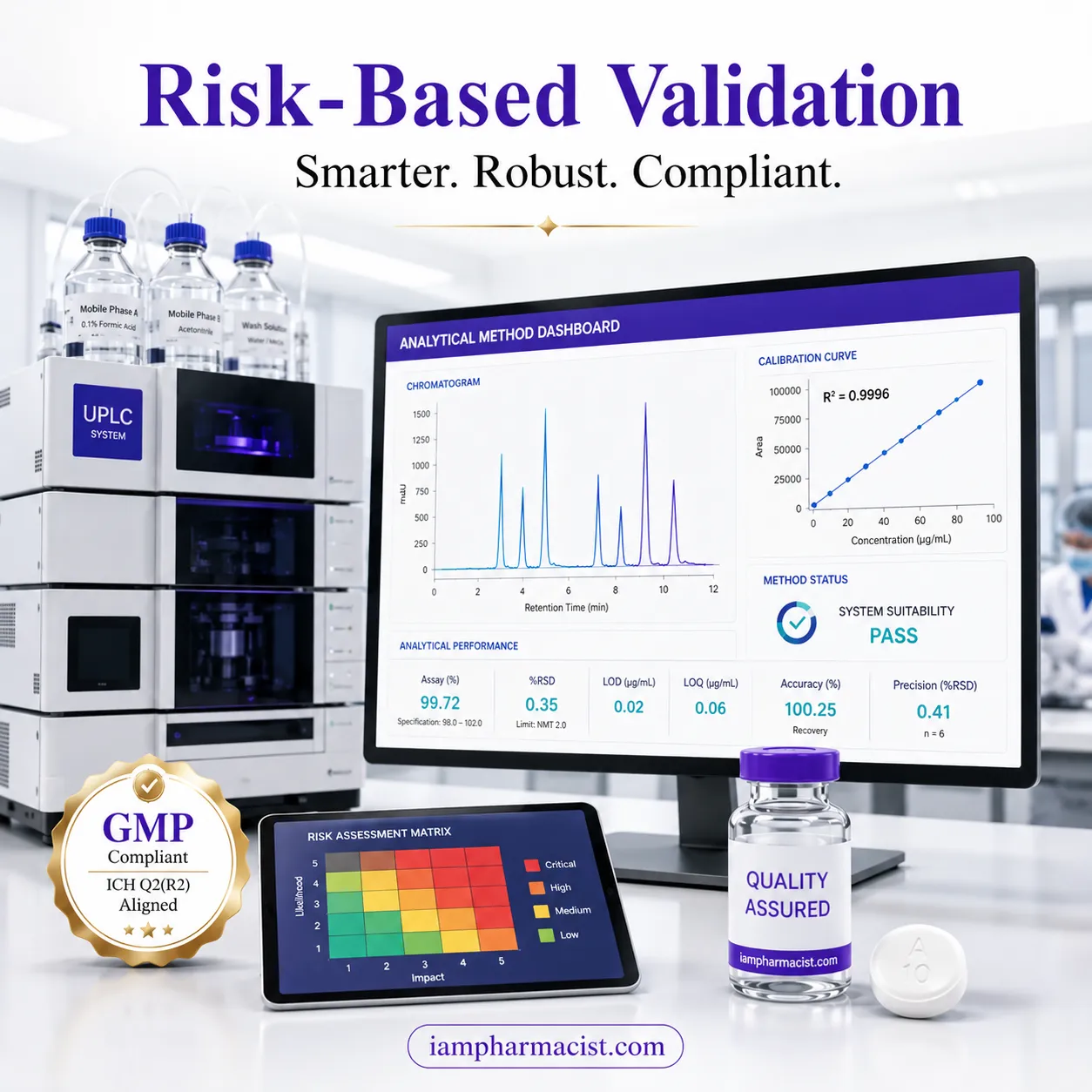

Learn risk-based analytical method validation strategies using AQbD, ATP, FMEA, ICH Q2, Q9, and lifecycle management for GMP-compliant methods.
Definition
Risk-Based Analytical Method Validation (RBAMV) is a lifecycle-driven approach that aligns validation activities with patient risk, product development stage, and method criticality. Using Analytical Quality by Design (AQbD), risk assessment tools such as FMEA, and continuous monitoring, organizations can develop robust, compliant analytical methods while reducing validation effort, cost, and regulatory risk.
Introduction
Analytical methods are critical components of pharmaceutical quality systems. They determine whether raw materials, intermediates, finished products, and stability samples meet predefined quality standards.
Historically, analytical methods were often developed using a trial-and-error approach, with robustness and performance evaluated only during final validation. While this traditional model satisfied basic regulatory requirements, it frequently resulted in lengthy development timelines, limited process understanding, and costly post-approval changes.
Modern pharmaceutical regulations increasingly encourage risk-based, science-driven methodologies that build quality into analytical methods from the beginning. This shift has led to the adoption of Risk-Based Analytical Method Validation (RBAMV) and Analytical Quality by Design (AQbD) principles throughout the analytical method lifecycle. These approaches emphasize predefined objectives, risk assessment, method understanding, and continual improvement.
This article explains how pharmaceutical companies can implement risk-based analytical validation strategies that improve robustness, regulatory flexibility, and lifecycle performance.
What Is Risk-Based Analytical Method Validation?
Risk-Based Analytical Method Validation (RBAMV) is a structured approach that prioritizes validation activities according to:
- Patient safety impact
- Product quality risk
- Method criticality
- Development phase
- Regulatory expectations
Rather than treating all analytical parameters equally, RBAMV focuses resources on areas that present the greatest risk to product quality and patient safety.
The concept aligns closely with:
- ICH Q2(R2) Analytical Validation
- ICH Q14 Analytical Procedure Development
- ICH Q9(R1) Quality Risk Management
- ICH Q8(R2) Pharmaceutical Development
Why Risk-Based Validation Matters
Limitations of Traditional Validation
Traditional “Quality by Testing” (QbT) approaches often rely on one-factor-at-a-time experimentation (OFAT).
Common Challenges
| Traditional Approach | Limitation |
|---|---|
| Trial-and-error development | Slow optimization |
| OFAT experiments | Misses variable interactions |
| End-stage robustness testing | Late discovery of risks |
| Fixed operating point | Limited flexibility |
| Minimal process understanding | Higher regulatory burden |
This approach can lead to false optimization and insufficient understanding of method variability.
AQbD: The Foundation of Risk-Based Validation
What Is AQbD?
Analytical Quality by Design (AQbD) is a systematic approach that begins with predefined objectives and emphasizes:
- Scientific understanding
- Risk management
- Experimental design
- Lifecycle monitoring
According to AQbD principles, quality is designed into the method rather than tested at the end.
Core Elements of Risk-Based Validation
1. Analytical Target Profile (ATP)
The ATP defines what the analytical method must achieve.
Example ATP
For an assay method:
| Parameter | Requirement |
|---|---|
| Accuracy | 98–102% |
| Precision | %RSD ≤ 2.0 |
| Specificity | No interference |
| Reporting Range | 80–120% |
| Run Time | ≤ 15 minutes |
The ATP becomes the foundation for all development and validation decisions.
2. Risk Assessment
Once ATP is defined, risks affecting performance are identified.
Common Risk Sources
- Sample preparation variability
- Instrument performance
- Analyst technique
- Mobile phase composition
- Column variability
- Environmental conditions
FMEA-Based Risk Assessment Example
| Failure Mode | Impact | Severity | Probability | Risk Priority |
|---|---|---|---|---|
| Incorrect pH | Peak distortion | High | Medium | High |
| Flow variation | Retention shift | Medium | Medium | Medium |
| Detector instability | Poor sensitivity | High | Low | Medium |
| Sample degradation | Incorrect results | High | High | Critical |
Failure Mode and Effects Analysis (FMEA) helps prioritize validation efforts toward critical risks.
3. Critical Method Parameters (CMPs)
CMPs are variables that significantly affect method performance.
Examples include:
- Mobile phase pH
- Organic solvent percentage
- Flow rate
- Column temperature
- Injection volume
4. Critical Method Attributes (CMAs)
CMAs measure method performance.
Examples include:
- Resolution
- Tailing factor
- Precision
- Accuracy
- Sensitivity
- Retention time
Understanding the relationship between CMPs and CMAs is essential for risk control.
Role of Design of Experiments (DoE)
AQbD replaces OFAT experimentation with multivariate Design of Experiments.
Benefits of DoE
- Fewer experiments
- Better process understanding
- Identification of interactions
- Statistical confidence
- Improved robustness
Example DoE Variables
| Factor | Low | High |
|---|---|---|
| pH | 2.8 | 3.2 |
| Flow Rate | 0.8 mL/min | 1.2 mL/min |
| Temperature | 25°C | 35°C |
DoE enables the creation of predictive models linking method variables to performance outcomes.
Method Operable Design Region (MODR)
One of AQbD’s most valuable outputs is the Method Operable Design Region (MODR).
What Is MODR?
MODR is a multidimensional space where method performance consistently meets ATP requirements with a defined probability of success.
Benefits
- Increased robustness
- Reduced variability
- Easier troubleshooting
- Greater regulatory flexibility
Phase-Appropriate Validation Strategy
Validation should align with the product lifecycle stage.
Recommended Validation Depth
| Development Stage | Validation Approach |
|---|---|
| Discovery | Method Qualification |
| Phase I | Limited Validation |
| Phase II | Enhanced Qualification |
| Phase III | Near-Full Validation |
| Commercial | Full ICH Validation |
This approach avoids unnecessary effort during early development while ensuring compliance for marketed products.
Step-by-Step Risk-Based Validation Strategy
Step 1: Define ATP
Establish method purpose and performance requirements.
Deliverable
Approved ATP document.
Step 2: Conduct Risk Assessment
Use tools such as:
- FMEA
- Ishikawa diagrams
- Risk ranking matrices
Deliverable
Risk register.
Step 3: Identify CMPs and CMAs
Determine which variables influence method performance.
Deliverable
Criticality assessment report.
Step 4: Perform DoE Studies
Investigate:
- Main effects
- Interactions
- Robustness
Deliverable
Statistical model.
Step 5: Define MODR
Establish operating ranges that consistently achieve ATP requirements.
Deliverable
MODR report.
Step 6: Execute Validation
Validate according to ICH Q2(R2).
Parameters
- Accuracy
- Precision
- Specificity
- Linearity
- Range
- Robustness
- LOD
- LOQ
Step 7: Implement Lifecycle Monitoring
Monitor performance using:
- System suitability testing
- Trend analysis
- Control charts
- Annual product reviews
Practical Example: HPLC Assay Method
Traditional Approach
- Single optimized condition
- Limited robustness understanding
- Regulatory changes require approval
Outcome
Higher risk of method failure.
Risk-Based Approach
- ATP established
- FMEA completed
- DoE optimization performed
- MODR defined
Outcome
Improved robustness and flexibility.
Lifecycle Management After Validation
Modern validation does not end after approval.
Continuous Verification Activities
System Suitability Monitoring
Track:
- Resolution
- Tailing factor
- Plate count
Trending
Monitor:
- Assay drift
- Retention time changes
- Precision trends
Periodic Review
Assess:
- OOS frequency
- OOT events
- Instrument performance
Regulatory Advantages of AQbD-Based Validation
Increased Method Understanding
Regulators increasingly support methods developed using systematic risk-based approaches.
Easier Post-Approval Changes
Traditional methods often require regulatory approval for minor changes.
AQbD methods provide flexibility because relationships between CMPs and CMAs are already understood. Changes within the established MODR may only require notification rather than full regulatory resubmission.
Alignment with ICH Q12
ICH Q12 encourages lifecycle management and risk-based post-approval change management.
Benefits include:
- Faster implementation
- Reduced regulatory burden
- Continuous improvement
GMP and Regulatory Considerations
Key Guidelines
| Guideline | Relevance |
|---|---|
| ICH Q2(R2) | Validation requirements |
| ICH Q14 | Analytical development |
| ICH Q9(R1) | Risk management |
| ICH Q8(R2) | Quality by Design |
| ICH Q12 | Lifecycle management |
| USP <1220> | Analytical procedure lifecycle |
GMP Expectations
Risk-based validation should support:
- Data integrity
- Method robustness
- Change control
- CAPA effectiveness
- Ongoing verification
Benefits of Risk-Based Analytical Validation
| Benefit | Impact |
|---|---|
| Faster Development | Reduced timelines |
| Lower Costs | Fewer experiments |
| Better Robustness | Fewer failures |
| Improved Compliance | Stronger inspections |
| Lifecycle Flexibility | Easier changes |
| Greater Understanding | Reduced risk |
FAQs
1. What is Risk-Based Analytical Method Validation?
A lifecycle approach that aligns validation activities with patient risk, product quality impact, and method criticality.
2. What is ATP in analytical validation?
The Analytical Target Profile defines the intended purpose and required performance characteristics of a method.
3. How does AQbD support validation?
AQbD builds quality into method development through risk assessment, DoE, and scientific understanding.
4. What is MODR?
Method Operable Design Region is the multidimensional operating space where method performance consistently meets ATP requirements.
5. Why is FMEA used in method validation?
FMEA identifies and prioritizes potential method failure modes based on risk.
6. What is the role of ICH Q14?
ICH Q14 provides guidance on analytical procedure development using lifecycle and risk-based principles.
7. Can risk-based validation reduce development costs?
Yes. It reduces unnecessary experiments and minimizes method failures during commercialization.
8. What are Critical Method Parameters (CMPs)?
Variables such as pH, flow rate, and temperature that influence method performance.
9. How does lifecycle monitoring improve compliance?
Continuous monitoring identifies method drift early and supports ongoing method suitability.
10. Is AQbD accepted by regulators?
Yes. Regulatory agencies increasingly encourage AQbD and risk-based analytical development approaches.