


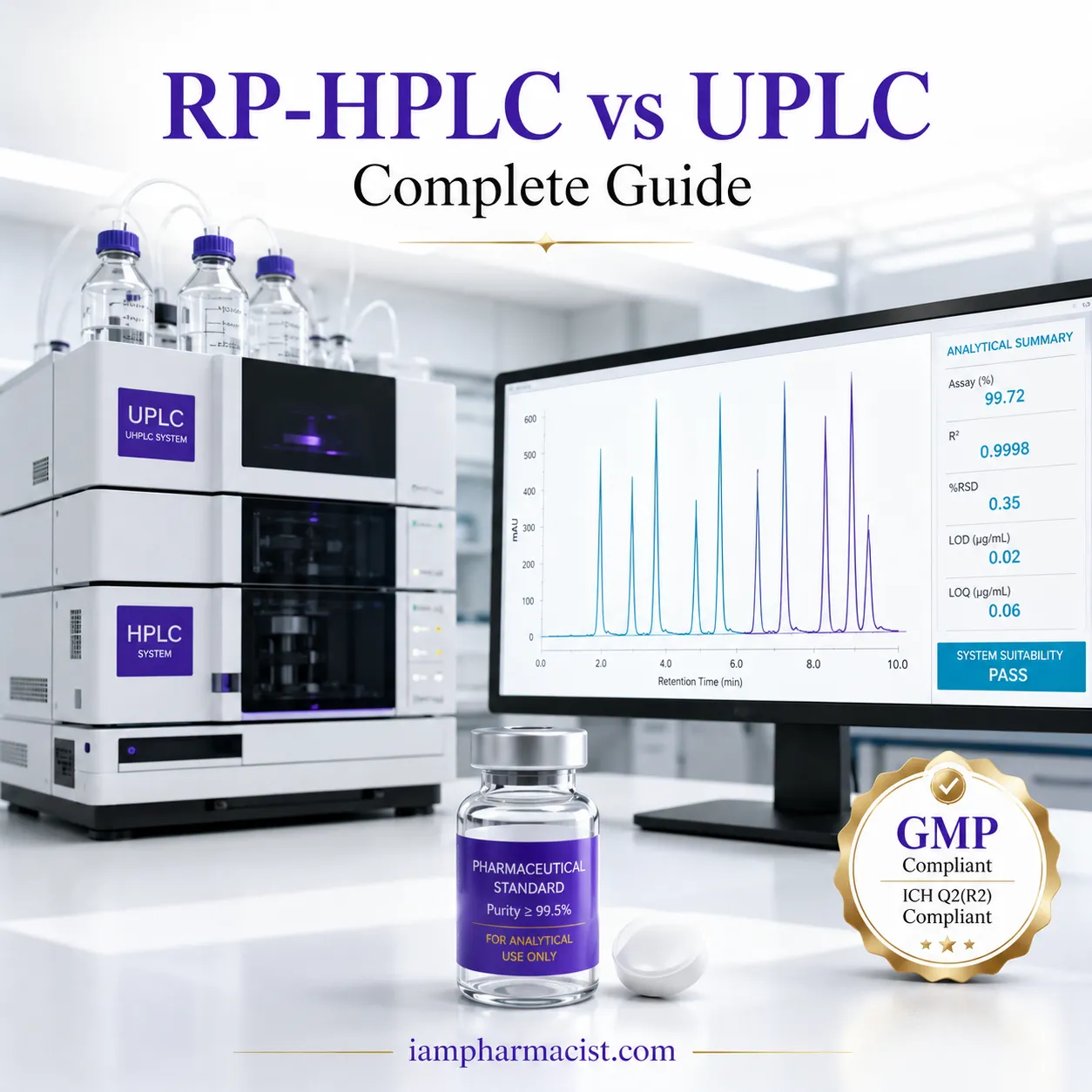

Compare RP-HPLC vs UPLC in pharmaceutical analysis. Learn differences in speed, resolution, sensitivity, cost, validation, and GMP compliance.
Definition
RP-HPLC and UPLC are reverse-phase chromatographic techniques used in pharmaceutical analysis. RP-HPLC typically uses 3–5 μm column particles and operates up to 6,000 psi, while UPLC uses sub-2 μm particles and pressures above 15,000 psi. UPLC provides faster analysis, higher resolution, better sensitivity, and lower solvent consumption, whereas RP-HPLC remains the industry standard for routine quality control and pharmacopeial testing.
Chromatographic analysis is the backbone of pharmaceutical quality control, method development, stability testing, and regulatory compliance. Among the most widely used separation techniques are Reverse-Phase High-Performance Liquid Chromatography (RP-HPLC) and Ultra-Performance Liquid Chromatography (UPLC/UHPLC).
While both techniques rely on the same reverse-phase separation principles, significant differences exist in particle size, operating pressure, speed, sensitivity, and operational efficiency.
For pharmaceutical laboratories, selecting between RP-HPLC and UPLC can directly impact analytical throughput, regulatory compliance, operational costs, and product release timelines.
This guide provides a detailed comparison of RP-HPLC and UPLC, practical pharmaceutical applications, validation considerations, and GMP-focused recommendations.
Understanding RP-HPLC
Reverse-Phase High-Performance Liquid Chromatography (RP-HPLC) uses a non-polar stationary phase (typically C18 columns) and a relatively polar mobile phase to separate pharmaceutical compounds based on hydrophobic interactions.
RP-HPLC has served as the industry standard for decades and remains the preferred technique for:
- Assay testing
- Dissolution analysis
- Content uniformity
- Stability studies
- Routine QC release testing
- Pharmacopeial monographs
Understanding UPLC
Ultra-Performance Liquid Chromatography (UPLC/UHPLC) is an advanced evolution of HPLC that employs sub-2 μm particle columns and ultra-high operating pressures.
The technology offers:
- Superior chromatographic resolution
- Faster run times
- Increased throughput
- Enhanced sensitivity
- Reduced solvent consumption
UPLC has become increasingly important in:
- Drug development
- Impurity profiling
- Biopharmaceutical analysis
- Forced degradation studies
- Genotoxic impurity analysis
RP-HPLC vs UPLC: Key Technical Differences
| Feature | RP-HPLC | UPLC/UHPLC |
|---|---|---|
| Column Particle Size | 3–5 μm | <2 μm (typically 1.7 μm) |
| Operating Pressure | Up to 6,000 psi | 15,000 psi or higher |
| Analysis Time | 15–30 min | 2–5 min |
| Resolution | Moderate | Very High |
| Peak Capacity | Standard | Superior |
| Sensitivity | Good | Excellent |
| Solvent Consumption | High | Low |
| Sample Throughput | Moderate | High |
| Instrument Cost | Lower | Higher |
| Maintenance Cost | Lower | Moderate to High |
Why Smaller Particle Size Improves Performance
The primary advantage of UPLC comes from its use of sub-2 μm particles.
Smaller particles:
- Increase surface area
- Reduce band broadening
- Improve mass transfer
- Generate sharper peaks
- Enhance signal-to-noise ratio
As a result, analysts achieve better separation of closely related impurities and degradation products.
Advantages of RP-HPLC
1. Industry-Wide Standardization
Most regulatory methods, pharmacopoeias, and validated procedures are based on conventional HPLC.
Examples include:
- USP monographs
- BP methods
- EP analytical procedures
- Generic product testing
2. Lower Capital Investment
RP-HPLC systems generally require:
- Lower equipment cost
- Less expensive columns
- Affordable spare parts
- Reduced maintenance expenses
This makes HPLC suitable for:
- Small pharmaceutical companies
- Academic laboratories
- Contract testing facilities
3. Easier Method Development
Because pressures remain relatively low:
- Columns experience less stress
- Instrument wear is reduced
- Troubleshooting is simpler
- Method robustness is easier to establish
Advantages of UPLC
1. Enhanced Resolution
UPLC provides significantly improved separation of:
- Related substances
- Degradation products
- Isomeric compounds
- Trace impurities
This is especially valuable during:
- Stability studies
- Forced degradation investigations
- Impurity characterization
2. Increased Throughput
A method requiring 30 minutes on HPLC may be completed within 3–5 minutes using UPLC.
Benefits include:
- Faster batch release
- Increased laboratory productivity
- Reduced sample backlog
3. Lower Solvent Consumption
UPLC can reduce solvent usage by:
80–90% compared with traditional HPLC
Benefits:
- Lower operating costs
- Reduced hazardous waste
- Improved environmental sustainability
4. Improved Sensitivity
UPLC generates:
- Sharper peaks
- Better signal-to-noise ratio
- Lower detection limits
This is critical for:
- Nitrosamine analysis
- Genotoxic impurities
- Trace-level degradants
Pharmaceutical Applications: RP-HPLC vs UPLC
| Application | RP-HPLC | UPLC |
|---|---|---|
| Assay Testing | Excellent | Excellent |
| Dissolution Testing | Excellent | Good |
| Content Uniformity | Excellent | Excellent |
| Related Substances | Good | Excellent |
| Stability Studies | Good | Excellent |
| Forced Degradation | Good | Excellent |
| Nitrosamine Analysis | Limited | Excellent |
| Biologics Analysis | Limited | Excellent |
| Drug Discovery | Moderate | Excellent |
| High-Throughput Screening | Moderate | Excellent |
Practical Example 1: Assay of Paracetamol Tablets
RP-HPLC Approach
- C18 column
- Run time: 20 minutes
- Suitable for routine QC
UPLC Approach
- Sub-2 μm C18 column
- Run time: 3 minutes
- Comparable accuracy with higher throughput
Outcome
A laboratory testing 300 samples per day can significantly improve efficiency using UPLC.
Practical Example 2: Stability-Indicating Method
During accelerated stability studies, analysts may encounter:
- Oxidative degradants
- Hydrolytic degradants
- Photolytic degradants
RP-HPLC Challenge
Some degradation peaks may co-elute.
UPLC Benefit
Improved peak capacity allows:
- Better separation
- Accurate quantification
- Regulatory-compliant impurity reporting
Step-by-Step Guide: Choosing Between RP-HPLC and UPLC
Step 1: Define Analytical Objective
Determine whether the method is intended for:
- Routine QC
- Stability testing
- Method development
- Impurity profiling
Step 2: Evaluate Sample Complexity
For complex samples containing:
- Multiple impurities
- Degradation products
- Biological matrices
UPLC often provides superior performance.
Step 3: Assess Throughput Requirements
High-volume laboratories generally benefit from UPLC due to shorter run times.
Step 4: Review Budget Constraints
Consider:
- Instrument acquisition cost
- Column replacement cost
- Maintenance requirements
RP-HPLC remains more economical initially.
Step 5: Consider Regulatory Requirements
Verify whether:
- Pharmacopeial methods specify HPLC
- Method transfer is required
- Revalidation is necessary
Step 6: Perform Comparative Validation
When migrating methods:
- Compare accuracy
- Compare precision
- Compare specificity
- Compare robustness
- Compare impurity profiles
GMP and Regulatory Considerations
ICH Q2(R2) Validation
Both RP-HPLC and UPLC methods must demonstrate:
- Accuracy
- Precision
- Specificity
- Linearity
- Range
- Detection limits
- Quantitation limits
- Robustness
Method Transfer Requirements
Moving from HPLC to UPLC generally requires:
- Comparative studies
- Transfer protocols
- Equivalency demonstration
- Documentation approval
Data Integrity Compliance
Analytical systems must comply with:
- FDA 21 CFR Part 11
- EU Annex 11
- ALCOA+ principles
Regardless of chromatography platform.
Stability Testing Compliance
Both techniques support:
- ICH Q1A(R2)
- Stability-indicating methods
- Shelf-life determination
However, UPLC often improves degradation product resolution.
Cost Comparison
| Cost Element | RP-HPLC | UPLC |
|---|---|---|
| Instrument Purchase | Lower | Higher |
| Column Cost | Lower | Higher |
| Solvent Usage | High | Low |
| Waste Disposal | High | Low |
| Throughput | Moderate | High |
| Long-Term Efficiency | Moderate | High |
When Should You Choose RP-HPLC?
Choose RP-HPLC when:
✓ Following existing pharmacopeial methods
✓ Performing routine QC testing
✓ Working with limited budgets
✓ Throughput demands are moderate
✓ Method transfer is unnecessary
When Should You Choose UPLC?
Choose UPLC when:
✓ High throughput is required
✓ Impurity profiling is critical
✓ Complex samples need better resolution
✓ Solvent reduction is important
✓ Drug development timelines are aggressive
✓ Trace-level impurity detection is needed
Conclusion
RP-HPLC and UPLC are both essential tools in pharmaceutical analysis. RP-HPLC remains the established standard for routine quality control, validated pharmacopeial methods, and cost-effective testing. UPLC, on the other hand, delivers superior resolution, faster analysis, enhanced sensitivity, and significant solvent savings.
For modern pharmaceutical laboratories focused on impurity profiling, stability studies, high-throughput screening, and advanced analytical development, UPLC often provides substantial advantages. However, RP-HPLC continues to offer unmatched familiarity, regulatory acceptance, and economic practicality for routine testing applications.
The best choice depends on analytical objectives, regulatory requirements, sample complexity, and laboratory resources.
FAQs
1. What is the main difference between RP-HPLC and UPLC?
UPLC uses sub-2 μm particles and higher pressure, resulting in faster analysis, better resolution, and higher sensitivity than RP-HPLC.
2. Is UPLC more accurate than HPLC?
Both can achieve excellent accuracy, but UPLC generally offers improved precision and sensitivity due to sharper peak shapes.
3. Why does UPLC operate at higher pressure?
Smaller particle columns create greater backpressure, requiring ultra-high-pressure systems.
4. Can HPLC methods be transferred to UPLC?
Yes, but comparative validation and method transfer studies are typically required.
5. Which technique consumes less solvent?
UPLC significantly reduces solvent consumption, often by 80–90%.
6. Is UPLC accepted by regulatory agencies?
Yes. UPLC methods are widely accepted when properly validated according to ICH and regulatory requirements.
7. Which technique is better for impurity profiling?
UPLC is generally superior because of its higher resolution and peak capacity.
8. Is RP-HPLC still relevant today?
Absolutely. RP-HPLC remains the dominant platform for routine pharmaceutical QC testing.
9. What is UHPLC?
UHPLC (Ultra-High-Performance Liquid Chromatography) is another term commonly used for UPLC-type technology.
10. Which technique is better for stability studies?
UPLC is often preferred for stability-indicating methods because it can better resolve degradation products and impurities.