


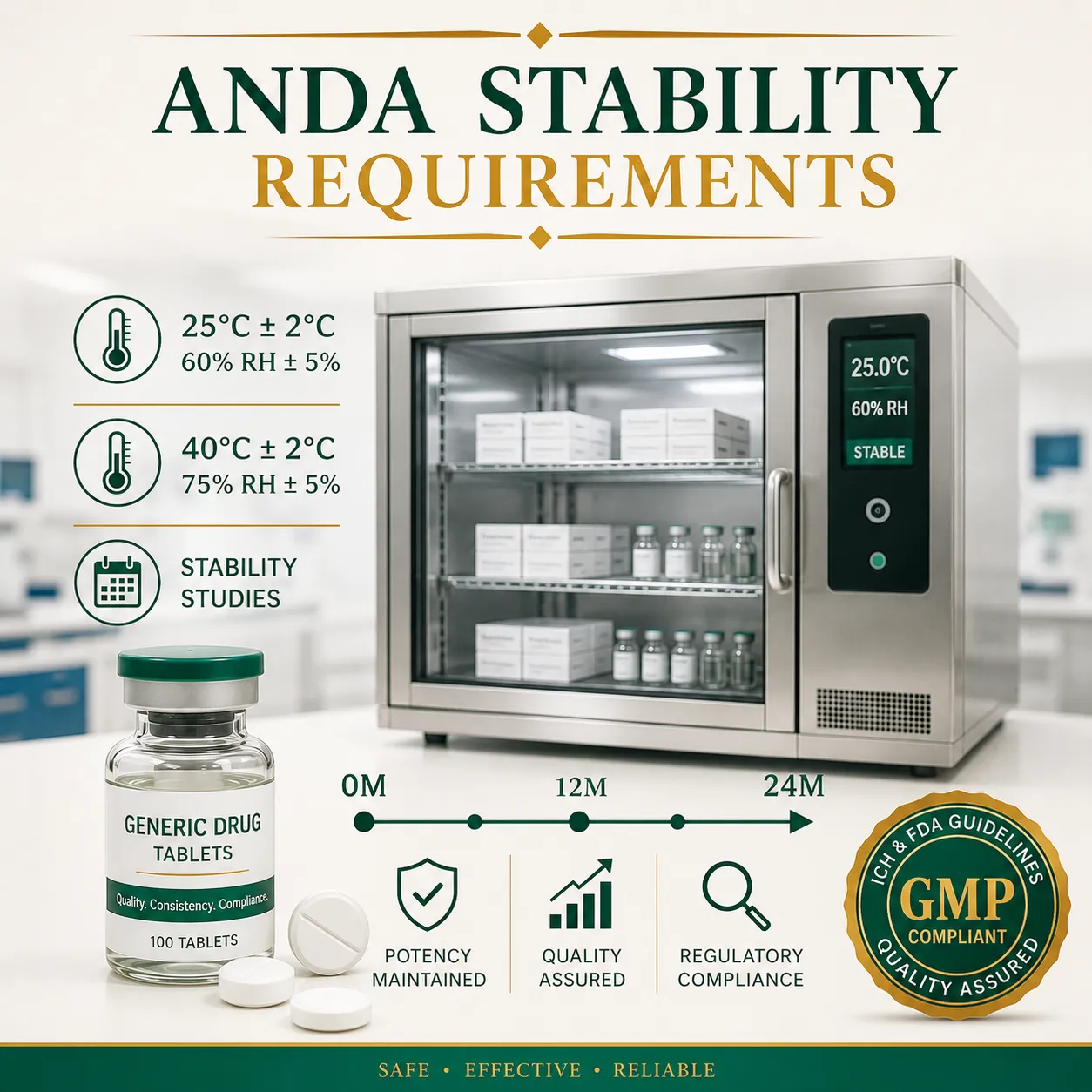

Learn FDA ANDA stability testing requirements, ICH guidelines, batch requirements, study conditions, shelf-life justification, and GMP compliance.
Definition
Stability testing for ANDA and generic drug applications requires manufacturers to submit stability data demonstrating that the drug product remains chemically, physically, and microbiologically stable throughout its proposed shelf life. FDA requirements follow ICH guidelines and typically include three stability batches, six months of accelerated data, six months of long-term data at submission, and continued stability monitoring throughout regulatory review and commercialization.
Stability Testing Requirements for ANDA and Generic Drug Applications
Generic drug approval depends on more than bioequivalence. Regulatory authorities expect manufacturers to demonstrate that a generic product maintains its identity, strength, quality, purity, and performance throughout its shelf life.
Stability testing is therefore a critical component of every Abbreviated New Drug Application (ANDA). Insufficient stability data is one of the most common causes of regulatory questions, review delays, and post-approval commitments.
The FDA’s expectations are largely aligned with International Council for Harmonisation (ICH) stability guidelines, requiring manufacturers to establish scientifically justified expiration dating periods supported by long-term and accelerated stability studies.
This guide explains FDA ANDA stability testing requirements, study design, batch expectations, data analysis requirements, and GMP considerations for successful generic drug submissions.
Why Stability Testing Is Critical for ANDA Approval
Stability studies provide evidence that a drug product remains suitable for patient use throughout its intended shelf life.
Regulators use stability data to evaluate:
- Expiration dating period
- Storage conditions
- Packaging suitability
- Product quality over time
- Degradation pathways
- Manufacturing consistency
Without adequate stability data, FDA reviewers cannot confirm that a generic product will perform similarly to the reference listed drug (RLD) throughout its lifecycle.
Regulatory Framework for ANDA Stability Studies
The FDA references multiple ICH guidelines when reviewing generic drug stability programs.
Key Regulatory References
| Guideline | Purpose |
|---|---|
| ICH Q1A(R2) | Stability Testing of New Drug Substances and Products |
| ICH Q1B | Photostability Testing |
| ICH Q1D | Bracketing and Matrixing Designs |
| ICH Q1E | Stability Data Evaluation |
| FDA Guidance for Industry: ANDAs Stability Testing | Generic Drug Stability Expectations |
| 21 CFR Part 211 | GMP Requirements |
| 21 CFR Part 11 | Electronic Records and Signatures |
FDA Stability Data Requirements for ANDA Submission
The FDA requires stability data at the time of ANDA filing to support the proposed shelf life.
Baseline Submission Requirements
| Requirement | FDA Expectation |
|---|---|
| Stability Batches | 3 batches |
| Batch Configuration | 3 pilot-scale OR 2 pilot-scale + 1 small-scale |
| Accelerated Data | Minimum 6 months |
| Long-Term Data | Minimum 6 months |
| Packaging | Commercial container closure system |
| Ongoing Studies | Continue throughout review process |
Stability Data During ANDA Review
FDA expects applicants to continue stability studies after submission.
Manufacturers should provide:
- Updated stability reports
- Additional long-term data
- Trend analyses
- Shelf-life justification updates
If available, FDA generally expects submission of:
- 12-month long-term stability data
- Ongoing accelerated results
- Significant change investigations
Required Stability Study Conditions
The study conditions should follow ICH recommendations appropriate for the intended market.
Standard Stability Conditions
| Study Type | Temperature | Relative Humidity | Duration |
|---|---|---|---|
| Accelerated | 40°C ± 2°C | 75% RH ± 5% | 6 Months |
| Long-Term | 25°C ± 2°C | 60% RH ± 5% | Proposed Shelf Life |
| Intermediate | 30°C ± 2°C | 65% RH ± 5% | 6–12 Months |
When Is Intermediate Testing Required?
Intermediate studies are generally initiated when accelerated testing demonstrates:
- Significant degradation
- Dissolution changes
- Assay reduction
- Physical instability
- Packaging concerns
These studies help determine whether accelerated failures are predictive of real-world product behavior.
Core Stability Studies Required for Generic Drug Applications
1. Long-Term Stability Studies
Long-term studies establish actual product behavior under recommended storage conditions.
Purpose
- Support expiration dating
- Monitor quality trends
- Confirm packaging suitability
Typical Testing Parameters
- Assay
- Dissolution
- Degradation products
- Water content
- Appearance
- Microbial limits
- Preservative content (where applicable)
2. Accelerated Stability Studies
Accelerated studies evaluate the product under stressed environmental conditions.
Purpose
- Predict degradation trends
- Identify formulation weaknesses
- Support shelf-life projections
Benefits
- Faster data generation
- Early risk identification
- Regulatory support for shelf-life estimation
3. Stress Testing (Forced Degradation Studies)
Stress testing is a critical development activity used to establish stability-indicating analytical methods.
Typical Stress Conditions
| Stress Condition | Objective |
|---|---|
| Heat | Thermal degradation |
| Humidity | Hydrolysis evaluation |
| Light | Photodegradation assessment |
| Acid/Base | Chemical stability assessment |
| Oxidation | Oxidative degradation profiling |
Why FDA Reviews Forced Degradation Data
Forced degradation studies demonstrate that:
- Analytical methods detect degradation
- Impurities are properly separated
- Stability-indicating methods are validated
Packaging Requirements for Stability Studies
FDA expects stability batches to be packaged in the same container closure system proposed for commercial marketing.
Acceptable Packaging Examples
- HDPE bottles
- Blister packs
- Glass containers
- Sachets
- Unit-dose packaging
Packaging Evaluation Criteria
| Parameter | Purpose |
|---|---|
| Moisture Barrier | Protect product stability |
| Oxygen Barrier | Prevent oxidation |
| Light Protection | Prevent photodegradation |
| Seal Integrity | Prevent contamination |
| Container Closure Integrity | Maintain shelf-life quality |
Statistical Evaluation of Stability Data
FDA expects stability data evaluation according to ICH Q1E recommendations.
Statistical Objectives
- Estimate expiration dating period
- Analyze degradation trends
- Support shelf-life extrapolation
- Demonstrate batch consistency
Typical Statistical Assessments
- Regression analysis
- Trend analysis
- Confidence interval calculations
- Poolability assessments
- Shelf-life modeling
Example
Three pilot batches show assay results:
| Time Point | Batch A | Batch B | Batch C |
|---|---|---|---|
| Initial | 100.1% | 99.8% | 100.3% |
| 6 Months | 99.4% | 99.1% | 99.5% |
| 12 Months | 98.8% | 98.5% | 98.9% |
The stability trend supports shelf-life justification and demonstrates batch consistency.
Step-by-Step Guide for ANDA Stability Program Design
Step 1: Select Representative Batches
Manufacture:
- Three registration batches
- Pilot-scale production
- Commercially representative process
Step 2: Package in Marketed Configuration
Use:
- Final commercial packaging
- Proposed container closure system
- Commercial labeling configuration
Step 3: Initiate Long-Term and Accelerated Studies
Place samples into qualified chambers under:
- ICH long-term conditions
- Accelerated conditions
Step 4: Perform Stability-Indicating Testing
Evaluate:
- Assay
- Dissolution
- Related substances
- Appearance
- Moisture content
Step 5: Analyze Stability Trends
Perform:
- Statistical evaluations
- Degradation assessments
- Shelf-life projections
Step 6: Submit Data and Continue Monitoring
Provide:
- Initial ANDA data package
- Stability updates during review
- Commitment stability protocol
GMP Considerations for ANDA Stability Programs
A successful ANDA stability program requires compliance with pharmaceutical GMP requirements.
Critical GMP Controls
| GMP Area | Requirement |
|---|---|
| Stability Chambers | Qualification and mapping |
| Environmental Monitoring | Continuous recording |
| Data Integrity | Audit trails and security |
| Sample Management | Traceability and accountability |
| OOS Investigations | Formal procedures |
| CAPA Program | Root cause management |
| Documentation | Controlled records |
Common FDA Observations Related to Stability Programs
Manufacturers frequently receive regulatory observations for:
- Insufficient stability data
- Inadequate chamber qualification
- Missing trend analysis
- Incomplete investigations
- Poor data integrity controls
- Unsupported shelf-life claims
- Packaging qualification deficiencies
Practical Example: Generic Tablet ANDA Submission
A manufacturer develops a generic immediate-release tablet.
Stability Program
- 3 pilot-scale batches
- Commercial HDPE bottle
- 6 months accelerated data
- 6 months long-term data
- Photostability assessment
- Forced degradation studies
Outcome
The stability package supports:
- 24-month shelf life
- Controlled room temperature storage
- Successful FDA review
This illustrates how a well-designed stability program can streamline ANDA approval.
Best Practices Checklist
| Best Practice | Status |
|---|---|
| Use three representative batches | ✓ |
| Package in final market configuration | ✓ |
| Generate 6 months accelerated data | ✓ |
| Generate 6 months long-term data | ✓ |
| Conduct forced degradation studies | ✓ |
| Use stability-indicating methods | ✓ |
| Perform ICH Q1E statistical evaluation | ✓ |
| Continue studies during FDA review | ✓ |
| Maintain GMP compliance | ✓ |
| Implement annual stability program | ✓ |
FAQs
1. What stability data is required for an ANDA submission?
FDA generally requires six months of accelerated stability data and six months of long-term stability data from three representative batches.
2. How many batches are required for ANDA stability studies?
Typically three batches, consisting of three pilot-scale batches or two pilot-scale batches and one small-scale batch.
3. What are the FDA accelerated stability conditions?
40°C ± 2°C and 75% RH ± 5% RH for six months.
4. What are the FDA long-term stability conditions?
25°C ± 2°C and 60% RH ± 5% RH, unless regional conditions justify alternative parameters.
5. Why is forced degradation testing important for ANDAs?
It demonstrates that analytical methods are stability-indicating and capable of detecting degradation products.
6. Is intermediate stability testing always required?
No. Intermediate testing is typically performed when accelerated studies show significant changes.
7. Can shelf life be extrapolated from stability data?
Yes, when scientifically justified according to ICH Q1E recommendations.
8. Must stability batches use commercial packaging?
Yes. FDA expects registration batches to be packaged in the proposed commercial container closure system.
9. What is a stability-indicating method?
An analytical method capable of accurately measuring the active ingredient while separating degradation products and impurities.
10. What happens if stability studies fail during review?
FDA may request additional data, investigations, revised shelf-life claims, or other corrective actions before approval.