


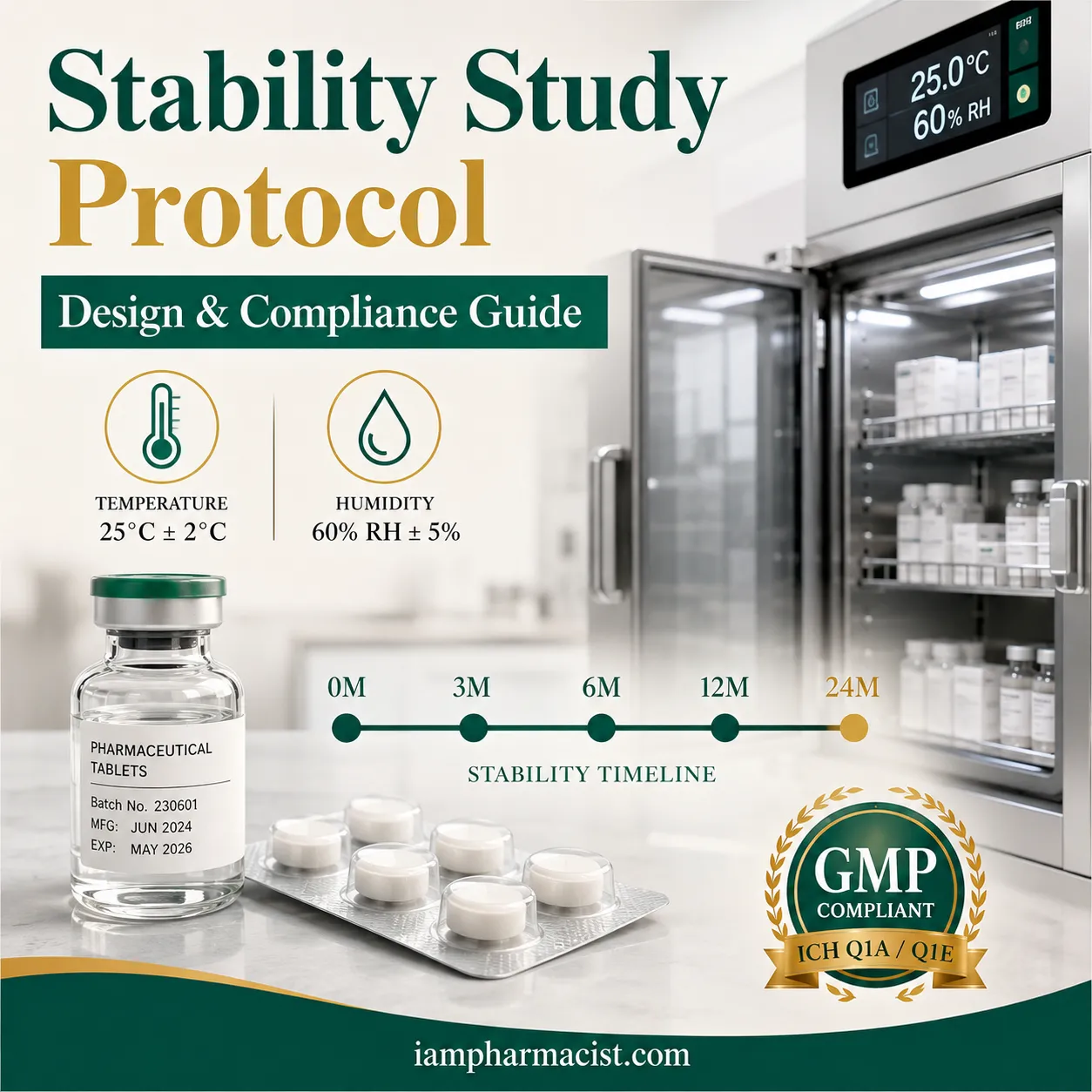

Learn how to design a GMP-compliant stability study protocol with ICH guidelines, testing conditions, batch selection, and shelf-life evaluation.
Definition
A stability study protocol is a GMP-controlled document that defines how a drug product’s quality, safety, and efficacy are evaluated over time under specific environmental conditions to establish shelf life and storage requirements.
Introduction
Ensuring that a pharmaceutical product maintains its identity, strength, quality, and purity throughout its lifecycle is a regulatory and scientific necessity—not a formality. A poorly designed stability program can lead to product recalls, regulatory observations, or rejected filings.
A GMP-compliant stability study protocol provides a structured framework for evaluating product stability using validated methods, controlled environmental conditions, and statistically sound data interpretation aligned with ICH Q1A(R2), Q1D, and Q2(R1) guidelines.
This guide breaks down how to design a robust stability program that meets global regulatory expectations (FDA, EMA, WHO) while remaining practical for industry implementation.
What is a Stability Study Protocol?
A stability protocol is a pre-approved, controlled document outlining:
- Study design and objectives
- Batch selection criteria
- Storage conditions
- Testing intervals
- Analytical methods
- Acceptance criteria
- Data evaluation approach
It ensures consistency, traceability, and regulatory compliance throughout the product lifecycle.
Step-by-Step Guide to Designing a GMP Stability Program
1. Define Study Objectives
Clarify the purpose of the study:
- Shelf-life determination
- Retest period for API
- Post-approval changes
- Ongoing stability commitment
2. Batch Selection and Configuration
| Parameter | Requirement |
|---|---|
| Minimum batches | ≥ 3 primary batches |
| Scale | Pilot or production scale |
| Manufacturing | Same process as commercial |
| Packaging | Market-intended container |
Bracketing & Matrixing (ICH Q1D)
| Approach | Description | Use Case |
|---|---|---|
| Bracketing | Test extreme strengths/pack sizes | Multiple strengths |
| Matrixing | Test subset at intervals | Large product families |
Environmental Storage Conditions
| Study Type | Conditions | Duration |
|---|---|---|
| Long-term | 25°C ± 2°C / 60% RH ± 5% | 12–36 months |
| Accelerated | 40°C ± 2°C / 75% RH ± 5% | 6 months |
| Intermediate | 30°C ± 2°C / 65% RH ± 5% | If needed |
GMP Requirements for Chambers
- IQ/OQ/PQ qualification
- Temperature & humidity mapping
- Continuous monitoring with alarms
- Calibrated sensors
4. Testing Frequency and Time Points
| Study Type | Time Points |
|---|---|
| Long-term | 0, 3, 6, 9, 12, 18, 24, 36 months |
| Accelerated | 0, 3, 6 months |
5. Stability-Indicating Analytical Methods
All methods must comply with ICH Q2(R1).
Key Requirement:
Methods must be stability-indicating, meaning they can:
- Detect degradation products
- Separate API from impurities
- Provide accurate quantification
Typical Methods:
- HPLC/UPLC assay
- Dissolution testing
- pH measurement
- Microbial testing
6. Critical Quality Attributes (CQAs)
| Category | Examples |
|---|---|
| Chemical | Assay, impurities |
| Physical | Color, dissolution, hardness |
| Microbiological | Sterility, bioburden |
| Functional | Delivery performance |
7. Documentation and Data Evaluation
Shelf-Life Estimation
- Based on statistical analysis of stability data
- Use regression analysis (ICH Q1E)
- Evaluate trends and variability
Significant Change Criteria
- Assay failure
- Increased degradation products
- Dissolution failure
8. Ongoing Stability Program (GMP Requirement)
- At least one batch per year must be added
- Confirms continued product quality post-approval
- Detects process drift or variability
Practical Example
Product: Immediate-release tablet
Market: Zone II
| Parameter | Example |
|---|---|
| Batches | 3 pilot batches |
| Packaging | PVC/Alu blister |
| Long-term | 25°C/60% RH (24 months) |
| Accelerated | 40°C/75% RH (6 months) |
| Tests | Assay, dissolution, impurities |
| Outcome | Shelf life: 24 months |
Common Pitfalls to Avoid
- Using non–stability-indicating methods
- Inadequate chamber qualification
- Poor batch representativeness
- Missing intermediate condition triggers
- Weak statistical justification
Regulatory & GMP Insights
- ICH Q1A(R2): Core stability guideline
- ICH Q1D: Bracketing and matrixing
- ICH Q2(R1): Analytical validation
- ICH Q1E: Data evaluation
- FDA/EMA: Expect lifecycle stability commitment
Inspection Focus Areas:
- Data integrity (ALCOA+)
- Trend analysis
- Out-of-specification (OOS) handling
- Change control linkage
FAQs
1. What is a stability study protocol?
A documented plan outlining how stability testing is conducted to determine shelf life.
2. How many batches are required for stability studies?
At least three primary batches.
3. What are ICH stability conditions?
Standardized temperature and humidity settings defined in ICH Q1A.
4. What is accelerated stability testing?
Testing under elevated conditions to predict long-term stability.
5. What is a stability-indicating method?
An analytical method that detects changes due to degradation.
6. What is bracketing in stability studies?
Testing only extreme conditions of product variants.
7. What is matrixing?
Testing a subset of samples at specific time points.
8. How is shelf life determined?
Using statistical evaluation of stability data.
9. What is ongoing stability testing?
Annual testing of commercial batches post-approval.
10. Which ICH guidelines apply to stability?
ICH Q1A, Q1D, Q1E, and Q2.