


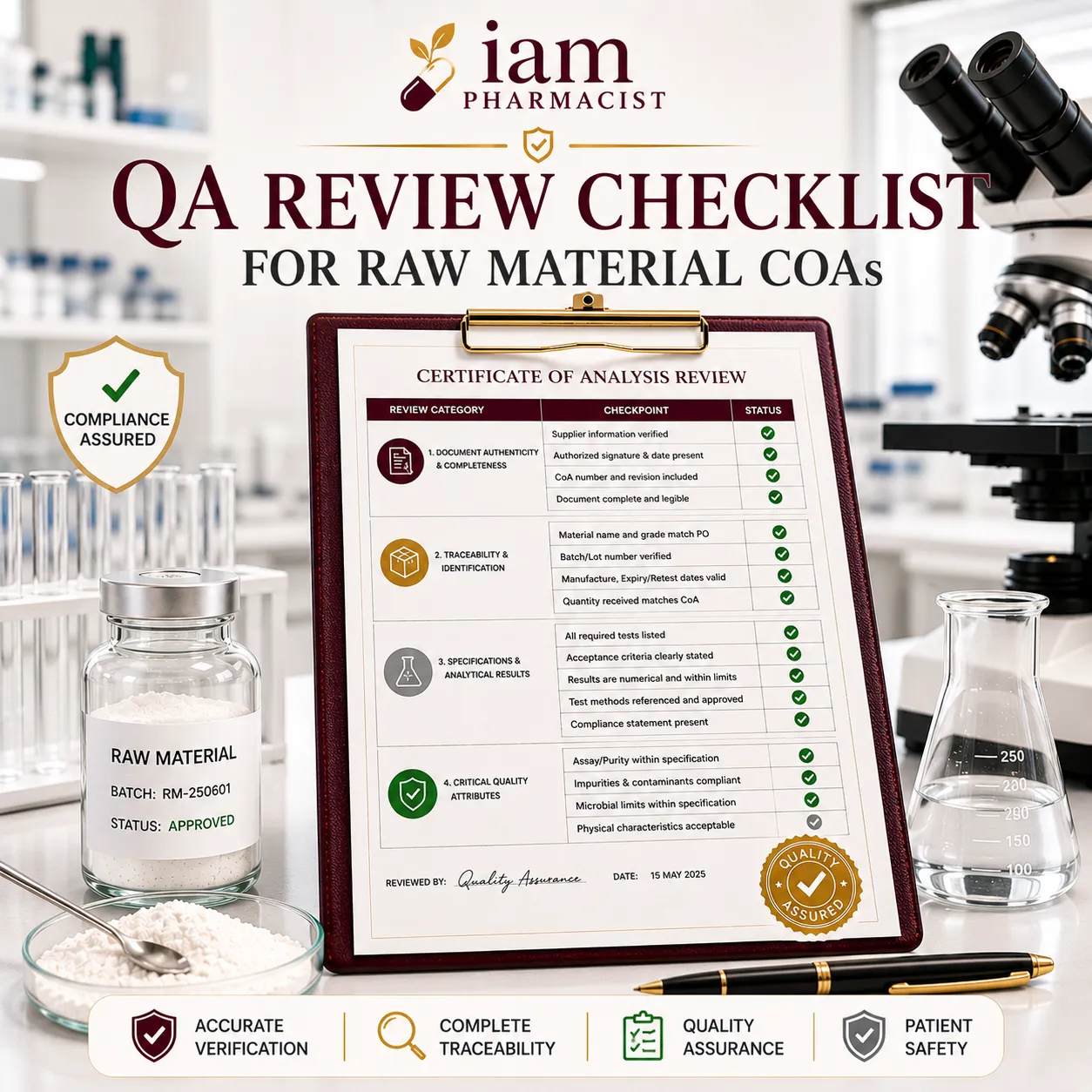

Learn how to perform a QA Review Checklist for Raw Material Certificates of Analysis with GMP-compliant checklists, traceability checks, and quality verification.
Definition
A QA Review Checklist for Raw Material Certificates of Analysis (CoAs) is a structured verification process used to confirm document authenticity, batch traceability, analytical compliance, and critical quality attributes before releasing raw materials for pharmaceutical manufacturing. Proper CoA review helps ensure GMP compliance, supplier reliability, and product quality.
Introduction
Raw materials form the foundation of pharmaceutical product quality. Even the most robust manufacturing process cannot compensate for poor-quality ingredients entering production. For this reason, Quality Assurance (QA) departments play a critical role in reviewing and approving raw material Certificates of Analysis (CoAs) before materials are released for use.
Regulatory agencies including the FDA, EMA, MHRA, WHO, and PIC/S authorities expect manufacturers to maintain effective incoming material control systems supported by documented CoA review procedures. During GMP inspections, auditors routinely evaluate whether companies verify supplier documentation, confirm traceability, review analytical results, and ensure compliance with approved specifications.
A comprehensive QA review checklist provides a standardized approach that reduces compliance risks, prevents material mix-ups, and strengthens supplier oversight.
This guide outlines a practical, GMP-compliant checklist that QA professionals can use when reviewing raw material CoAs.
Why QA Review of Raw Material CoAs Is Important
A thorough CoA review supports:
| Function | Importance |
|---|---|
| Material Release | Confirms suitability for use |
| Supplier Qualification | Verifies supplier reliability |
| GMP Compliance | Supports regulatory expectations |
| Product Quality | Prevents defective materials entering production |
| Traceability | Links material to batch records |
| Inspection Readiness | Demonstrates robust quality oversight |
Overview of the QA CoA Review Process
A complete review typically covers four key areas:
- Document Authenticity & Completeness
- Traceability & Product Identification
- Specifications & Analytical Results
- Critical Quality Attributes (CQAs)
Section 1: Document Authenticity and Completeness
Before evaluating analytical results, QA should confirm the CoA itself is legitimate and complete.
1. Supplier Information Verification
Verify that the CoA includes:
- Supplier name
- Manufacturing site
- Address
- Contact details
QA Review Questions
✔ Is the supplier on the Approved Vendor List (AVL)?
✔ Does the manufacturer match supplier qualification records?
2. Template Consistency
The document format should align with previously approved supplier templates.
Common Audit Findings
- Unauthorized template changes
- Missing sections
- Altered formats
3. Authorization Verification
The CoA should contain:
| Requirement | Verification |
|---|---|
| Signature | Present |
| Approval Date | Present |
| Authorized Representative | Identified |
| Electronic Approval | Validated if electronic |
GMP Expectation
The document should show evidence of QA/QC review before issuance.
4. Document Identification
Verify:
- CoA number
- Revision number
- Page numbering
- Issue date
Example
| Field | Example |
|---|---|
| CoA Number | COA-250604 |
| Revision | Rev. 01 |
| Pages | 1 of 2 |
Section 2: Traceability and Product Identification
Traceability is a key GMP requirement.
5. Material Name Verification
Ensure the material name matches:
- Purchase Order
- Internal Specification
- Supplier Documentation
Example
| Source | Material Name |
|---|---|
| Purchase Order | Lactose Monohydrate USP |
| CoA | Lactose Monohydrate USP |
6. Grade Verification
Confirm the correct grade:
- USP-NF
- Ph. Eur.
- BP
- JP
- Internal Grade
7. Batch/Lot Number Verification
Batch numbers must match across all records.
Compare Against
- Container labels
- Delivery notes
- Receiving records
- Warehouse system
Example
| Record | Lot Number |
|---|---|
| CoA | RM-250604 |
| Label | RM-250604 |
| Delivery Note | RM-250604 |
8. Date Verification
Review:
- Manufacturing Date
- Expiry Date
- Retest Date
QA Review Questions
✔ Is the material within shelf life?
✔ Is sufficient remaining shelf life available?
Section 3: Specifications and Analytical Results
Analytical review is the most critical part of the CoA assessment.
9. Parameter Alignment
Confirm all required tests appear on the CoA.
Examples
| Parameter | Required |
|---|---|
| Identification | Yes |
| Assay | Yes |
| Impurities | Yes |
| Water Content | Yes |
| Microbial Limits | When applicable |
10. Verify Actual Results
Regulators generally expect actual values rather than simple Pass/Fail statements.
Preferred Example
| Test | Specification | Result |
|---|---|---|
| Assay | 98.0–102.0% | 99.4% |
Less Desirable
| Test | Result |
|---|---|
| Assay | Pass |
Actual data provides stronger evidence of compliance.
11. Acceptance Criteria Verification
Ensure specification limits are clearly stated.
Example
| Test | Limit |
|---|---|
| Assay | 98.0–102.0% |
| Water Content | NMT 0.5% |
QA Review Questions
✔ Do limits match approved specifications?
✔ Are limits current and approved?
12. Analytical Method Verification
Review referenced methods.
Acceptable Examples
- USP
- EP
- BP
- JP
- Validated Internal Method
Example
| Test | Method |
|---|---|
| Assay | USP Monograph |
| Water Content | Karl Fischer |
13. Compliance Statement
The CoA should clearly state compliance status.
Example
“This batch complies with all approved specifications.”
Section 4: Critical Quality Attributes (CQAs)
The specific CQAs reviewed depend on the material type.
14. Purity and Assay
Verify potency or purity remains within approved limits.
Example
| Test | Specification | Result |
|---|---|---|
| Assay | 98.0–102.0% | 99.6% |
15. Impurities and Contaminants
Review:
- Heavy metals
- Residual solvents
- Organic impurities
- Inorganic impurities
Example
| Parameter | Limit | Result |
|---|---|---|
| Lead | NMT 0.5 ppm | 0.08 ppm |
16. Microbiological Limits
Important for:
- Excipients
- Natural products
- Biologically derived materials
Typical Parameters
| Test | Requirement |
|---|---|
| TAMC | Within limit |
| TYMC | Within limit |
| Pathogens | Absent |
17. Physical Characteristics
Review attributes such as:
| Characteristic | Importance |
|---|---|
| Appearance | Identity confirmation |
| Color | Consistency |
| Odor | Material verification |
| pH | Stability |
| Density | Processability |
| Viscosity | Product performance |
Comprehensive QA CoA Review Checklist
| Review Item | Verify |
|---|---|
| Supplier Approved | ✔ |
| CoA Authentic | ✔ |
| Signature Present | ✔ |
| Material Name Correct | ✔ |
| Grade Correct | ✔ |
| Batch Number Match | ✔ |
| Dates Acceptable | ✔ |
| Specifications Listed | ✔ |
| Actual Results Provided | ✔ |
| Methods Referenced | ✔ |
| Assay Within Limits | ✔ |
| Impurities Acceptable | ✔ |
| Microbial Limits Met | ✔ |
| Compliance Statement Present | ✔ |
| QA Approval Documented | ✔ |
Step-by-Step Guide to Reviewing a Raw Material CoA
Step 1: Verify Supplier Qualification
Confirm supplier remains approved.
Step 2: Confirm Document Authenticity
Review signatures, approvals, and document controls.
Step 3: Verify Material Identification
Check:
- Material name
- Grade
- Lot number
Step 4: Review Traceability Information
Match records against:
- Labels
- Delivery notes
- ERP records
Step 5: Evaluate Analytical Results
Review all critical parameters and specifications.
Step 6: Verify Regulatory Compliance
Confirm applicable pharmacopeial and regulatory declarations.
Step 7: Approve or Reject Material
Document QA disposition decision.
Practical Example: Raw Material CoA Review
Material
Magnesium Stearate NF
CoA Results
| Test | Specification | Result |
|---|---|---|
| Identification | Conforms | Conforms |
| Assay | 96.0–101.0% | 98.8% |
| Lead | NMT 0.5 ppm | 0.04 ppm |
| Water Content | NMT 5.0% | 1.8% |
| Microbial Limits | Complies | Complies |
QA Verification
✔ Supplier approved
✔ Batch number matched
✔ Specifications met
✔ CoA signed
✔ Material released
Common GMP Audit Findings Related to Raw Material CoAs
Inspectors frequently identify:
- Missing supplier qualification
- Missing signatures
- Incomplete specifications
- Lack of traceability
- Unsupported acceptance criteria
- Missing test methods
- Inadequate identity verification
GMP and Regulatory Insights
FDA Requirements
Under 21 CFR 211.84, manufacturers must:
- Verify supplier reliability
- Perform identity testing
- Review incoming material documentation
EU GMP Expectations
EU inspectors focus on:
- Supplier qualification
- Traceability
- Data integrity
- Material release controls
WHO GMP Expectations
WHO emphasizes:
- Documentation completeness
- Quality oversight
- Supplier accountability
Best Practices for QA Professionals
Use Standardized Review Checklists
Improve consistency across reviewers.
Verify Supplier Performance Periodically
Support ongoing supplier qualification.
Implement Electronic Review Workflows
Enhance traceability and efficiency.
Trend Supplier Quality Data
Identify emerging quality risks.
Conduct Internal Audits
Verify compliance before inspections.
FAQs
1. What is a QA review checklist for a CoA?
A QA review checklist is a structured process used to verify the authenticity, traceability, analytical results, and compliance status of a raw material CoA.
2. Why is CoA review important in pharmaceuticals?
It ensures raw materials meet quality standards before being released into manufacturing.
3. What should be verified first on a CoA?
Document authenticity, supplier information, signatures, and approval status.
4. Why are batch numbers important during CoA review?
They ensure traceability between the CoA, material labels, delivery notes, and warehouse records.
5. Should actual analytical results appear on a CoA?
Yes. Actual numerical results are preferred over generic pass/fail statements.
6. What are critical quality attributes in raw material CoAs?
Assay, impurities, microbial limits, water content, pH, density, viscosity, and appearance.
7. What regulations govern raw material CoA review?
FDA 21 CFR Part 211, EU GMP, WHO GMP, and ICH quality guidelines.
8. Can a material be released without QA review?
No. GMP systems require documented review and approval before release.
9. What are common CoA review deficiencies?
Missing signatures, incomplete specifications, traceability gaps, and unsupported acceptance criteria.
10. How can companies improve CoA review effectiveness?
By using standardized checklists, electronic review systems, supplier qualification programs, and periodic audits.