


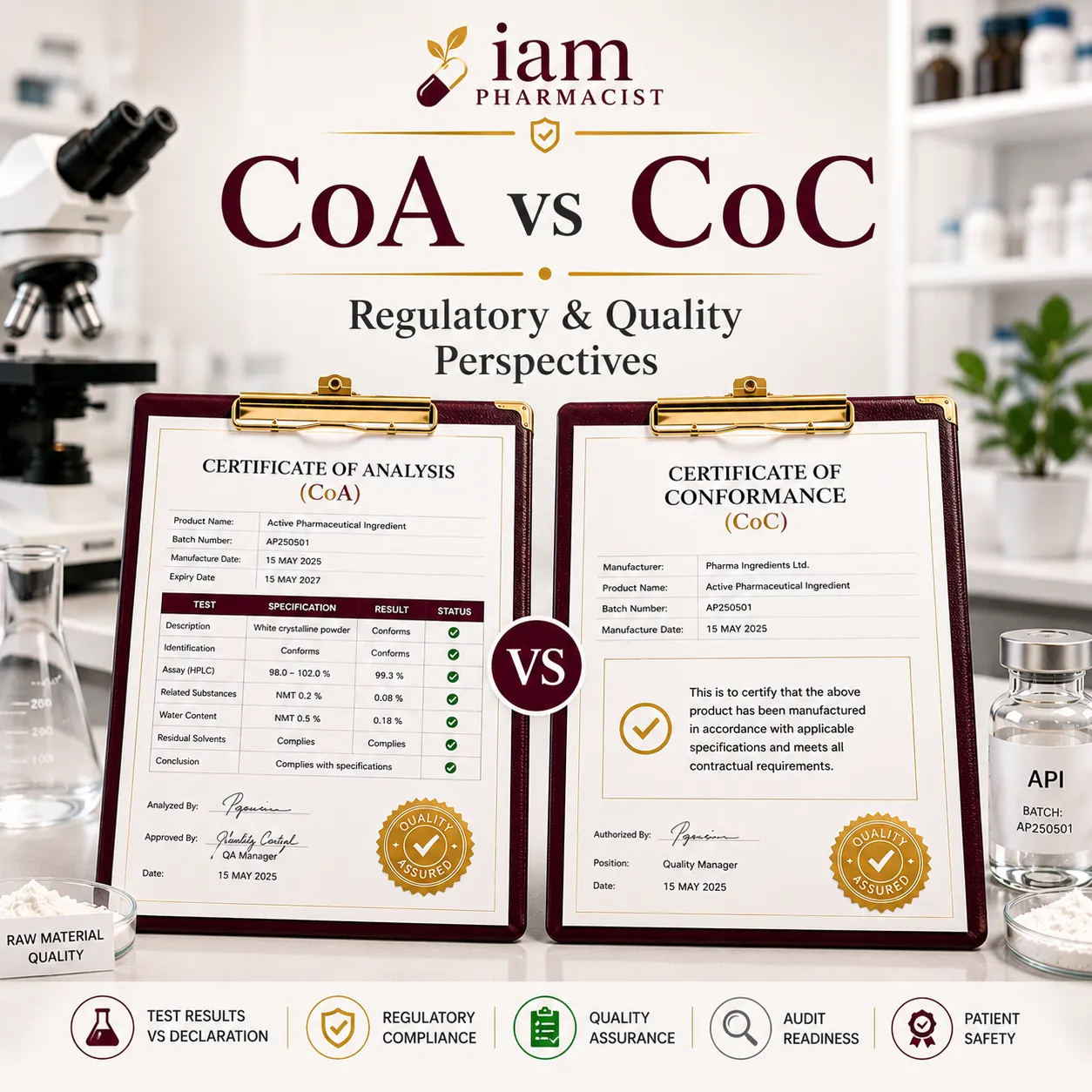

Learn the differences between Certificate of Analysis (CoA) vs Certificate of Conformance (CoC), including GMP requirements, regulatory expectations, and quality implications.
Definition
A Certificate of Analysis (CoA) is a batch-specific quality document containing actual analytical test results, acceptance criteria, and testing methods that demonstrate a material complies with specifications. A Certificate of Conformance (CoC) is a manufacturer’s declaration stating that a product meets predetermined requirements but typically does not include detailed laboratory test data. In pharmaceutical manufacturing, CoAs are generally required for GMP compliance, while CoCs are supplementary compliance documents.
Introduction
Manufacturers, suppliers, procurement teams, quality professionals, and regulators routinely encounter two seemingly similar documents: the Certificate of Analysis (CoA) and the Certificate of Conformance (CoC).
Although both documents support quality assurance and regulatory compliance, they serve fundamentally different purposes. Misunderstanding the distinction can lead to supplier qualification issues, audit observations, batch release delays, and regulatory non-compliance.
In pharmaceutical manufacturing, where patient safety depends on scientifically verified quality attributes, regulators expect objective evidence of identity, purity, potency, and quality. This is why a CoA often carries far greater regulatory significance than a CoC.
This article explains the differences between CoAs and CoCs from both quality and regulatory perspectives, helping pharmaceutical professionals determine when each document is appropriate.
What Is a Certificate of Analysis (CoA)?
A Certificate of Analysis is a batch-specific document that provides analytical evidence that a material meets approved specifications.
The document is generated after laboratory testing and includes actual test results.
Typical CoA Contents
| CoA Element | Description |
|---|---|
| Product Name | Material identification |
| Batch/Lot Number | Batch traceability |
| Manufacturing Date | Production date |
| Expiry/Retest Date | Stability information |
| Test Parameters | Quality attributes tested |
| Acceptance Criteria | Approved limits |
| Actual Results | Numerical or qualitative results |
| Analytical Methods | USP, EP, BP, JP, or validated methods |
| Approval Signature | QA/QC authorization |
Example
| Test | Specification | Result |
|---|---|---|
| Assay | 98.0–102.0% | 99.5% |
| Water Content | NMT 0.5% | 0.18% |
| Related Substances | NMT 0.2% | 0.08% |
The CoA demonstrates precisely how the material performed against specifications.
What Is a Certificate of Conformance (CoC)?
A Certificate of Conformance is a declaration issued by a manufacturer or supplier stating that a product conforms to agreed requirements.
Unlike a CoA, a CoC generally does not include detailed analytical results.
Typical CoC Contents
| CoC Element | Description |
|---|---|
| Product Name | Material identification |
| Part Number | Product reference |
| Batch Number | Manufacturing traceability |
| Compliance Statement | Declaration of conformity |
| Applicable Standards | ISO, ASTM, CE, etc. |
| Authorized Signature | Manufacturer approval |
Example Statement
“This product has been manufactured and inspected in accordance with applicable specifications and complies with all contractual requirements.”
No numerical laboratory data is typically provided.
CoA vs CoC: Side-by-Side Comparison
| Feature | Certificate of Analysis (CoA) | Certificate of Conformance (CoC) |
|---|---|---|
| Purpose | Demonstrates quality through testing | Declares compliance |
| Analytical Results | Included | Usually not included |
| Acceptance Criteria | Included | Usually omitted |
| Test Methods | Included | Rarely included |
| Batch-Specific Data | Extensive | Limited |
| Laboratory Involvement | Required | Not always required |
| GMP Relevance | High | Moderate |
| Regulatory Acceptance | Strong | Limited in pharma |
| Supplier Qualification Support | Strong | Limited |
| Batch Release Suitability | Yes | Usually No |
Why Pharmaceuticals Depend on CoAs
Pharmaceutical products directly impact patient health and safety.
Because of this, regulators require objective evidence—not simply declarations of compliance.
Regulatory Expectations
Authorities expect manufacturers to verify:
- Identity
- Purity
- Potency
- Strength
- Quality attributes
- Microbiological compliance
A CoA provides this evidence.
A CoC generally does not.
Regulatory Perspective: Certificate of Analysis
FDA Expectations
FDA regulations under 21 CFR Part 211 require scientifically supported testing records.
Key Requirements
- Batch-specific testing
- Supplier CoA verification
- Incoming material identity testing
- Traceability to raw data
Regulatory Significance
CoAs support:
✔ Raw material release
✔ API acceptance
✔ Finished product release
✔ Supplier qualification
✔ Inspection readiness
EU GMP Expectations
EU GMP requires:
- Analytical verification
- Traceability
- Data integrity
- Supplier qualification
Qualified Persons (QPs) rely heavily on CoAs during batch certification activities.
WHO GMP Expectations
WHO GMP emphasizes:
- Transparent reporting
- Test result traceability
- Laboratory accountability
- Batch-specific compliance documentation
Regulatory Perspective: Certificate of Conformance
CoCs play an important role in many industries.
Common Regulatory Uses
| Industry | Typical Use |
|---|---|
| Aerospace | Material compliance |
| Automotive | Component conformity |
| Electronics | Product certification |
| Industrial Manufacturing | Design compliance |
| Construction | Standards compliance |
CoCs often support:
- ISO compliance
- CE declarations
- Contractual requirements
- Trade regulations
Limitations of CoCs in Pharmaceuticals
A CoC generally lacks:
- Analytical results
- Test methods
- Acceptance criteria
- Scientific evidence
Therefore, it is rarely sufficient as the sole release document in GMP environments.
GMP Perspective: Why CoAs Carry Greater Weight
Quality Risk Management
Under ICH Q9, risk-based decisions require objective evidence.
CoA Provides
- Quantitative data
- Product-specific verification
- Scientific support
CoC Provides
- Compliance declaration only
For high-risk products, regulators prefer documented evidence over declarations.
Step-by-Step Guide: Determining Whether a CoA or CoC Is Needed
Step 1: Assess Product Risk
Ask:
- Does the product impact patient safety?
- Is it used in pharmaceutical manufacturing?
If yes, a CoA is generally required.
Step 2: Review Regulatory Requirements
Determine whether regulations require:
- Analytical testing
- Batch-specific documentation
- Supplier qualification evidence
Step 3: Evaluate Intended Use
CoA Typically Required For
- APIs
- Excipients
- Finished pharmaceuticals
- Food ingredients
- Biotechnology products
CoC Commonly Used For
- Packaging components
- Equipment parts
- Industrial materials
- Mechanical components
Step 4: Verify Supplier Documentation
Review:
- Test results
- Specifications
- Approval records
- Quality agreements
Step 5: Maintain Traceability
Ensure documentation supports:
- Batch investigations
- Recalls
- Audits
- Regulatory inspections
Practical Example 1: API Procurement
Scenario
A pharmaceutical manufacturer purchases an API.
Supplier Provides
Certificate of Conformance only.
Problem
The document states compliance but provides:
❌ No assay result
❌ No impurity data
❌ No identification results
Outcome
Material cannot be released solely on the basis of the CoC.
A CoA is required.
Practical Example 2: Equipment Spare Part
Scenario
A manufacturing site purchases a stainless-steel machine component.
Supplier Provides
Certificate of Conformance.
Outcome
The CoC confirms compliance with engineering specifications.
No analytical testing data is required.
The CoC is sufficient.
CoA and CoC in Supplier Qualification Programs
CoA Supports
| Activity | Supported |
|---|---|
| Reduced Testing Programs | Yes |
| Supplier Verification | Yes |
| Batch Release | Yes |
| Regulatory Audits | Yes |
CoC Supports
| Activity | Supported |
|---|---|
| Contract Compliance | Yes |
| Procurement Verification | Yes |
| Engineering Materials | Yes |
| Batch Release | Usually No |
Common Inspection Findings
Regulators frequently identify:
- Acceptance of CoCs instead of CoAs for critical materials
- Missing supplier testing records
- Inadequate supplier qualification
- Lack of incoming identity testing
- Incomplete traceability
These deficiencies can result in audit observations and warning letters.
Best Practices for Pharmaceutical Companies
Define Documentation Requirements
Specify when CoAs and CoCs are required.
Qualify Suppliers
Audit supplier quality systems regularly.
Verify Supplier CoAs
Perform identity testing and periodic verification.
Maintain Quality Agreements
Clarify documentation responsibilities.
Train Procurement Teams
Ensure personnel understand the difference between CoAs and CoCs.
FAQs
1. What is the difference between a CoA and a CoC?
A CoA contains actual analytical test results, while a CoC is a declaration that a product meets requirements without detailed test data.
2. Is a CoC acceptable for pharmaceutical batch release?
Generally no. Pharmaceutical batch release typically requires a CoA containing analytical results.
3. Why are CoAs important in GMP?
They provide documented evidence of identity, purity, potency, and compliance with specifications.
4. Can a CoC replace a CoA?
For most pharmaceutical materials, no. A CoC does not provide the detailed analytical evidence regulators expect.
5. Who issues a Certificate of Analysis?
A QC laboratory, QA department, contract laboratory, or qualified testing organization.
6. Who issues a Certificate of Conformance?
An authorized representative of the manufacturer or supplier.
7. Does FDA require CoAs?
FDA regulations require testing documentation and verification of material quality, which is typically provided through CoAs.
8. Which industries commonly use CoCs?
Aerospace, automotive, electronics, industrial manufacturing, and construction sectors.
9. What information should be included in a CoA?
Batch number, specifications, test methods, analytical results, dates, and authorized signatures.
10. Why do audits focus on CoAs rather than CoCs?
Because CoAs provide objective analytical evidence supporting product quality and regulatory compliance.