


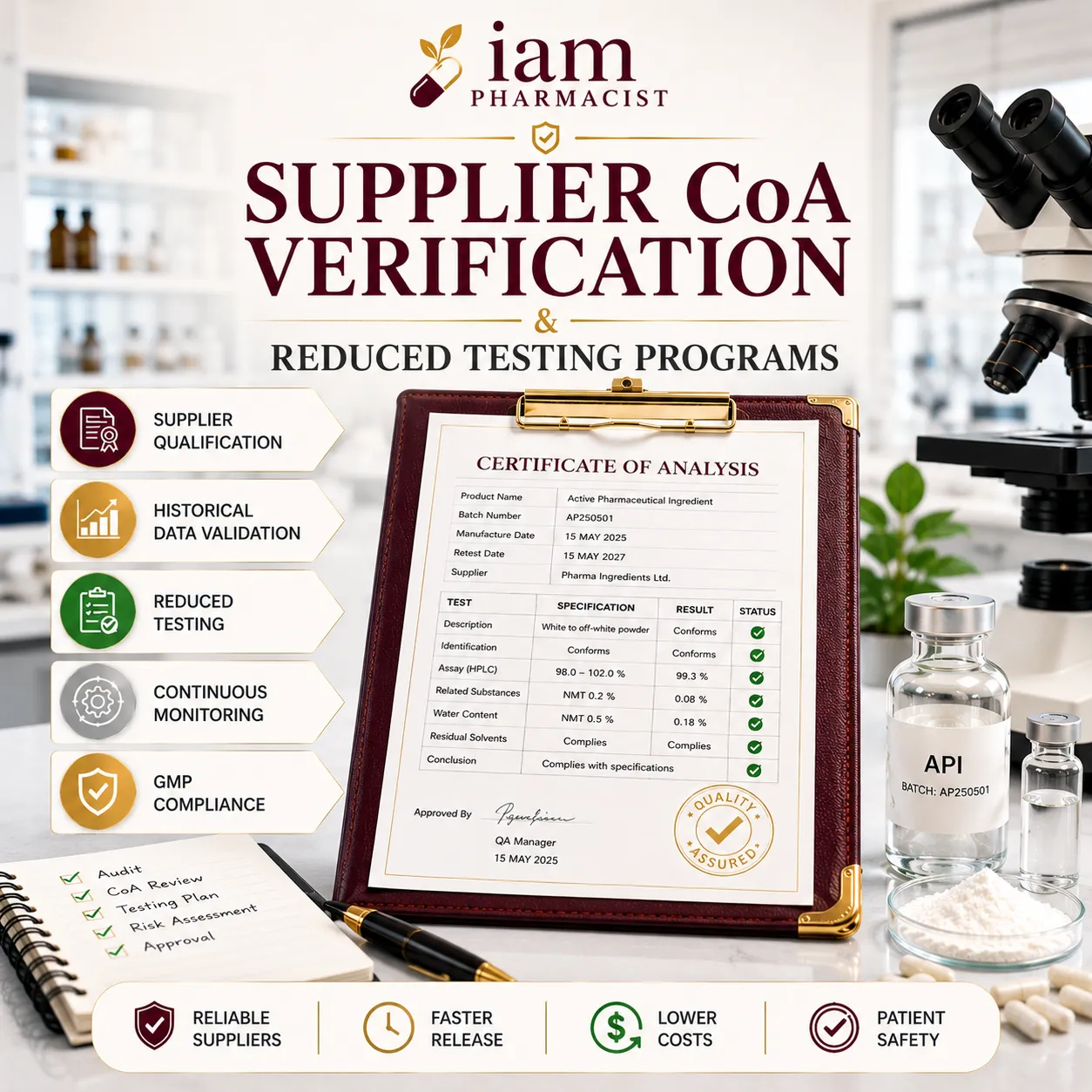

Learn how supplier CoA verification and reduced testing programs support GMP compliance, supplier qualification, risk management, and efficient material release.
Definition
Supplier CoA verification is the process of confirming the accuracy, reliability, and compliance of a supplier’s Certificate of Analysis before relying on its test results. Reduced testing programs, also known as skip-lot testing, allow pharmaceutical manufacturers to decrease incoming material testing after establishing supplier reliability through qualification, historical performance data, and periodic re-verification in accordance with GMP requirements.
Introduction
Pharmaceutical manufacturers routinely receive thousands of batches of raw materials, active pharmaceutical ingredients (APIs), excipients, and packaging components from approved suppliers. Performing complete release testing on every incoming lot can be costly, time-consuming, and resource-intensive.
To improve efficiency while maintaining compliance, regulators permit the use of supplier Certificate of Analysis (CoA) verification programs and reduced testing strategies. These programs allow manufacturers to rely on qualified suppliers’ analytical results instead of performing full testing on every lot.
However, reduced testing is not a shortcut to compliance. Regulatory agencies such as the FDA, EMA, MHRA, WHO, and PIC/S authorities require manufacturers to scientifically demonstrate supplier reliability through audits, testing comparisons, quality agreements, and continuous monitoring.
This article explains how supplier CoA verification works, outlines regulatory expectations, and provides a practical framework for implementing reduced testing programs in pharmaceutical manufacturing.
What Is Supplier CoA Verification?
Supplier CoA verification is the systematic process of evaluating and confirming that a supplier’s analytical results are accurate, reliable, and consistent with the receiving site’s quality requirements.
The objective is to determine whether the manufacturer can reasonably rely on the supplier’s test results for material release decisions.
Verification typically includes:
- Supplier qualification audits
- Comparative laboratory testing
- Quality agreements
- Historical performance review
- Ongoing supplier monitoring
What Is a Reduced Testing Program?
A reduced testing program allows a pharmaceutical manufacturer to decrease the scope or frequency of incoming material testing after establishing confidence in the supplier’s analytical controls.
Common terms include:
| Term | Meaning |
|---|---|
| Reduced Testing | Testing fewer attributes |
| Skip-Lot Testing | Testing selected lots only |
| Reduced Sampling | Fewer samples collected |
| Supplier Certification Program | Reliance on approved supplier data |
Reduced testing does not eliminate all testing requirements.
Regulatory Basis for Reduced Testing
FDA Requirements
The primary FDA requirement is:
21 CFR 211.84(d)(2)
FDA permits reduced testing when:
- Supplier reliability has been established
- Appropriate validation studies are completed
- Supplier performance is continuously monitored
Critical FDA Requirement
Under 21 CFR 211.84(d)(1):
At least one specific identity test must be performed on every incoming lot of a component.
This requirement applies even when reduced testing programs are implemented.
ICH Guidelines
ICH Q9 – Quality Risk Management
ICH Q9 supports risk-based decisions regarding:
- Supplier qualification
- Testing frequency
- Material criticality
- Supply chain risks
ICH Q10 – Pharmaceutical Quality System
ICH Q10 encourages lifecycle approaches that integrate:
- Supplier management
- Risk assessment
- Continuous improvement
- Performance monitoring
Why Companies Implement Reduced Testing Programs
Benefits
| Benefit | Impact |
|---|---|
| Lower Laboratory Costs | Reduced testing expenses |
| Faster Material Release | Shorter lead times |
| Improved Efficiency | Better resource utilization |
| Reduced Laboratory Workload | Increased productivity |
| Enhanced Supply Chain Performance | Faster manufacturing response |
However, benefits must never compromise patient safety or GMP compliance.
Supplier Qualification: The Foundation of Reduced Testing
Before reduced testing can be considered, the supplier must be formally qualified.
Supplier Qualification Activities
Quality Audit
Evaluate:
- GMP compliance
- Laboratory controls
- Data integrity systems
- Testing procedures
Quality Agreement
A formal agreement should define:
| Requirement | Description |
|---|---|
| Change Notification | Supplier responsibilities |
| Testing Requirements | Analytical expectations |
| Documentation Controls | Record management |
| Deviation Reporting | Investigation obligations |
Supplier Risk Assessment
Consider:
- Material criticality
- Supply history
- Regulatory inspection history
- Product impact
Historical Data Validation: The 3–5 Lot Rule
A common industry practice is the 3–5 Lot Verification Rule.
How It Works
The manufacturer performs full testing on multiple consecutive lots and compares results against the supplier CoA.
Example
| Lot | Supplier Assay | Internal Assay |
|---|---|---|
| Lot 1 | 99.6% | 99.5% |
| Lot 2 | 99.4% | 99.3% |
| Lot 3 | 99.8% | 99.7% |
| Lot 4 | 99.5% | 99.4% |
| Lot 5 | 99.7% | 99.6% |
If results consistently match within acceptable variability, supplier reliability may be established.
Required Elements of an Acceptable Supplier CoA
A compliant CoA should contain complete analytical information.
Mandatory CoA Components
| Element | Requirement |
|---|---|
| Manufacturer Name | Required |
| Manufacturer Address | Required |
| Material Name | Required |
| Batch/Lot Number | Required |
| Manufacturing Date | Required |
| Expiry or Retest Date | Required |
| Specifications | Required |
| Actual Results | Required |
| Test Methods | Required |
| Authorized Signature | Required |
CoA vs Certificate of Conformance (CoC)
| Feature | CoA | CoC |
|---|---|---|
| Actual Results | Yes | No |
| Numerical Data | Yes | No |
| Acceptance Criteria | Yes | Usually No |
| Suitable for Reduced Testing | Yes | No |
A Certificate of Conformance alone is generally insufficient for reduced testing programs.
Step-by-Step Guide to Implementing a Reduced Testing Program
Step 1: Identify Candidate Materials
Suitable candidates may include:
- Established excipients
- Low-risk raw materials
- Consistently performing suppliers
Avoid critical materials initially.
Step 2: Conduct Supplier Qualification
Complete:
- Supplier audits
- Quality agreements
- Risk assessments
Step 3: Verify Multiple Lots
Perform full testing on:
- 3 to 5 consecutive lots
- All specification attributes
Compare results against supplier CoAs.
Step 4: Evaluate Data Trends
Assess:
- Assay consistency
- Impurity profiles
- Historical deviations
- OOS trends
Step 5: Approve Reduced Testing
Define:
- Tests to retain
- Testing frequency
- Re-verification schedule
Step 6: Continue Identity Testing
Perform identity testing on every incoming lot.
This remains mandatory under FDA regulations.
Step 7: Periodically Re-Verify
Conduct periodic full testing such as:
| Verification Frequency | Example |
|---|---|
| Every 5th Lot | Common |
| Every 10th Lot | Low-risk materials |
| Annual Verification | Established suppliers |
Continuous Monitoring Requirements
Reduced testing programs require ongoing oversight.
QC Trending Activities
Monitor:
- Assay trends
- Impurity trends
- OOS results
- Supplier changes
- Complaint data
Trigger Events for Review
| Event | Action |
|---|---|
| OOS Result | Suspend reduced testing |
| Supplier Change | Requalification |
| Process Change | Revalidation |
| Regulatory Finding | Risk reassessment |
Materials Commonly Excluded from Reduced Testing
Not all materials are appropriate candidates.
Frequently Excluded Materials
High-Risk APIs
- Potent compounds
- Narrow therapeutic index products
Unstable Materials
- Moisture-sensitive APIs
- Temperature-sensitive ingredients
New Suppliers
- Limited performance history
Certain Market Requirements
Some international regulations may require:
- Full incoming testing
- Additional verification
Practical Example: Excipient Reduced Testing Program
Scenario
A pharmaceutical manufacturer receives microcrystalline cellulose from a long-term supplier.
Qualification Activities
✔ Supplier audited
✔ Quality agreement signed
✔ Five lots fully tested
✔ Results matched supplier CoAs
Reduced Testing Program
| Test | Frequency |
|---|---|
| Identity | Every Lot |
| Assay | Every 5th Lot |
| Moisture | Every 5th Lot |
| Microbial Limits | Annually |
Outcome
Reduced laboratory workload while maintaining GMP compliance.
Common GMP Inspection Findings
Regulators frequently identify:
- No supplier qualification
- Missing verification studies
- Lack of identity testing
- Unsupported reduced testing
- Poor supplier monitoring
- Missing quality agreements
- Failure to trend supplier performance
GMP and Regulatory Insights
FDA Focus
Inspectors evaluate:
- Supplier qualification records
- Identity testing compliance
- Verification studies
- Testing justifications
EU GMP Focus
EU inspectors emphasize:
- Supplier oversight
- Risk management
- Data integrity
- Traceability
WHO GMP Focus
WHO expectations include:
- Documented qualification
- Analytical reliability
- Ongoing supplier evaluation
Best Practices for Successful Reduced Testing Programs
Establish Formal Supplier Qualification Procedures
Audit suppliers regularly.
Use Risk-Based Decision Making
Apply ICH Q9 principles.
Maintain Quality Agreements
Clearly define responsibilities.
Trend Supplier Performance
Monitor ongoing reliability.
Perform Periodic Re-Verification
Never assume supplier performance remains constant.
Document Scientific Justification
Maintain inspection-ready evidence.
FAQs
1. What is supplier CoA verification?
Supplier CoA verification confirms that a supplier’s analytical results are reliable and suitable for material release decisions.
2. What is a reduced testing program in pharmaceuticals?
A reduced testing program allows manufacturers to decrease incoming material testing after establishing supplier reliability.
3. Does FDA allow reduced testing programs?
Yes. FDA permits reduced testing under 21 CFR 211.84(d)(2) when supplier reliability has been demonstrated.
4. Is identity testing still required during reduced testing?
Yes. FDA requires at least one specific identity test on every incoming lot.
5. What is the 3–5 lot verification rule?
It is a common industry practice where multiple lots are fully tested and compared to supplier CoAs to establish reliability.
6. What documents support supplier qualification?
Supplier audits, quality agreements, risk assessments, and historical performance records.
7. Can a Certificate of Conformance replace a CoA?
Generally no. A CoC lacks detailed analytical results required for verification programs.
8. How often should suppliers be re-verified?
Companies commonly perform verification every 5th to 10th lot or annually based on risk.
9. Which ICH guidelines support reduced testing?
ICH Q9 (Quality Risk Management) and ICH Q10 (Pharmaceutical Quality System).
10. What triggers suspension of a reduced testing program?
OOS results, supplier changes, process modifications, quality issues, or regulatory concerns.