


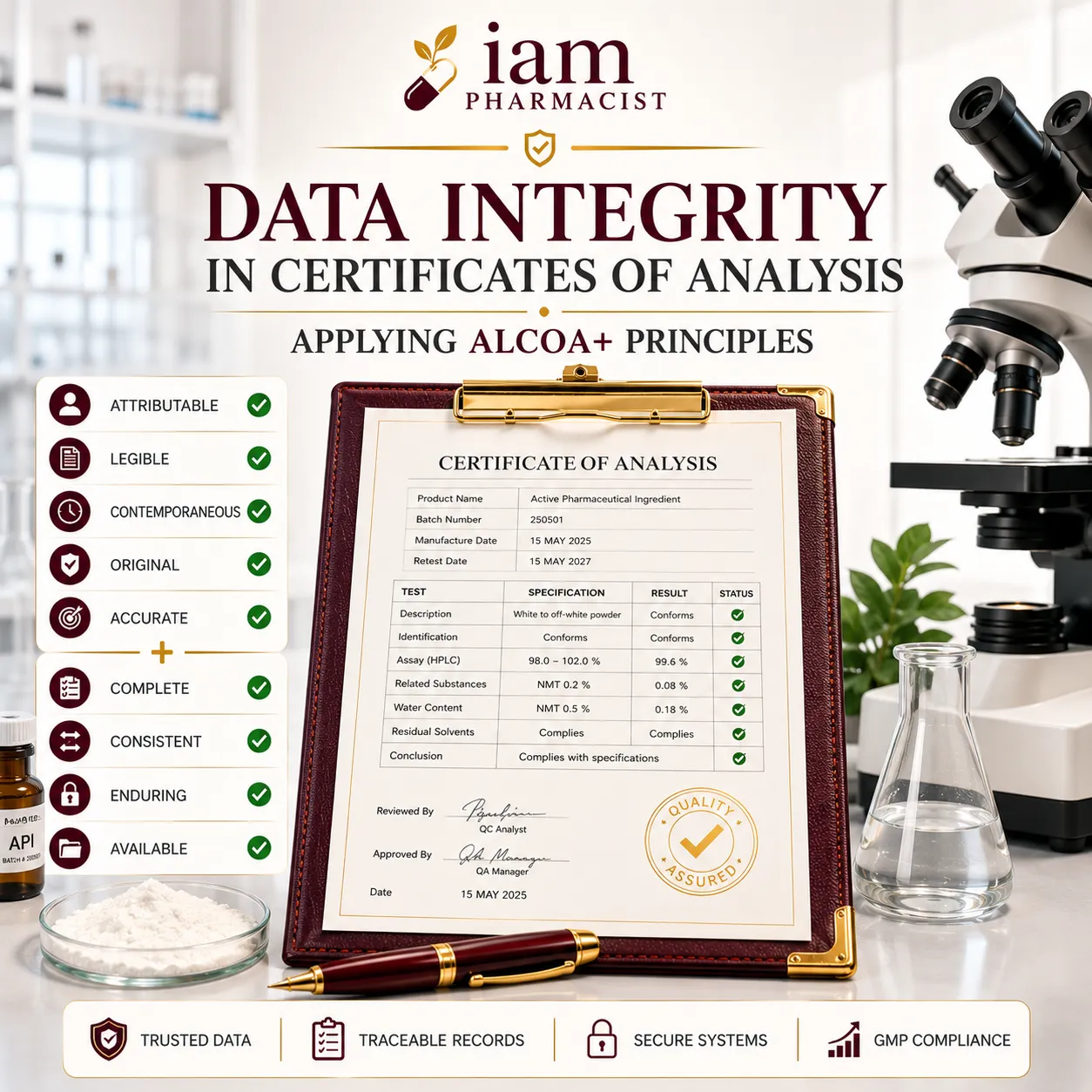

Learn how ALCOA+ principles ensure data integrity in Certificates of Analysis (CoAs), supporting GMP compliance, traceability, and regulatory readiness.
Definition
Data integrity in Certificates of Analysis (CoAs) refers to ensuring that all quality, safety, purity, and potency data are complete, accurate, traceable, and reliable throughout the record lifecycle. The pharmaceutical industry applies ALCOA+ principles—Attributable, Legible, Contemporaneous, Original, Accurate, Complete, Consistent, Enduring, and Available—to maintain GMP compliance and regulatory trust in CoA records.
Introduction
A Certificate of Analysis (CoA) is the final quality document used to demonstrate that a pharmaceutical material or finished product meets predefined specifications. Because release decisions, regulatory submissions, supplier approvals, and customer acceptance often depend on CoAs, regulators expect the underlying data to be trustworthy and fully traceable.
In recent years, FDA Warning Letters, MHRA inspection findings, and EU GMP observations have increasingly focused on data integrity failures. Missing records, altered results, poor audit trails, and undocumented changes can undermine confidence in a CoA and potentially lead to product recalls, import alerts, or regulatory enforcement actions.
To address these risks, global regulators promote the application of ALCOA+ principles, a framework that transforms CoAs from simple test reports into defensible, inspection-ready quality records.
This guide explains how pharmaceutical companies can apply ALCOA+ principles to Certificates of Analysis and strengthen GMP compliance.
What Is Data Integrity in a Certificate of Analysis?
Data integrity refers to the completeness, consistency, accuracy, and reliability of information throughout its lifecycle.
For a CoA, data integrity ensures that:
- Test results reflect actual laboratory findings
- Records are traceable to original data
- Results have not been altered or manipulated
- Approval decisions are properly documented
- Information remains available throughout retention periods
A CoA is only as reliable as the underlying laboratory data supporting it.
Why Data Integrity Matters for CoAs
Regulatory Perspective
Regulatory agencies rely heavily on CoAs to assess product quality.
Data integrity failures can result in:
| Consequence | Impact |
|---|---|
| FDA Form 483 Observations | Regulatory action |
| Warning Letters | Compliance risk |
| Product Recalls | Business disruption |
| Import Alerts | Supply chain impact |
| Batch Rejection | Financial loss |
| Customer Complaints | Reputation damage |
Understanding ALCOA+ Principles
ALCOA+ is the globally recognized framework for pharmaceutical data integrity.
ALCOA+ Overview
| Principle | Meaning |
|---|---|
| Attributable | Action linked to an individual |
| Legible | Readable and understandable |
| Contemporaneous | Recorded at the time performed |
| Original | First-capture data or true copy |
| Accurate | Correct and error-free |
| Complete | Includes all relevant information |
| Consistent | Chronological and logical |
| Enduring | Permanently retained |
| Available | Accessible when needed |
Applying ALCOA+ Principles to Certificates of Analysis
1. Attributable
Definition
Every activity must be traceable to the person who performed it.
CoA Application
Each test result should identify:
- Analyst name
- Reviewer name
- Approver name
- Date and time of activity
Examples
Compliant
| Test | Analyst |
|---|---|
| Assay | J. Smith |
| Impurities | A. Khan |
Non-Compliant
| Test | Analyst |
|---|---|
| Assay | Not recorded |
Best Practice
Use:
- Unique user IDs
- Electronic signatures
- Controlled access systems
2. Legible
Definition
Data must be readable and understandable throughout its retention period.
Common Issues
- Illegible handwriting
- Faded records
- Corrupted electronic files
- Missing metadata
Best Practices
✔ Controlled forms
✔ Electronic records
✔ Standardized templates
✔ Document preservation procedures
3. Contemporaneous
Definition
Data must be recorded at the time the activity occurs.
Example
Acceptable
Analyst records assay result immediately after instrument completion.
Unacceptable
Analyst enters results several days later from memory.
Regulatory Concern
Retrospective entries often raise concerns regarding data reliability.
4. Original
Definition
Records must represent the original observation or a verified true copy.
CoA Application
Original records include:
- Chromatograms
- Instrument printouts
- Electronic raw data
- Laboratory worksheets
Common Deficiencies
| Finding | Risk |
|---|---|
| Missing raw data | High |
| Uncontrolled copies | High |
| Manual transcription without verification | High |
5. Accurate
Definition
Data must be truthful, scientifically valid, and error-free.
Controls Supporting Accuracy
- Instrument calibration
- System suitability testing
- Analyst training
- Calculation verification
Example
Assay Specification:
98.0–102.0%
Actual Result:
99.4%
The result must accurately reflect the analytical output without manipulation.
The “+” Principles
6. Complete
Definition
All relevant information must be retained.
CoA Requirements
Include:
- Passing results
- Failed results
- Retests
- Deviations
- OOS investigations
- Metadata
Common Audit Finding
Companies sometimes retain only passing results while excluding failed analyses.
This violates ALCOA+ expectations.
7. Consistent
Definition
Records should follow logical and chronological order.
Example
| Activity | Date |
|---|---|
| Sampling | 05-May |
| Testing | 06-May |
| Review | 07-May |
| Approval | 08-May |
Any deviation from logical sequence requires justification.
8. Enduring
Definition
Data must remain preserved throughout the retention period.
Acceptable Storage
| Medium | Suitable |
|---|---|
| Validated LIMS | Yes |
| Secure Servers | Yes |
| Controlled Archives | Yes |
| Temporary Notes | No |
GMP Expectation
Records should remain accessible throughout the product lifecycle.
9. Available
Definition
Data must be retrievable whenever required.
Regulatory Expectations
Data should be accessible for:
- GMP inspections
- Customer audits
- Investigations
- Product complaints
- Recalls
ALCOA+ and Electronic Certificates of Analysis (eCoAs)
Modern pharmaceutical companies increasingly use:
- LIMS
- Electronic Laboratory Notebooks (ELNs)
- Chromatography Data Systems (CDS)
- Electronic CoAs (eCoAs)
These systems help enforce ALCOA+ principles through:
| Feature | Benefit |
|---|---|
| Audit Trails | Traceability |
| Electronic Signatures | Attribution |
| Automated Calculations | Accuracy |
| Access Controls | Security |
| Data Backups | Endurance |
Step-by-Step Guide: Applying ALCOA+ to CoA Management
Step 1: Establish Controlled Procedures
Develop SOPs covering:
- Testing
- Documentation
- Review
- Approval
Step 2: Utilize Validated Systems
Implement:
- LIMS
- CDS
- eQMS
Ensure systems meet:
- 21 CFR Part 11
- EU Annex 11
Step 3: Capture Data in Real Time
Record:
- Observations
- Results
- Deviations
Immediately when generated.
Step 4: Verify Original Records
Ensure:
- Raw data retained
- Audit trails active
- Copies controlled
Step 5: Conduct Independent Review
Review:
- Calculations
- Results
- Metadata
- Approval records
Step 6: Archive Securely
Store records in validated, retrievable systems.
Step 7: Periodically Audit Data Integrity
Perform internal audits focusing on:
- ALCOA+ compliance
- Traceability
- Electronic records
Practical Example: ALCOA+ Applied to a CoA
Scenario
A QC laboratory performs API testing.
Data Generated
| Test | Result |
|---|---|
| Assay | 99.6% |
| Water Content | 0.18% |
| Related Substances | 0.08% |
ALCOA+ Controls
| Principle | Application |
|---|---|
| Attributable | Analyst login captured |
| Legible | Electronic record generated |
| Contemporaneous | Results automatically recorded |
| Original | Raw chromatograms retained |
| Accurate | Verified calculations |
| Complete | All tests documented |
| Consistent | Chronological workflow |
| Enduring | Stored in validated LIMS |
| Available | Instantly retrievable |
Outcome
Inspection-ready, defensible CoA.
Common Data Integrity Deficiencies Found During Inspections
Regulators frequently identify:
| Observation | ALCOA+ Principle Violated |
|---|---|
| Missing signatures | Attributable |
| Illegible records | Legible |
| Backdated entries | Contemporaneous |
| Missing raw data | Original |
| Calculation errors | Accurate |
| Excluded failed tests | Complete |
| Date inconsistencies | Consistent |
| Lost records | Enduring |
| Unavailable records | Available |
GMP and Regulatory Expectations
FDA Expectations
FDA data integrity guidance emphasizes:
- Complete data lifecycle management
- Audit trail review
- Electronic record controls
EU GMP Expectations
EU GMP Annex 11 requires:
- Data security
- Electronic signature controls
- Audit trails
- System validation
WHO Expectations
WHO GMP promotes:
- Transparency
- Traceability
- Reliable documentation
Best Practices for Maintaining CoA Data Integrity
Implement ALCOA+ Training
Train QC and QA personnel regularly.
Review Audit Trails
Inspect electronic records routinely.
Strengthen Data Governance
Define ownership and accountability.
Use Validated Systems
Avoid uncontrolled spreadsheets.
Conduct Internal Audits
Identify issues before inspections.
Standardize CoA Templates
Reduce transcription risks.
FAQs
1. What is data integrity in a Certificate of Analysis?
Data integrity ensures CoA information is complete, accurate, traceable, and reliable throughout its lifecycle.
2. What does ALCOA+ stand for?
Attributable, Legible, Contemporaneous, Original, Accurate, Complete, Consistent, Enduring, and Available.
3. Why is ALCOA+ important for CoAs?
It ensures analytical results remain trustworthy and compliant with GMP requirements.
4. What is the most common data integrity issue in CoAs?
Missing raw data, incomplete records, and inadequate audit trails are frequently cited.
5. How does FDA assess CoA data integrity?
Through review of laboratory records, audit trails, electronic systems, and documentation practices.
6. Can electronic CoAs meet ALCOA+ requirements?
Yes, when supported by validated systems with audit trails and controlled access.
7. What is considered original data for a CoA?
Raw analytical records such as chromatograms, instrument outputs, and laboratory worksheets.
8. What happens if a CoA violates ALCOA+ principles?
Companies may face audit observations, warning letters, batch rejection, or regulatory enforcement.
9. Which GMP regulations support ALCOA+?
FDA Data Integrity Guidance, 21 CFR Part 11, EU GMP Annex 11, WHO GMP, and PIC/S guidance.
10. How can companies improve CoA data integrity?
By implementing validated systems, training personnel, reviewing audit trails, and conducting periodic data integrity audits.