


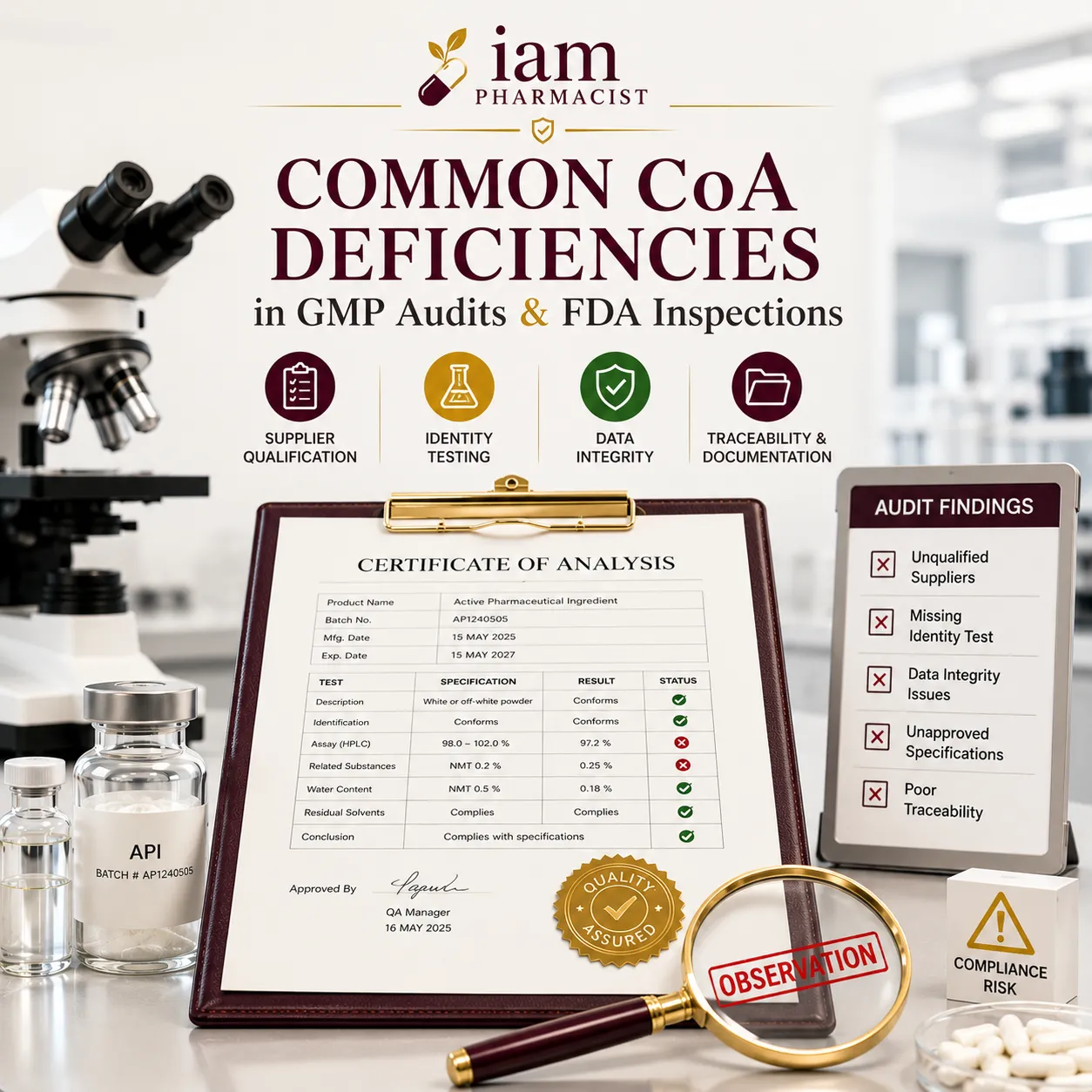

Discover common Certificate of Analysis (CoA) deficiencies cited during GMP audits and FDA inspections, including supplier qualification, testing, and data integrity issues.
Definition
Common Certificate of Analysis (CoA) deficiencies identified during GMP audits and FDA inspections include inadequate supplier qualification, failure to perform identity testing, poor data integrity controls, unapproved specifications, and missing traceability records. These deficiencies can lead to regulatory observations, warning letters, product recalls, and batch rejection.
Introduction
A Certificate of Analysis (CoA) is one of the most critical quality documents reviewed during GMP audits, FDA inspections, customer audits, and regulatory assessments. It provides documented evidence that raw materials, active pharmaceutical ingredients (APIs), excipients, packaging materials, and finished drug products meet approved quality specifications.
However, inspectors routinely identify deficiencies related to CoA management, supplier oversight, laboratory controls, and batch release procedures. Many of these observations stem from inadequate quality systems rather than isolated documentation errors.
Whether the inspection is conducted by the FDA, EMA, MHRA, WHO, PIC/S authorities, or customer auditors, the same question is asked:
“Can the company demonstrate that the material was properly tested, verified, reviewed, and approved before use or release?”
This article explores the most common CoA deficiencies cited during GMP audits and FDA inspections, explains the regulatory expectations behind them, and provides practical strategies for preventing observations.
Why CoAs Receive Significant Regulatory Attention
CoAs support critical GMP activities including:
| Function | Importance |
|---|---|
| Material Release | Confirms suitability for use |
| Batch Release | Supports product distribution |
| Supplier Qualification | Verifies vendor reliability |
| Traceability | Links testing to specific lots |
| Regulatory Compliance | Demonstrates GMP adherence |
| Data Integrity | Verifies authenticity of results |
Because release decisions depend heavily on CoAs, inspectors carefully review their accuracy, completeness, and traceability.
Overview of Common CoA Deficiencies
Top Audit Findings
| Deficiency Category | Regulatory Risk |
|---|---|
| Unqualified Suppliers | High |
| Missing Identity Testing | Critical |
| Data Integrity Issues | Critical |
| Unapproved Specifications | High |
| Missing Traceability | High |
| Incomplete Review Process | Major |
| Missing Signatures | Major |
| Unsupported Reduced Testing | Major |
Deficiency #1: Unqualified Suppliers and Blind Reliance on Vendor CoAs
The Problem
One of the most common FDA observations involves companies accepting supplier CoAs without independently verifying supplier reliability.
Many firms assume:
“The supplier tested it, so we don’t need to.”
Regulators strongly disagree.
Common Findings
- No supplier audits conducted
- No approved vendor list
- Missing quality agreements
- No supplier performance monitoring
- Blind acceptance of supplier CoAs
FDA Expectation
Under 21 CFR 211.84(d):
Manufacturers must establish the reliability of supplier test results before relying on supplier CoAs.
Inspection Example
Observation:
A manufacturer accepted API lots based solely on supplier CoAs without conducting supplier qualification audits or periodic verification testing.
Regulatory Impact:
FDA Form 483 observation issued.
Deficiency #2: Failure to Perform Identity Testing
The Problem
This remains one of the most frequently cited GMP violations.
FDA Requirement
Per 21 CFR 211.84(d)(1):
At least one specific identity test must be performed on every incoming lot of component material.
Common Deficiencies
| Finding | Risk |
|---|---|
| No identity testing | Critical |
| Reliance on supplier identity result | Critical |
| Incomplete testing records | Major |
| Unsupported testing exemptions | Major |
Example
Supplier CoA states:
Identification = Pass
Company performs no verification testing.
FDA inspectors determine no identity testing was performed internally.
Result:
✔ GMP violation
✔ Potential warning letter
Deficiency #3: Inadequate Justification for Reduced Testing
The Problem
Many companies reduce incoming material testing programs without sufficient scientific justification.
Regulatory Expectation
Reduced testing is permitted only when:
- Supplier reliability is established
- Historical data supports reduced frequency
- Periodic requalification occurs
- Risk assessments are documented
Common Audit Findings
- No risk assessment
- No statistical justification
- No supplier trend analysis
- No documented rationale
Deficiency #4: Data Integrity Issues
Why Inspectors Focus on Data Integrity
Regulators consider data integrity failures among the most serious GMP violations.
Common CoA Data Integrity Deficiencies
| Observation | Example |
|---|---|
| Missing results | Blank test fields |
| Altered entries | Overwritten values |
| Unauthorized changes | Untracked edits |
| Missing audit trails | No change history |
| Incomplete records | Missing raw data |
Red Flags
Inspectors frequently identify:
- Taped-over values
- White-out corrections
- Unexplained revisions
- Missing chromatograms
- Incomplete worksheets
Regulatory References
- FDA Data Integrity Guidance
- 21 CFR Part 11
- EU GMP Annex 11
- WHO Data Integrity Guidance
Deficiency #5: Failure to Investigate Discrepancies
The Problem
Supplier results do not match internal laboratory results, yet no investigation occurs.
Example
| Test | Supplier CoA | Internal Test |
|---|---|---|
| Assay | 99.8% | 97.4% |
The discrepancy exceeds expected variability.
However:
- No deviation raised
- No laboratory investigation
- No root cause analysis
Regulatory Concern
Inspectors view unexplained discrepancies as a major quality system weakness.
Deficiency #6: Vague or Unapproved Specifications
The Problem
Specifications reported on the CoA do not match approved quality standards.
Common Findings
- Limits differ from approved specifications
- Pharmacopoeial references outdated
- Internal standards not approved
- Acceptance criteria unsupported
Example
Approved Specification:
Assay = 98.0–102.0%
CoA Specification:
Assay = 95.0–105.0%
This inconsistency immediately raises compliance concerns.
Deficiency #7: Use of Unvalidated Analytical Methods
Regulatory Expectation
Methods used for release testing must be:
- Validated
- Qualified
- Scientifically justified
Common Audit Findings
| Finding | Impact |
|---|---|
| No validation report | High |
| Expired method version | Medium |
| Unapproved test procedure | High |
| Method transfer not documented | High |
Without validated methods, CoA results may not be scientifically defensible.
Deficiency #8: Missing Traceability
Why Traceability Matters
Inspectors must be able to trace every result back to:
- Raw data
- Laboratory records
- Specific batch
- Supplier lot
Common Traceability Issues
- Missing supplier lot numbers
- Missing internal lot numbers
- Unlinked laboratory records
- Incomplete receipt documentation
Example
Supplier Lot:
SUP-24015
Internal Lot:
RM-2025-0084
If no documented link exists between these identifiers, traceability is compromised.
Deficiency #9: Missing Review and Approval Signatures
The Problem
Some CoAs lack evidence of formal review before release.
Missing Elements
- Reviewer signature
- QA approval
- Approval date
- Electronic authorization
GMP Requirement
All CoAs should demonstrate:
✔ Technical review
✔ Quality review
✔ Authorized approval
Deficiency #10: Inadequate Batch Release Controls
The Problem
Materials are released before:
- CoA review completion
- OOS closure
- QA approval
Inspection Findings
| Deficiency | Risk |
|---|---|
| Premature release | Critical |
| Incomplete investigations | Critical |
| Missing QA disposition | Major |
These findings often trigger extensive regulatory scrutiny.
Step-by-Step Guide to Preventing CoA Deficiencies
Step 1: Qualify Suppliers
Establish:
- Vendor audits
- Quality agreements
- Performance reviews
Step 2: Perform Identity Testing
Conduct at least one specific identity test on every incoming component lot.
Step 3: Verify Data Integrity
Review:
- Audit trails
- Raw data
- Laboratory records
Step 4: Confirm Specifications
Ensure CoA limits match:
- Approved specifications
- Regulatory filings
- Pharmacopoeial standards
Step 5: Investigate Discrepancies
Initiate investigations for:
- OOS results
- OOT results
- Supplier differences
Step 6: Complete Quality Review
Verify:
- Data accuracy
- Documentation completeness
- Approval status
Step 7: Maintain Traceability
Ensure complete linkage between:
- Supplier lots
- Internal lots
- Laboratory records
- Released batches
Practical Audit Scenario
Observation
An excipient supplier provides a CoA indicating compliance.
The manufacturer:
- Performs no identity testing
- Has not audited the supplier
- Maintains no quality agreement
- Releases material directly to production
Inspector Finding
Violation of supplier qualification and incoming testing requirements.
Corrective Action
- Supplier audit completed
- Quality agreement established
- Identity testing implemented
- Vendor monitoring program initiated
GMP and Regulatory Insights
FDA Focus Areas
FDA inspectors commonly evaluate:
- Incoming material controls
- Supplier qualification
- Identity testing compliance
- Data integrity
EU GMP Focus Areas
EU inspectors emphasize:
- Supplier oversight
- Annex 11 compliance
- Traceability
- Batch certification support
WHO GMP Focus Areas
WHO inspections focus on:
- Documentation completeness
- Traceability
- Laboratory controls
- CoA authenticity
Best Practices for Inspection Readiness
Implement Robust Supplier Qualification
Audit suppliers regularly.
Strengthen Data Integrity Controls
Use validated computerized systems.
Standardize CoA Templates
Ensure consistency across products.
Conduct Internal Audits
Identify deficiencies before regulators do.
Train QA and QC Personnel
Maintain competency in GMP documentation.
Utilize Electronic Review Workflows
Reduce approval delays and transcription errors.
FAQs
1. What are the most common CoA deficiencies found during FDA inspections?
Supplier qualification failures, missing identity testing, data integrity issues, traceability gaps, and incomplete approvals.
2. Why does FDA require identity testing on every incoming lot?
To independently verify material identity and prevent reliance solely on supplier test results.
3. Can manufacturers rely entirely on supplier CoAs?
No. Supplier reliability must be qualified and verified through testing and oversight programs.
4. What is a data integrity issue on a CoA?
Missing results, altered values, incomplete records, unauthorized changes, or lack of audit trails.
5. What happens if supplier and internal test results differ?
The discrepancy must be investigated and documented before material release.
6. Why is supplier qualification important for CoA compliance?
It demonstrates confidence in supplier testing and supports reduced testing programs.
7. What traceability information should a CoA contain?
Product identification, batch numbers, supplier lot numbers, test methods, results, and approval records.
8. Are signatures required on CoAs?
Yes. CoAs should show evidence of technical review and authorized approval.
9. Can unvalidated methods be used for release testing?
No. Release testing methods must be validated and scientifically justified.
10. How can companies avoid CoA-related audit findings?
By implementing supplier qualification, identity testing, data integrity controls, traceability systems, and QA review processes.