


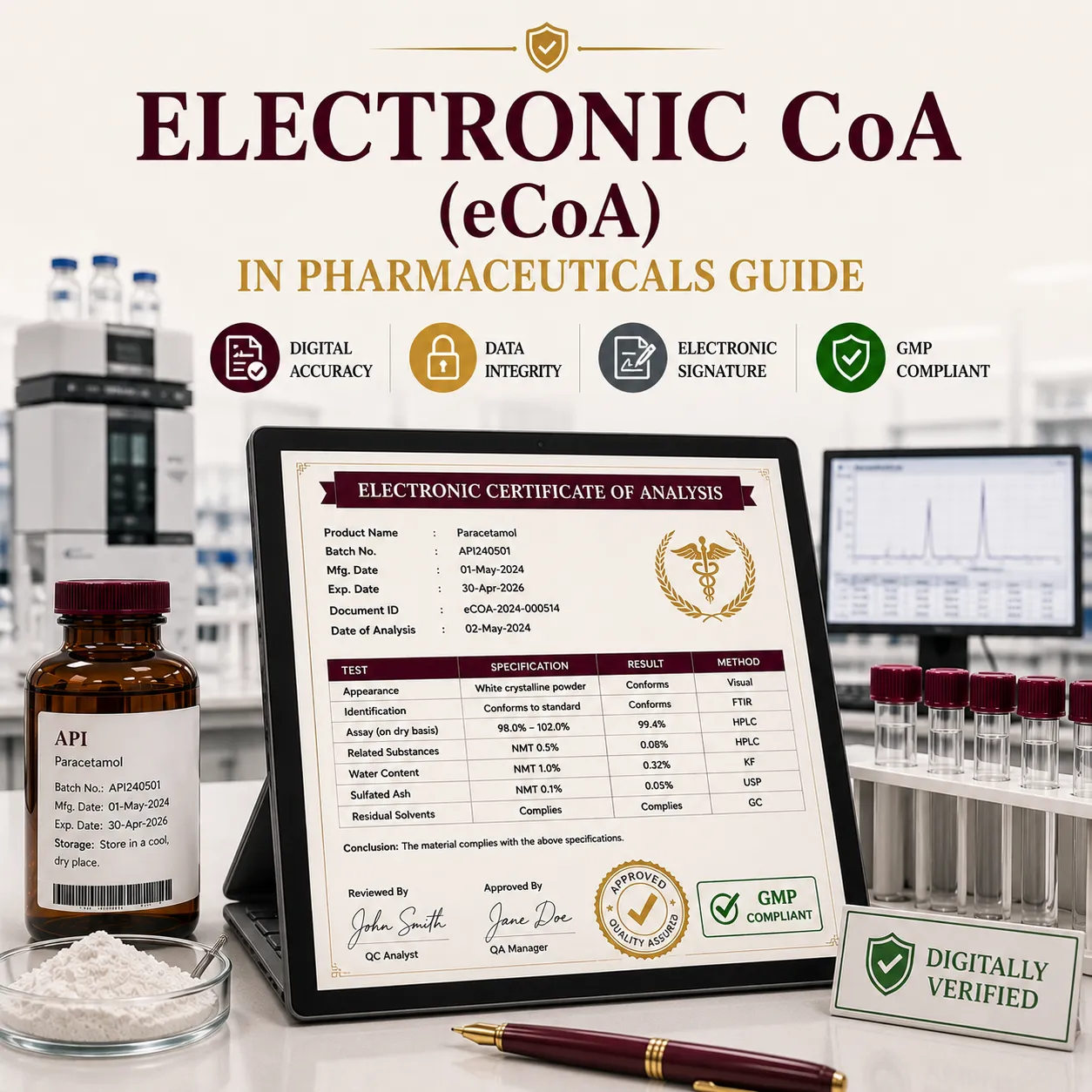

Learn how Electronic Certificates of Analysis (eCoA) improve GMP compliance, data integrity, traceability, and batch release efficiency in pharma.
Definition
An Electronic Certificate of Analysis (eCoA) is a digital version of a traditional Certificate of Analysis that automatically captures laboratory data, supports electronic signatures, maintains audit trails, and ensures regulatory compliance. eCoAs improve data integrity, traceability, and batch release efficiency in pharmaceutical manufacturing.
The pharmaceutical industry is undergoing a rapid digital transformation, driven by increasing regulatory expectations, data integrity requirements, and operational efficiency goals. One critical area experiencing significant modernization is the Certificate of Analysis (CoA) process.
Traditionally, CoAs were generated manually, reviewed on paper, and distributed as PDF documents. While functional, these methods are vulnerable to transcription errors, delayed approvals, document version issues, and compliance risks.
The Electronic Certificate of Analysis (eCoA) addresses these challenges by transforming a traditionally paper-based process into a secure, automated, and fully traceable digital workflow.
For Quality Assurance (QA), Quality Control (QC), Manufacturing, Regulatory Affairs, and Supply Chain professionals, eCoAs offer substantial advantages in compliance, efficiency, and risk management.
What Is an Electronic Certificate of Analysis (eCoA)?
An Electronic Certificate of Analysis (eCoA) is a digital, batch-specific quality document that certifies a material or finished product meets predefined specifications.
Like a traditional CoA, an eCoA contains:
- Product identification
- Batch information
- Analytical test results
- Acceptance criteria
- Test methods
- Compliance statement
- Authorized approval signatures
However, unlike paper-based systems, eCoAs are generated, approved, stored, and distributed electronically through validated digital platforms.
Traditional CoA vs Electronic CoA
| Feature | Traditional CoA | Electronic CoA (eCoA) |
|---|---|---|
| Data Entry | Manual | Automated |
| Signatures | Handwritten | Electronic |
| Audit Trail | Limited | Complete |
| Retrieval Time | Minutes to Hours | Instant |
| Error Risk | Higher | Lower |
| Regulatory Compliance | Manual Controls | Automated Controls |
| Integration | Limited | LIMS/ERP/QMS Integration |
The Shift Toward Digitalization
Pharmaceutical organizations increasingly adopt digital quality systems to improve compliance and operational efficiency.
The move from paper-based CoAs to eCoAs is typically enabled through:
- Laboratory Information Management Systems (LIMS)
- Enterprise Resource Planning (ERP) platforms
- Quality Management Systems (QMS)
- Electronic Document Management Systems (EDMS)
Single-Source Data Architecture
One major advantage of eCoAs is the elimination of duplicate data entry.
Traditional Process
- Analyst records results.
- Data entered into spreadsheets.
- Results manually transferred to CoA.
- Reviewer verifies information.
Each transfer introduces potential error.
eCoA Process
- Instrument generates results.
- Results transfer automatically into LIMS.
- eCoA populates automatically.
- Reviewer approves electronically.
This approach significantly reduces transcription mistakes.
Automated Workflow Management
Modern eCoA systems automate:
- Document generation
- Data population
- Approval routing
- Version control
- Distribution
Benefits
| Process | Manual CoA | eCoA |
|---|---|---|
| Document Creation | Manual | Automated |
| Approval Routing | Email/Paper | Workflow Engine |
| Record Retention | Filing Cabinets | Digital Archive |
| Distribution | Manual | Automated |
Regulatory Compliance Requirements
Electronic CoAs must satisfy the same regulatory requirements as paper documents while providing additional controls for data integrity.
FDA 21 CFR Part 11 Compliance
Part 11 governs:
- Electronic records
- Electronic signatures
- System validation
- Audit trails
Key Requirements
| Requirement | Purpose |
|---|---|
| Audit Trails | Record system activity |
| Access Controls | Prevent unauthorized access |
| Electronic Signatures | Verify approvals |
| Validation | Demonstrate system reliability |
Failure to comply can result in regulatory observations and warning letters.
Data Integrity and ALCOA+
eCoAs help support ALCOA+ principles:
- Attributable
- Legible
- Contemporaneous
- Original
- Accurate
- Complete
- Consistent
- Enduring
- Available
Automated systems significantly reduce risks associated with manual record handling.
GMP Compliance
eCoA systems support GMP requirements by ensuring:
- Controlled documentation
- Change management
- Version control
- Reviewer accountability
- Traceability
These capabilities improve inspection readiness and audit performance.
Enhanced Traceability and Batch Genealogy
Traceability is one of the strongest advantages of eCoA systems.
Modern platforms maintain links between:
- Raw materials
- Manufacturing batches
- Laboratory testing
- Product release decisions
- Distribution records
Example
| Data Point | Linked Information |
|---|---|
| API Batch | Supplier CoA |
| Manufacturing Batch | Production Record |
| Finished Product | Release CoA |
| Customer Shipment | Distribution Record |
This creates a complete digital chain of custody.
Accelerated Batch Release
Traditional batch release often involves:
- Printing documents
- Physical review
- Manual approvals
- Scanning and archiving
eCoA systems eliminate these bottlenecks.
Benefits
- Faster QA review
- Immediate approvals
- Real-time visibility
- Reduced lead times
Practical Example: eCoA Workflow
Traditional Process
| Activity | Time |
|---|---|
| Data Entry | 30 Minutes |
| Review | 20 Minutes |
| Printing & Filing | 15 Minutes |
| Distribution | 10 Minutes |
Total: 75 Minutes
eCoA Process
| Activity | Time |
|---|---|
| Automated Data Transfer | 1 Minute |
| Electronic Review | 10 Minutes |
| Digital Approval | 2 Minutes |
| Automated Distribution | 1 Minute |
Total: 14 Minutes
Reducing Supply Chain Errors
Incorrect CoAs frequently cause:
- Shipment delays
- Material rejection
- Customer complaints
- Regulatory concerns
Automated eCoA systems help ensure:
✔ Correct customer specifications
✔ Correct batch assignment
✔ Correct version control
✔ Controlled document distribution
Sustainability and Cost Savings
Organizations adopting eCoAs often achieve:
| Area | Benefit |
|---|---|
| Paper Usage | Reduced |
| Printing Costs | Reduced |
| Storage Costs | Reduced |
| Courier Costs | Reduced |
| Administrative Labor | Reduced |
Digital systems also support corporate sustainability initiatives.
Step-by-Step Guide: Implementing an eCoA Program
Step 1
Assess current CoA generation processes.
Step 2
Select a validated LIMS, QMS, or ERP platform.
Step 3
Define eCoA templates and workflows.
Step 4
Configure electronic signature controls.
Step 5
Validate the system according to GMP requirements.
Step 6
Train QA, QC, and manufacturing personnel.
Step 7
Perform pilot implementation.
Step 8
Monitor performance and compliance metrics.
Common Challenges During eCoA Implementation
| Challenge | Mitigation |
|---|---|
| Legacy Systems | Phased migration |
| User Resistance | Training programs |
| Validation Complexity | Risk-based validation |
| Data Migration | Controlled verification |
| Regulatory Concerns | Comprehensive documentation |
GMP and Regulatory Insights
FDA
Electronic records must comply with:
- 21 CFR Part 11
- 21 CFR Part 210
- 21 CFR Part 211
EU GMP Annex 11
Defines requirements for:
- Computerized systems
- Electronic records
- Data security
- System validation
ICH Guidelines
ICH Q9
Supports risk-based implementation strategies.
ICH Q10
Promotes continuous improvement within pharmaceutical quality systems.
FAQs
1. What is an Electronic Certificate of Analysis (eCoA)?
An eCoA is a digital version of a Certificate of Analysis generated, approved, and managed electronically.
2. How does an eCoA differ from a traditional CoA?
eCoAs use automated data capture, electronic signatures, and audit trails, while traditional CoAs rely on manual processes.
3. Is an eCoA legally acceptable?
Yes, when implemented in compliance with applicable regulations such as 21 CFR Part 11.
4. What systems generate eCoAs?
LIMS, ERP, QMS, and EDMS platforms commonly generate eCoAs.
5. How do eCoAs improve data integrity?
They reduce manual data entry and maintain secure audit trails.
6. What is the role of electronic signatures in eCoAs?
They provide authenticated approvals and accountability.
7. Are eCoAs compliant with GMP?
Yes, if the underlying systems are validated and properly controlled.
8. Can eCoAs support product recalls?
Yes, digital traceability enables rapid identification and retrieval of affected batches.
9. What is the biggest benefit of eCoAs?
Improved efficiency, traceability, and compliance.
10. How long should eCoAs be retained?
According to applicable GMP, regulatory, and company record retention requirements.