


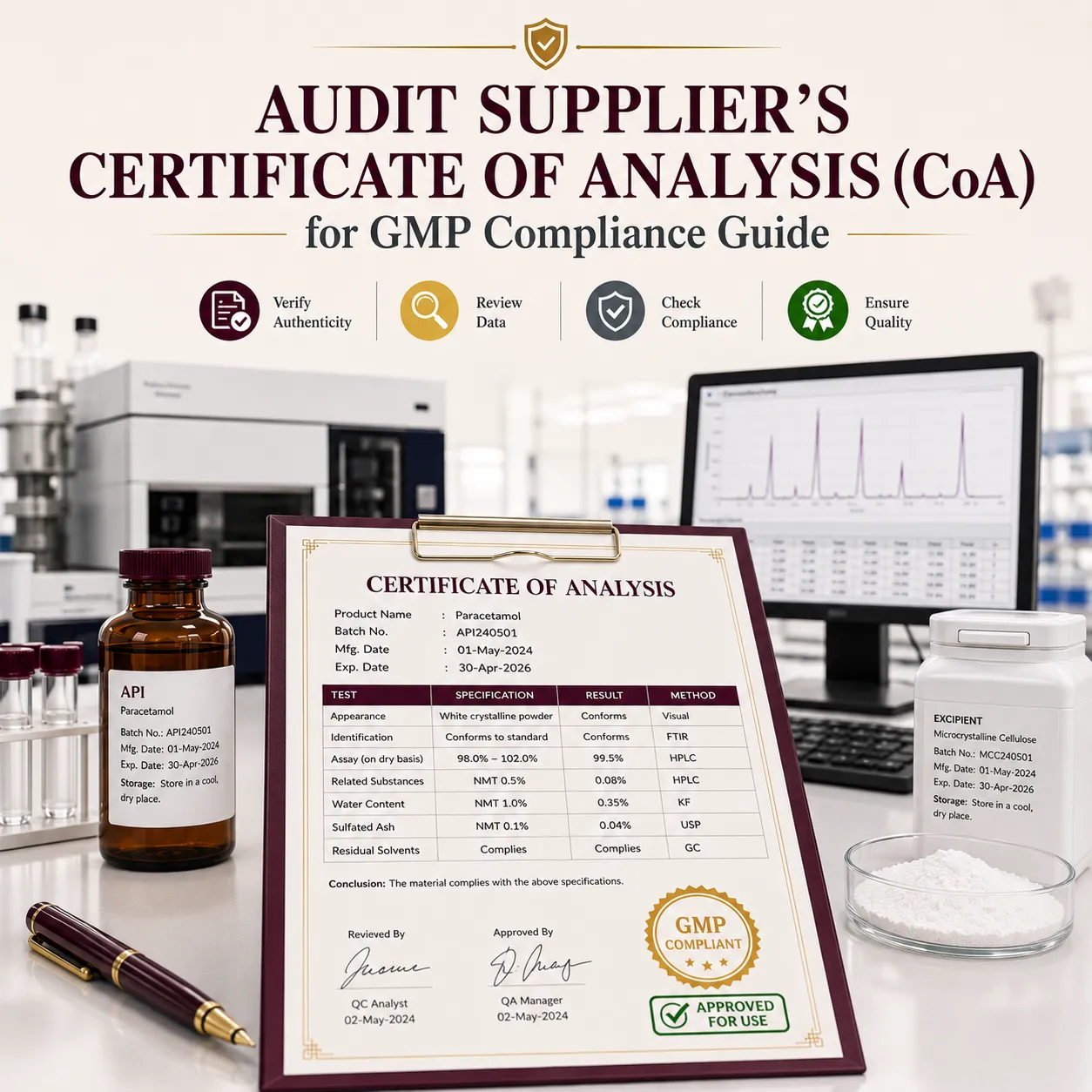

Learn how to audit supplier’s Certificate of Analysis (CoA) for GMP compliance, including traceability, specifications, data integrity, and QA review.
Definition
Auditing a supplier’s Certificate of Analysis (CoA) for GMP compliance involves verifying document authenticity, batch traceability, analytical results, testing methods, supply chain integrity, and supplier quality system controls. A successful CoA audit ensures incoming materials meet approved specifications and regulatory requirements before release for pharmaceutical manufacturing.
In pharmaceutical manufacturing, supplier-provided Certificates of Analysis (CoAs) are critical quality documents that support incoming material release decisions. However, GMP regulations require manufacturers to verify supplier data rather than blindly relying on supplier test results.
An effective supplier CoA audit helps Quality Assurance (QA), Quality Control (QC), Regulatory Affairs, and Supplier Quality teams ensure that raw materials, APIs, excipients, and packaging materials consistently meet predefined quality standards.
This guide explains the complete process for auditing a supplier’s Certificate of Analysis to ensure compliance with GMP, GDP, pharmacopoeial standards, and quality agreements.
Why Is Auditing a Supplier CoA Important?
A supplier CoA audit helps organizations:
- Verify authenticity of analytical data
- Confirm compliance with approved specifications
- Detect documentation deficiencies
- Strengthen supplier qualification programs
- Support risk-based material release decisions
- Reduce quality and regulatory risks
- Ensure patient safety
Regulatory agencies expect manufacturers to periodically verify supplier analytical data and maintain oversight of supplier quality systems.
Key GMP Requirements for Supplier CoA Audits
Several regulations support supplier CoA verification:
| Regulation | Relevance |
|---|---|
| 21 CFR Part 211 | Testing and release requirements |
| ICH Q7 | API quality systems and supplier controls |
| ICH Q9 | Risk-based decision making |
| ICH Q10 | Pharmaceutical Quality System |
| EU GMP Chapter 5 | Production and quality control |
| WHO GMP | Supplier qualification and material release |
Step 1: Verify Document Authenticity and Traceability
The first audit step is ensuring that the CoA is authentic and traceable to the material received.
Official Authorization
Every CoA should contain:
- Authorized reviewer name
- Signature
- Approval date
- Document identification number
What to Verify
| Requirement | Audit Check |
|---|---|
| Signature Present | Yes |
| Approval Date | Yes |
| Document Number | Yes |
| Authorized Signatory | Verified |
Data Integrity Consideration
Electronic signatures should comply with:
- 21 CFR Part 11
- ALCOA+ principles
- Audit trail requirements
Batch Number Verification
The batch number listed on the CoA must exactly match:
- Material container labels
- Shipping documents
- Purchase orders
- ERP records
Example
| Document | Batch Number |
|---|---|
| Supplier CoA | API240501 |
| Container Label | API240501 |
| Goods Receipt | API240501 |
All records must match.
Manufacturing and Expiry Date Review
Confirm:
- Manufacturing date
- Expiration date
- Retest date
- Shelf-life validity
Audit Objective
Ensure the material remains within its approved usage period.
Step 2: Audit Analytical Data and Specifications
The analytical section is the most critical part of the CoA audit.
Compare Against Approved Specifications
Supplier specifications should match or exceed the requirements defined in:
- Quality Agreements
- Technical Agreements
- Approved material specifications
Example Comparison
| Parameter | Internal Spec | Supplier Spec | Acceptable |
|---|---|---|---|
| Assay | 98–102% | 98–102% | Yes |
| Water Content | NMT 1.0% | NMT 1.0% | Yes |
| Impurity A | NMT 0.2% | NMT 0.5% | No |
If supplier specifications are less stringent, additional assessment is required.
Verify Actual Numerical Results
A GMP-compliant CoA should provide actual test values.
Preferred Reporting
✔ Assay = 99.5%
✔ Water Content = 0.35%
✔ Impurity A = 0.08%
Avoid
❌ Pass
❌ Meets Specification
❌ Conforms
Without numerical values, independent quality assessment becomes difficult.
Verify Analytical Methods
Testing methods should be clearly referenced.
Typical Methods
| Test | Method |
|---|---|
| Assay | HPLC |
| Identification | FTIR |
| Water Content | Karl Fischer |
| Residual Solvents | GC |
Methods should align with:
- USP
- EP
- BP
- JP
- Validated in-house procedures
Step 3: Evaluate Supply Chain Integrity
A CoA audit should confirm complete traceability throughout the supply chain.
Original Manufacturer Verification
When materials are purchased through distributors:
- Obtain original manufacturer CoA
- Verify manufacturer details
- Maintain full traceability
Risk
Distributor-generated CoAs without manufacturer references may compromise supply chain transparency.
GMP Compliance Statement
Review the document for statements such as:
“This material was manufactured and tested in accordance with current Good Manufacturing Practices (cGMP).”
Such statements support supplier quality commitments.
Step 4: Cross-Reference Supplier Audit Information
CoA review should be integrated with supplier qualification activities.
Outsourced Testing Verification
If testing is performed by a contract laboratory:
Verify:
- Laboratory approval status
- Quality agreement availability
- Supplier oversight program
Audit Question
Is the contract laboratory included in the supplier’s approved vendor management system?
OOS and Deviation Assessment
Review supplier quality history for:
- Out-of-Specification (OOS) results
- Major deviations
- Laboratory incidents
- CAPA activities
Audit Objective
Ensure there are no unresolved quality events affecting the batch.
Reprocessing and Rework Review
Determine whether the batch underwent:
- Reprocessing
- Rework
- Additional purification
- Corrective manufacturing activities
All activities should be documented and approved.
Step 5: Review Change Control Compliance
Manufacturing changes can impact product quality and regulatory status.
Verify whether changes occurred involving:
- Raw materials
- Manufacturing processes
- Testing methods
- Equipment
- Facility upgrades
- Specifications
GMP Expectation
Changes should be formally communicated according to Quality Agreements and supplier notification procedures.
Step-by-Step Supplier CoA Audit Workflow
Step 1
Verify document authenticity and approvals.
Step 2
Confirm batch traceability.
Step 3
Review manufacturing and expiry dates.
Step 4
Compare supplier specifications with internal specifications.
Step 5
Evaluate actual analytical results.
Step 6
Verify analytical methods and references.
Step 7
Assess supply chain integrity.
Step 8
Review supplier audit history.
Step 9
Investigate OOS, deviations, and change controls.
Step 10
Approve, reject, or request clarification.
Practical Example: Supplier CoA Audit
Scenario
A pharmaceutical manufacturer receives an API from an approved supplier.
CoA Review Findings
| Audit Item | Result |
|---|---|
| Authorized Signature | Present |
| Batch Match | Verified |
| Numerical Results | Reported |
| USP Methods Referenced | Yes |
| GMP Statement Present | Yes |
| OOS History | None |
| Change Notifications | None |
Final Decision
Supplier CoA Accepted
Material proceeds to QA release review.
Common Findings During Supplier CoA Audits
| Finding | Risk |
|---|---|
| Missing signature | Data integrity concern |
| Batch mismatch | Traceability failure |
| Pass/fail results only | Insufficient transparency |
| Unlisted analytical methods | Questionable reliability |
| Missing GMP statement | Compliance concern |
| Unapproved contract laboratory | Supplier oversight issue |
FAQs
1. What is a supplier CoA audit?
A review process used to verify the authenticity, accuracy, and GMP compliance of a supplier’s Certificate of Analysis.
2. Why is auditing a supplier CoA important?
It ensures incoming materials meet approved specifications before use in manufacturing.
3. What should be checked first on a CoA?
Authorization signatures, batch numbers, and material identification details.
4. Are pass/fail results acceptable on a pharmaceutical CoA?
Actual numerical values are preferred because they provide better transparency and traceability.
5. How do you verify batch traceability?
Compare batch numbers on the CoA with container labels, shipping documents, and inventory records.
6. What analytical methods should be listed on a CoA?
Methods such as HPLC, FTIR, GC, or pharmacopoeial procedures should be referenced.
7. How are distributor-issued CoAs audited?
By verifying traceability to the original manufacturer’s CoA.
8. Why are Quality Agreements important during CoA audits?
They define approved specifications, responsibilities, and change notification requirements.
9. Should supplier OOS investigations be reviewed?
Yes. Unresolved OOS events can impact material acceptability.
10. How often should supplier CoAs be audited?
Based on supplier risk, material criticality, and historical performance.