


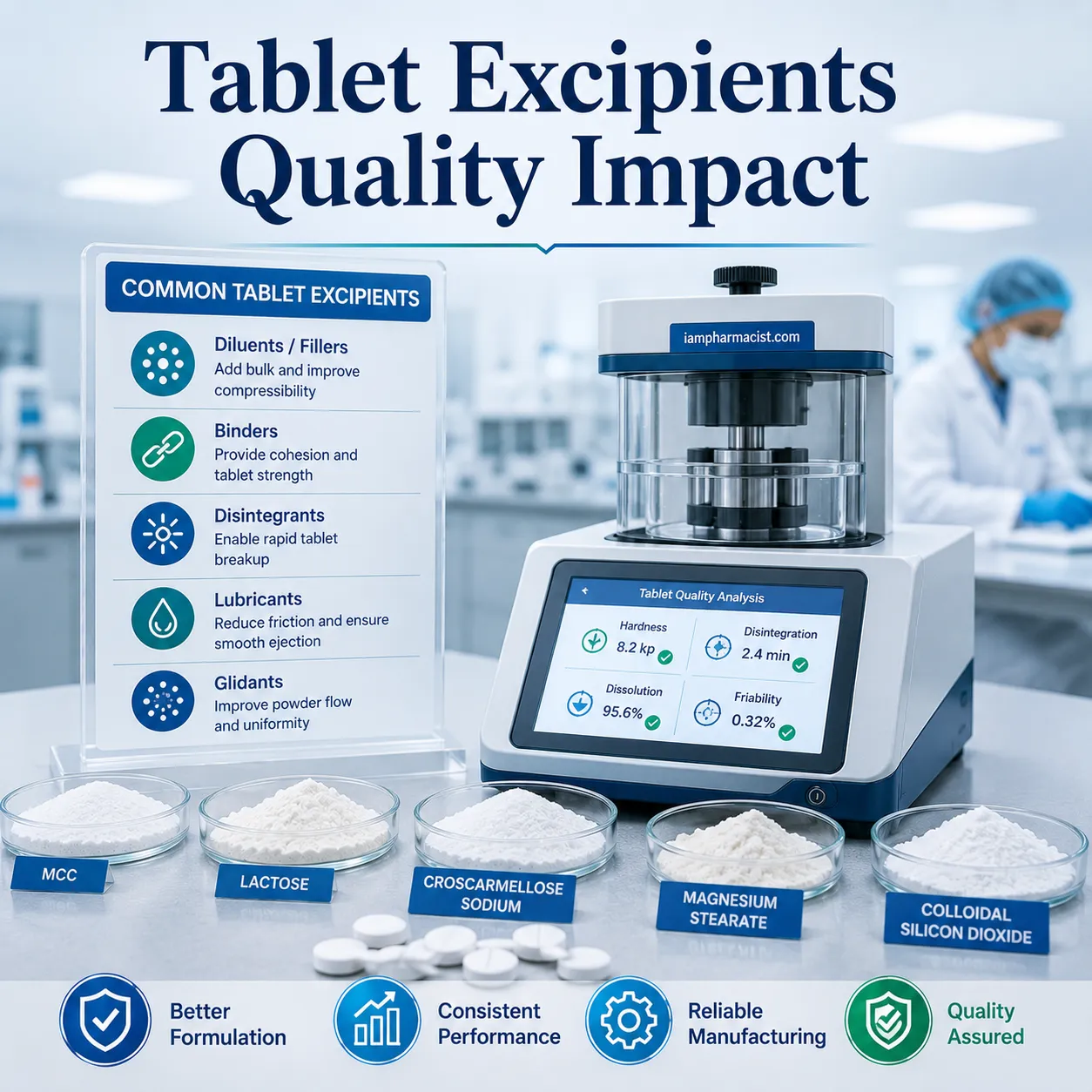

Explore common tablet excipients, their functions, and their impact on tablet quality attributes including hardness, dissolution, disintegration, stability, and bioavailability.
Definition
Tablet excipients are inactive pharmaceutical ingredients that support manufacturing, improve stability, facilitate drug release, and influence critical Product Quality Attributes (PQAs) such as hardness, disintegration, dissolution, content uniformity, bioavailability, and shelf life. Proper excipient selection is essential for robust tablet performance and regulatory compliance.
Introduction
The success of a tablet formulation depends not only on the Active Pharmaceutical Ingredient (API) but also on the careful selection and control of excipients. Although excipients are pharmacologically inactive, they significantly influence manufacturing efficiency, product stability, patient acceptability, and therapeutic performance.
Modern pharmaceutical development, guided by Quality by Design (QbD) principles, recognizes excipients as critical contributors to Product Quality Attributes (PQAs). Variations in excipient properties such as particle size, moisture content, density, compressibility, and functionality can directly affect tablet quality and process robustness.
Understanding how each excipient category impacts PQAs is essential for formulation scientists, production teams, quality assurance professionals, and regulatory specialists.
What Are Tablet Excipients?
Tablet excipients are non-active ingredients incorporated into formulations to:
- Add bulk
- Improve flowability
- Enhance compressibility
- Facilitate disintegration
- Improve stability
- Enable controlled drug release
- Support large-scale manufacturing
While they do not provide therapeutic activity, excipients play a decisive role in ensuring the drug product performs as intended.
Relationship Between Excipients and Product Quality Attributes (PQAs)
What Are Product Quality Attributes?
PQAs are measurable characteristics that determine whether a product consistently meets its intended quality requirements.
Key Tablet PQAs
| Product Quality Attribute | Importance |
|---|---|
| Hardness | Mechanical strength |
| Friability | Resistance to breakage |
| Disintegration Time | Drug release initiation |
| Dissolution Profile | Bioavailability |
| Content Uniformity | Dose accuracy |
| Stability | Shelf-life performance |
| Appearance | Patient acceptance |
Excipient functionality directly influences each of these attributes.
Major Categories of Tablet Excipients
1. Diluents (Fillers)
Diluents add bulk to formulations when the API dose is too small for practical tablet manufacture.
Common Diluents
| Excipient | Characteristics |
|---|---|
| Microcrystalline Cellulose (MCC) | Excellent compressibility |
| Lactose Monohydrate | Good flow and cost-effective |
| Mannitol | Non-hygroscopic and pleasant taste |
| Dicalcium Phosphate (DCP) | High density and stability |
Impact of Diluents on Product Quality
Tablet Hardness
MCC enhances compactability and improves mechanical strength.
Blend Uniformity
Particle size distribution influences segregation risk and content uniformity.
Dissolution
Water-soluble fillers such as lactose often support faster drug release compared with insoluble fillers.
Practical Example
Switching from spray-dried lactose to anhydrous lactose may alter:
- Flow properties
- Compression force requirements
- Tablet hardness
- Dissolution behavior
Even though both comply with pharmacopoeial standards.
2. Binders
Binders provide cohesion between particles and help tablets maintain integrity after compression.
Common Binders
| Excipient | Typical Application |
|---|---|
| Povidone (PVP) | Wet granulation |
| HPMC | Controlled-release systems |
| Pregelatinized Starch | Direct compression |
| Starch Paste | Conventional granulation |
Impact on Product Quality
Hardness and Friability
Binders increase tablet strength and reduce breakage.
Dissolution Performance
Excessive binder concentration may:
- Slow disintegration
- Delay dissolution
- Reduce bioavailability
Example
Increasing PVP concentration from 3% to 8% may significantly improve hardness but extend disintegration time beyond specification limits.
3. Disintegrants
Disintegrants enable tablets to break apart after administration.
They are critical for immediate-release formulations.
Common Disintegrants
| Excipient | Mechanism |
|---|---|
| Crospovidone | Capillary action |
| Croscarmellose Sodium | Swelling |
| Sodium Starch Glycolate | Rapid swelling |
| Starch | Water uptake |
Impact on Product Quality
Dissolution
Faster tablet breakup increases exposed surface area and enhances dissolution.
Bioavailability
Rapid disintegration often improves absorption of poorly soluble drugs.
Superdisintegrants
Modern formulations frequently use:
- Crospovidone
- Croscarmellose Sodium
- Sodium Starch Glycolate
These excipients achieve rapid tablet breakup at low concentrations.
4. Lubricants
Lubricants reduce friction during compression and tablet ejection.
Common Lubricants
| Excipient | Function |
|---|---|
| Magnesium Stearate | Industry standard lubricant |
| Stearic Acid | Friction reduction |
| Sodium Stearyl Fumarate | Water-soluble alternative |
Impact on Product Quality
Manufacturing Performance
Lubricants prevent:
- Sticking
- Picking
- Capping
- Lamination
Dissolution Challenges
Hydrophobic lubricants can create a barrier around particles.
Consequences include:
- Delayed wetting
- Slower disintegration
- Reduced dissolution rate
Over-Lubrication Risk
Excessive blending with magnesium stearate may result in:
| Defect | Impact |
|---|---|
| Reduced hardness | Tablet weakness |
| Slow dissolution | Lower bioavailability |
| Delayed disintegration | Specification failure |
5. Glidants
Glidants improve powder flow properties.
Common Glidants
| Excipient | Function |
|---|---|
| Colloidal Silicon Dioxide | Flow enhancement |
| Talc | Anti-caking and flow aid |
Impact on Product Quality
Weight Uniformity
Improved flow ensures consistent die filling.
Content Uniformity
Enhanced blend movement reduces segregation risk.
Manufacturing Efficiency
Supports high-speed tablet production.
How Excipients Influence Critical Quality Attributes
Excipient-PQA Relationship Matrix
| Excipient Category | Hardness | Dissolution | Disintegration | Stability | Uniformity |
|---|---|---|---|---|---|
| Diluents | High | Medium | Medium | Medium | High |
| Binders | High | High | High | Medium | Medium |
| Disintegrants | Low | High | High | Low | Low |
| Lubricants | Medium | High | High | Medium | Medium |
| Glidants | Low | Low | Low | Low | High |
Common Excipient-Related Quality Challenges
Moisture Sensitivity
Certain excipients absorb moisture and may affect:
- API stability
- Compression performance
- Shelf life
Examples
| Excipient | Moisture Sensitivity |
|---|---|
| Lactose | Moderate |
| PVP | High |
| MCC | Moderate |
| Mannitol | Low |
Hydrophobicity Issues
Hydrophobic lubricants improve manufacturability but may negatively affect dissolution.
Example
Excess magnesium stearate coating can significantly reduce dissolution rates in immediate-release formulations.
Batch-to-Batch Variability
Variations in:
- Particle morphology
- Density
- Surface area
- Moisture content
can alter manufacturing performance even within approved specifications.
How to Select Tablet Excipients for Optimal Quality
Step 1: Characterize the API
Assess:
- Solubility
- Dose
- Stability
- Compressibility
- Moisture sensitivity
Step 2: Define Product Quality Attributes
Identify target specifications for:
- Hardness
- Dissolution
- Disintegration
- Stability
Step 3: Select Functional Excipients
Choose excipients that support desired performance.
| Formulation Goal | Preferred Excipient |
|---|---|
| Direct compression | MCC |
| Fast disintegration | Crospovidone |
| Improved flow | Aerosil |
| Lubrication | Magnesium Stearate |
Step 4: Conduct Compatibility Studies
Evaluate:
- Chemical interactions
- Physical stability
- Moisture effects
Step 5: Optimize Using Design of Experiments (DoE)
Study:
- Excipient levels
- Compression force
- Blend characteristics
Step 6: Establish Control Strategy
Monitor critical material attributes (CMAs) and process parameters throughout commercial manufacturing.
Regulatory and GMP Considerations
ICH Guidelines
Excipient selection and control align with:
- ICH Q8(R2) Pharmaceutical Development
- ICH Q9 Quality Risk Management
- ICH Q10 Pharmaceutical Quality System
- ICH Q11 Development and Manufacture
GMP Expectations
Manufacturers should ensure:
- Qualified suppliers
- Defined specifications
- Change control management
- Incoming material testing
- Excipient traceability
Excipient Variability and QbD
Regulators increasingly expect scientific justification for excipient selection and demonstration of excipient impact on PQAs.
Practical Case Study
Immediate-Release Paracetamol Tablet
Problem
Observed:
- Slow dissolution
- High disintegration time
Root Cause Investigation
Identified:
- Excessive magnesium stearate blending
- Reduced tablet wettability
Corrective Action
- Reduced lubrication time
- Optimized mixing sequence
Result
- Improved dissolution profile
- Faster disintegration
- Consistent batch performance
Best Practices for Excipient Management
Understand Functional Roles
Select excipients based on scientific rationale rather than historical preference.
Control Critical Material Attributes
Monitor:
- Particle size
- Moisture content
- Density
- Flow properties
Qualify Suppliers
Ensure consistent material performance.
Use Risk-Based Approaches
Link excipient attributes to PQAs through QbD studies.
FAQs
1. What are tablet excipients?
Tablet excipients are inactive ingredients that support manufacturing, stability, and drug delivery.
2. Why are excipients important in tablet formulations?
They influence critical quality attributes such as hardness, dissolution, disintegration, and stability.
3. What is the role of diluents in tablets?
Diluents add bulk and improve compressibility and content uniformity.
4. How do binders affect tablet quality?
Binders improve tablet strength but excessive levels may slow dissolution.
5. What are superdisintegrants?
Specialized disintegrants that rapidly break tablets apart after administration.
6. Why is magnesium stearate widely used?
It reduces friction during compression and improves tablet ejection.
7. Can lubricants affect dissolution?
Yes. Over-lubrication may create hydrophobic barriers that slow dissolution.
8. What is the purpose of glidants?
Glidants improve powder flow and support weight uniformity.
9. How does excipient variability affect product quality?
Changes in particle size, density, or moisture can alter manufacturing performance and PQAs.
10. Which guidelines govern excipient control?
ICH Q8, Q9, Q10, GMP regulations, USP-NF, and pharmacopoeial standards.