


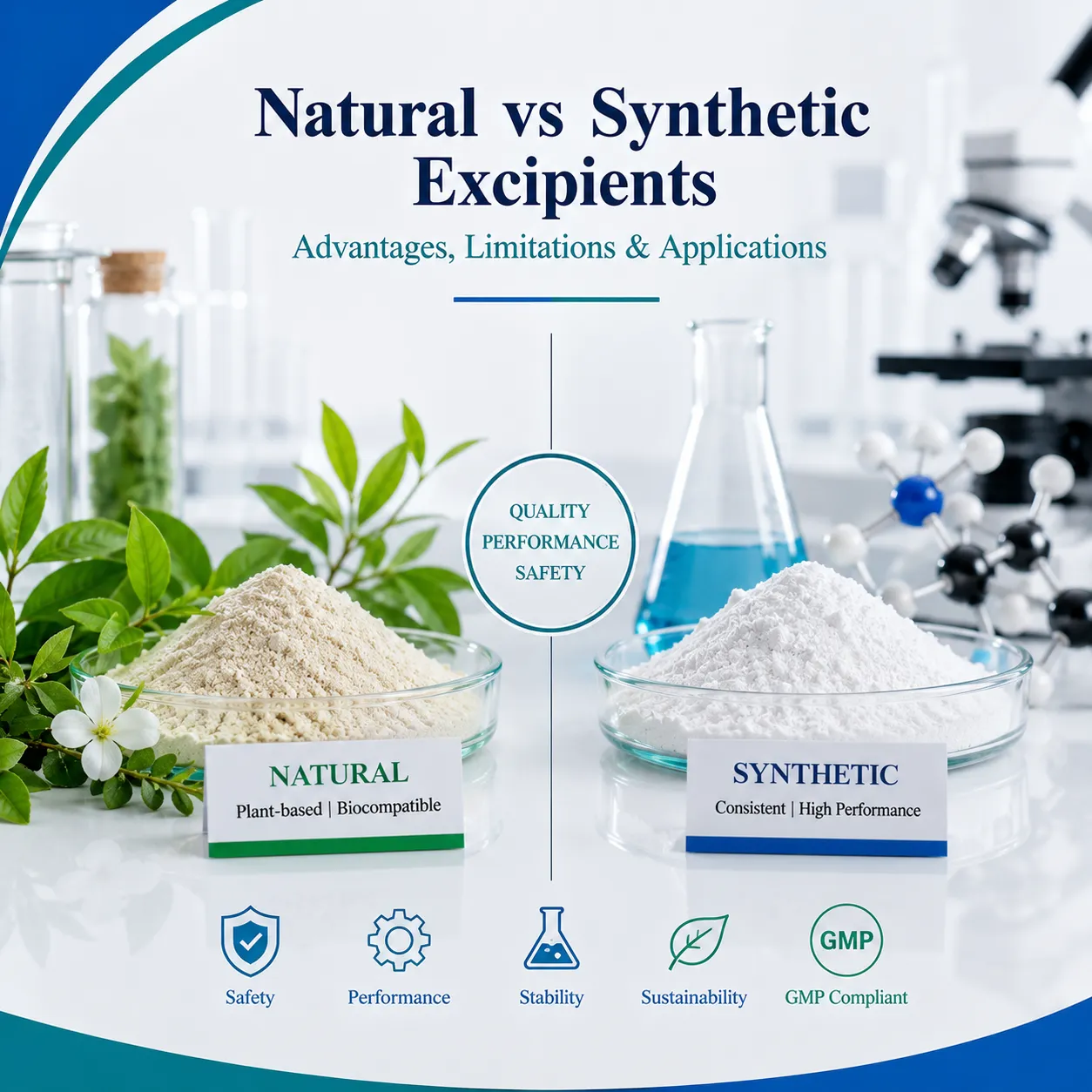

Compare natural vs synthetic pharmaceutical excipients, including advantages, limitations, applications, GMP requirements, and formulation selection strategies.
Definition
Natural pharmaceutical excipients are derived from plant, animal, or mineral sources, while synthetic excipients are manufactured through controlled chemical processes. Natural excipients offer biocompatibility and sustainability, whereas synthetic excipients provide superior consistency, stability, and performance for modern pharmaceutical manufacturing.
Introduction
Pharmaceutical excipients play a critical role in ensuring the quality, safety, efficacy, and manufacturability of drug products. Although active pharmaceutical ingredients (APIs) provide therapeutic action, excipients determine how effectively a formulation is processed, delivered, and accepted by patients.
One of the most important decisions during formulation development is choosing between natural and synthetic excipients. This choice affects product stability, manufacturing efficiency, regulatory compliance, cost, environmental impact, and patient safety.
As pharmaceutical technologies evolve toward patient-centric and sustainable formulations, understanding the strengths and limitations of both excipient categories is essential for formulation scientists, quality professionals, and regulatory teams.
What Are Pharmaceutical Excipients?
Pharmaceutical excipients are non-active ingredients intentionally incorporated into formulations to support manufacturing, stability, drug release, and patient acceptability.
Key Functions of Excipients
- Improve tablet compressibility
- Enhance powder flow
- Promote disintegration
- Stabilize APIs
- Control drug release
- Improve taste and appearance
- Increase shelf life
- Facilitate manufacturing
Although they do not provide therapeutic effects, excipients significantly influence overall product performance.
Understanding Natural Pharmaceutical Excipients
Natural excipients originate from biological or mineral sources and are minimally processed before pharmaceutical use.
Common Sources
Plant-Based
- Starch
- Acacia Gum
- Tragacanth
- Guar Gum
- Pectin
- Cellulose Derivatives
Animal-Based
- Gelatin
- Chitosan
Mineral-Based
- Bentonite
- Kaolin
- Talc
Advantages of Natural Excipients
1. Excellent Biocompatibility
Natural excipients are generally well tolerated by the human body and often demonstrate low toxicity.
Benefits
- Reduced irritation
- Better patient acceptance
- Suitable for sensitive populations
2. Eco-Friendly and Sustainable
Natural materials are often biodegradable and renewable.
Environmental Benefits
- Lower environmental burden
- Reduced chemical waste
- Sustainable sourcing opportunities
3. Multifunctional Performance
Many natural excipients perform multiple formulation roles.
Examples
| Excipient | Functions |
|---|---|
| Starch | Diluent, Binder, Disintegrant |
| Acacia | Binder, Suspending Agent |
| Pectin | Gelling Agent, Release Modifier |
4. Lower Raw Material Costs
Natural excipients may have lower procurement costs compared to highly engineered synthetic polymers.
Limitations of Natural Excipients
1. Batch-to-Batch Variability
Natural materials are influenced by:
- Climate
- Soil conditions
- Seasonal changes
- Harvesting practices
This variability can impact formulation consistency.
2. Higher Microbial Risk
Plant-derived materials may support microbial growth if not properly processed.
Risks
- Bacterial contamination
- Fungal contamination
- Reduced shelf life
3. Processing Challenges
Natural excipients often require higher concentrations to achieve desired functionality.
Potential Issues
- Increased tablet weight
- Reduced manufacturing efficiency
- Variable performance
Applications of Natural Excipients
Tablet Manufacturing
Used as:
- Binders
- Diluents
- Disintegrants
Herbal and Nutraceutical Products
Preferred due to their natural origin and consumer acceptance.
Topical Formulations
Used as:
- Gelling agents
- Viscosity modifiers
- Suspending agents
Ophthalmic Products
Natural polymers are often employed to enhance viscosity and comfort.
Understanding Synthetic Pharmaceutical Excipients
Synthetic excipients are manufactured through controlled chemical synthesis or polymerization processes.
They are designed to provide consistent functionality and superior process performance.
Common Synthetic Excipients
| Excipient | Primary Function |
|---|---|
| Microcrystalline Cellulose (MCC) | Diluent and Binder |
| Magnesium Stearate | Lubricant |
| Polyethylene Glycol (PEG) | Solubilizer |
| Polyvinylpyrrolidone (PVP) | Binder |
| Sodium Starch Glycolate | Superdisintegrant |
| HPMC | Controlled Release Polymer |
Advantages of Synthetic Excipients
1. Consistency and Reproducibility
Synthetic materials are manufactured under tightly controlled conditions.
Benefits
- Minimal variability
- Predictable performance
- Easier process validation
2. Superior Stability
Synthetic excipients generally exhibit greater resistance to:
- Moisture
- Oxidation
- Microbial degradation
- Environmental stress
3. Enhanced Manufacturing Performance
They are specifically engineered for:
- High-speed tableting
- Direct compression
- Controlled-release technologies
- Continuous manufacturing
4. Precise Functional Control
Synthetic excipients enable highly reproducible:
- Drug release profiles
- Tablet hardness
- Dissolution rates
- Powder flow properties
Limitations of Synthetic Excipients
1. Potential Safety Concerns
Some synthetic excipients have been associated with:
- Hypersensitivity reactions
- Allergic responses
- Intolerance in susceptible patients
Examples
- Certain dyes
- Preservatives
- Solubilizing agents
2. Environmental Impact
Manufacturing may involve:
- Energy-intensive processes
- Chemical waste generation
- Limited biodegradability
3. Regulatory Complexity
Novel synthetic excipients often require extensive toxicological and regulatory evaluation before approval.
Applications of Synthetic Excipients
Conventional Tablets and Capsules
Used extensively for:
- Direct compression
- Wet granulation
- High-speed manufacturing
Modified Release Systems
Synthetic polymers provide precise control over:
- Sustained release
- Extended release
- Delayed release
Injectable Formulations
Preferred for their purity and consistency.
Advanced Drug Delivery Systems
Including:
- Nanotechnology-based products
- Targeted delivery systems
- Controlled-release implants
Natural vs Synthetic Excipients Comparison
| Feature | Natural Excipients | Synthetic Excipients |
|---|---|---|
| Origin | Plants, Animals, Minerals | Chemical Synthesis |
| Consistency | Variable | Highly Consistent |
| Biocompatibility | High | Moderate to High |
| Microbial Risk | Higher | Low |
| Environmental Impact | Lower | Higher |
| Stability | Moderate | Excellent |
| Manufacturing Performance | Moderate | Excellent |
| Regulatory Documentation | Variable | Extensive |
| Cost of Raw Material | Lower | Higher |
| Controlled Release Applications | Limited | Excellent |
How to Choose Between Natural and Synthetic Excipients
Step 1: Define Product Requirements
Determine:
- Dosage form
- Drug release profile
- Stability needs
- Patient population
Step 2: Assess API Compatibility
Conduct compatibility studies using:
- FTIR
- DSC
- HPLC
- Forced degradation studies
Step 3: Evaluate Manufacturing Process
Consider:
- Direct compression
- Wet granulation
- Continuous manufacturing
- Scale-up requirements
Step 4: Assess Safety and Patient Needs
Review:
- Allergens
- Pediatric suitability
- Dietary restrictions
- Hypersensitivity risks
Step 5: Evaluate Regulatory Requirements
Verify compliance with:
- USP-NF
- Ph. Eur.
- BP
- IPEC guidelines
Step 6: Conduct Risk Assessment
Apply ICH Q9 Quality Risk Management principles to determine the most suitable excipient strategy.
Practical Example: Immediate-Release Tablet
Scenario
Developing a high-volume generic tablet.
Natural Option
- Starch as binder and disintegrant
Synthetic Option
- MCC as diluent
- Crospovidone as superdisintegrant
Outcome
Synthetic excipients may provide:
- Better compressibility
- Faster production speeds
- More consistent dissolution performance
However, natural alternatives may be selected for herbal or nutraceutical products where consumer preference favors natural ingredients.
GMP and Regulatory Considerations
Pharmacopeial Compliance
Excipients should comply with:
- USP-NF
- European Pharmacopoeia (Ph. Eur.)
- British Pharmacopoeia (BP)
- Indian Pharmacopoeia (IP)
- Japanese Pharmacopoeia (JP)
IPEC Guidelines
The International Pharmaceutical Excipients Council (IPEC) provides globally recognized guidance for:
- Excipient GMP
- Supplier qualification
- Risk management
- Quality systems
Supplier Qualification
Manufacturers should evaluate:
- GMP compliance
- Audit reports
- Quality agreements
- Change control procedures
- Traceability systems
Emerging Trends in Excipient Development
Hybrid Excipients
Combining natural and synthetic materials to achieve:
- Enhanced functionality
- Improved sustainability
- Better manufacturability
Sustainable Formulation Development
Increasing focus on:
- Renewable resources
- Green chemistry
- Biodegradable excipients
Novel Functional Excipients
Supporting:
- Personalized medicine
- Continuous manufacturing
- Advanced drug delivery technologies
FAQs
1. What are natural pharmaceutical excipients?
Natural excipients are formulation ingredients derived from plant, animal, or mineral sources and used to support drug manufacturing and delivery.
2. What are synthetic pharmaceutical excipients?
Synthetic excipients are chemically manufactured substances designed to provide specific functional properties in pharmaceutical formulations.
3. Which is safer: natural or synthetic excipients?
Both can be safe when properly evaluated and approved. Natural excipients generally offer excellent biocompatibility, while synthetic excipients provide highly controlled quality and consistency.
4. Why do synthetic excipients provide better consistency?
They are manufactured under controlled processes, minimizing batch-to-batch variation.
5. What is the major limitation of natural excipients?
Batch variability and susceptibility to microbial contamination are common challenges.
6. Are natural excipients environmentally friendly?
Most natural excipients are biodegradable and sourced from renewable materials, making them more sustainable.
7. Which excipients are used in controlled-release formulations?
Synthetic polymers such as HPMC and ethylcellulose are commonly used for controlled-release systems.
8. Can natural excipients be used in tablet manufacturing?
Yes. Starch, acacia, and other natural materials are widely used as binders, diluents, and disintegrants.
9. What role does IPEC play in excipient regulation?
IPEC provides internationally recognized GMP, quality, and risk-management guidance for excipient manufacturers and users.
10. How are excipients selected during formulation development?
Selection is based on compatibility, functionality, safety, manufacturing requirements, patient considerations, and regulatory compliance.