


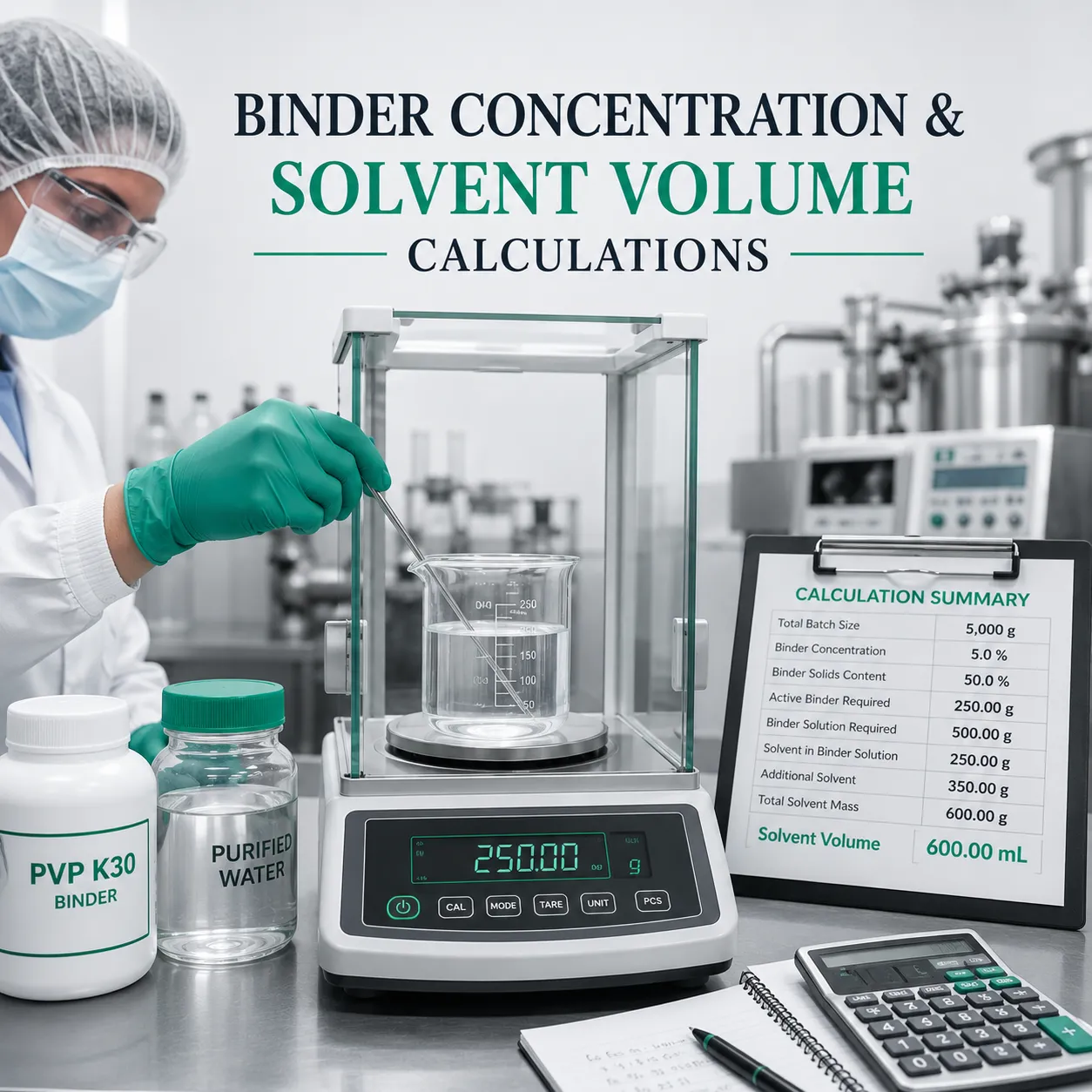

Learn binder concentration, binder quantity, and solvent volume calculations with formulas, examples, GMP guidance, and pharma applications.
Definition
Binder concentration calculations determine the exact amount of binder and solvent required in pharmaceutical formulations, coatings, or granulation processes. The binder percentage defines the amount of active binder solids needed, while solvent volume is calculated by dividing solvent mass by solvent density.
What Is Binder Concentration?
Binder concentration refers to the percentage of binder solids present in the total formulation weight.https://www.webofpharma.com/2022/05/sop-for-preparation-of-master-formula.html
The concentration is typically expressed as:
- % w/w (weight by weight)
- % w/v (weight by volume)
- % solids content
In pharmaceutical wet granulation, binder concentrations commonly range from:
| Application | Typical Binder Range |
|---|---|
| Tablet Wet Granulation | 2–10% |
| Film Coating | 1–5% |
| Paints & Coatings | Variable |
| Industrial Adhesives | 5–25% |
Core Binder Calculation Formulas
Formula 1: Binder Mass for 100% Solid Binders
Use this formula when the binder is pure solid material.
Binder Mass=Total Batch Size×(100Target Concentration %)
Formula 2: Binder Solution Quantity for Liquid Binders
When using commercial binder solutions, divide by solids fraction.
Component Mass Needed=Fraction of SolidsTarget Binder Mass
Formula 3: Solvent Mass Calculation
Solvent Mass=Total Batch Weight−Total Solid Mass
Formula 4: Solvent Volume Calculation
Solvent Volume=Solvent DensitySolvent Mass
Step-by-Step Binder Calculation Example
Example Scenario
A pharmaceutical batch requires:
- Total batch size = 5,000 g
- Target binder concentration = 5%
- Binder stock solution = 50% solids
- Additional purified water required = 350 g
- Water density = 1.0 g/mL
Step 1: Calculate Pure Binder Requirement
5000×1005=250 g
Result
Required active binder solids = 250 g
Step 2: Calculate Required Binder Solution
Since the binder solution contains only 50% solids:
0.50250=500 g
Result
Required binder solution = 500 g
This 500 g contains:
- 250 g active binder
- 250 g solvent
Step 3: Calculate Total Solvent Mass
Additional solvent required = 350 g
Total solvent:250+350=600 g
Result
Total solvent mass = 600 g
Step 4: Calculate Solvent Volume
Using water density:
1.0600=600 mL
Result
Total solvent volume = 600 mL
Final Formulation Summary
| Component | Quantity |
|---|---|
| Active Binder | 250 g |
| Binder Solution (50%) | 500 g |
| Additional Water | 350 g |
| Total Solvent | 600 g |
| Solvent Volume | 600 mL |
Binder Concentration & Solvent Volume Calculator
Key Pharmaceutical Terminology
1. Binder Concentration (% w/w)
Percentage of binder solids relative to total batch weight.
2. Solids Content
The percentage of active solids present in commercial binder solutions.
Example:
- 50% PVP solution
- 40% acrylic resin
- 30% HPMC solution
3. Solvent Volume
The physical volume occupied by the solvent, determined using density.
Solvent Density Reference Table
| Solvent | Density (g/mL) |
|---|---|
| Purified Water | 1.00 |
| Ethanol | 0.789 |
| IPA | 0.786 |
| Methanol | 0.792 |
| Acetone | 0.784 |
Pharmaceutical Applications
1. Tablet Wet Granulation
Precise binder-to-solvent ratios improve:
- Granule flow
- Compressibility
- Tablet hardness
2. Film Coating
Binder concentration affects:
- Coating uniformity
- Sprayability
- Film adhesion
3. Sustained Release Formulations
Polymer binder calculations determine drug release profiles.
4. Industrial Coatings & Paints
Binder concentration controls:
- Viscosity
- Pigment dispersion
- Film formation
GMP and Regulatory Considerations
GMP Expectations for Binder Preparation
Documentation
- Approved master formula
- Batch manufacturing records
- Raw material traceability
Equipment Controls
- Calibrated balances
- Qualified mixing vessels
- Validated solvent measuring systems
Process Controls
- Mixing time verification
- Viscosity checks
- Homogeneity confirmation
Data Integrity
Ensure compliance with:
- ALCOA+
- 21 CFR Part 11
- Electronic batch recording requirements
FAQs
1. What is binder concentration?
Binder concentration is the percentage of binder solids relative to the total formulation weight.
2. Why is solids content important in binder calculations?
Commercial binders may contain solvents, so solids content determines the actual active binder amount.
3. How do you calculate binder mass?
Multiply total batch size by target binder concentration percentage.
4. How is solvent volume calculated?
Divide solvent mass by solvent density.
5. What is the typical binder concentration in pharmaceuticals?
Most pharmaceutical formulations use 2–10% binder concentration.
6. Why is solvent density important?
Density converts solvent weight into accurate measurable volume.
7. What happens if binder concentration is too high?
High concentrations can increase viscosity and create processing problems.
8. Which binders are commonly used in tablet manufacturing?
Common binders include PVP, HPMC, starch paste, and gelatin.
9. Can binder calculations affect drying time?
Yes. Excess solvent increases drying duration and energy consumption.
10. What GMP controls apply to binder preparation?
Manufacturers must ensure validated procedures, calibrated equipment, and accurate documentation.