



Learn how to calculate granulation binder solution for tablet production with formulas, GMP guidance, examples, and pharma industry best practices.
Definition
Granulation binder solution calculation is the process of determining the required quantity of dry binder and solvent needed to prepare a binder solution used during wet granulation in tablet manufacturing. Typically, binders constitute 2–5% of the batch weight and are dissolved in water or solvent at a specified concentration to achieve proper granule formation and tablet integrity.https://www.webofpharma.com/2022/05/sop-for-preparation-of-master-formula.html
Granulation Binder Solution Calculation for Tablet Production
Wet granulation is one of the most widely used manufacturing techniques in pharmaceutical tablet production. The success of the process largely depends on accurate binder solution preparation. Incorrect binder concentration can lead to poor granule flow, weak tablets, capping, sticking, or extended drying times.
In pharmaceutical manufacturing, binder solution calculations must be scientifically accurate, reproducible, and GMP-compliant to ensure batch-to-batch consistency and product quality.
This guide explains how to calculate granulation binder solution step-by-step with formulas, examples, tables, and practical industry considerations.
What Is a Binder in Wet Granulation?
A binder is a pharmaceutical excipient used to improve adhesion between powder particles during granulation. It helps produce granules with adequate strength for downstream processing and tablet compression.
Common Pharmaceutical Binders
| Binder | Typical Concentration | Common Use |
|---|---|---|
| PVP K30 | 2–10% | Immediate-release tablets |
| Starch Paste | 5–15% | Conventional wet granulation |
| HPMC | 2–5% | Controlled-release formulations |
| Gelatin | 2–10% | High-strength granules |
| MCC Slurry | Variable | Specialized formulations |
Step-by-Step Binder Solution Calculation Example
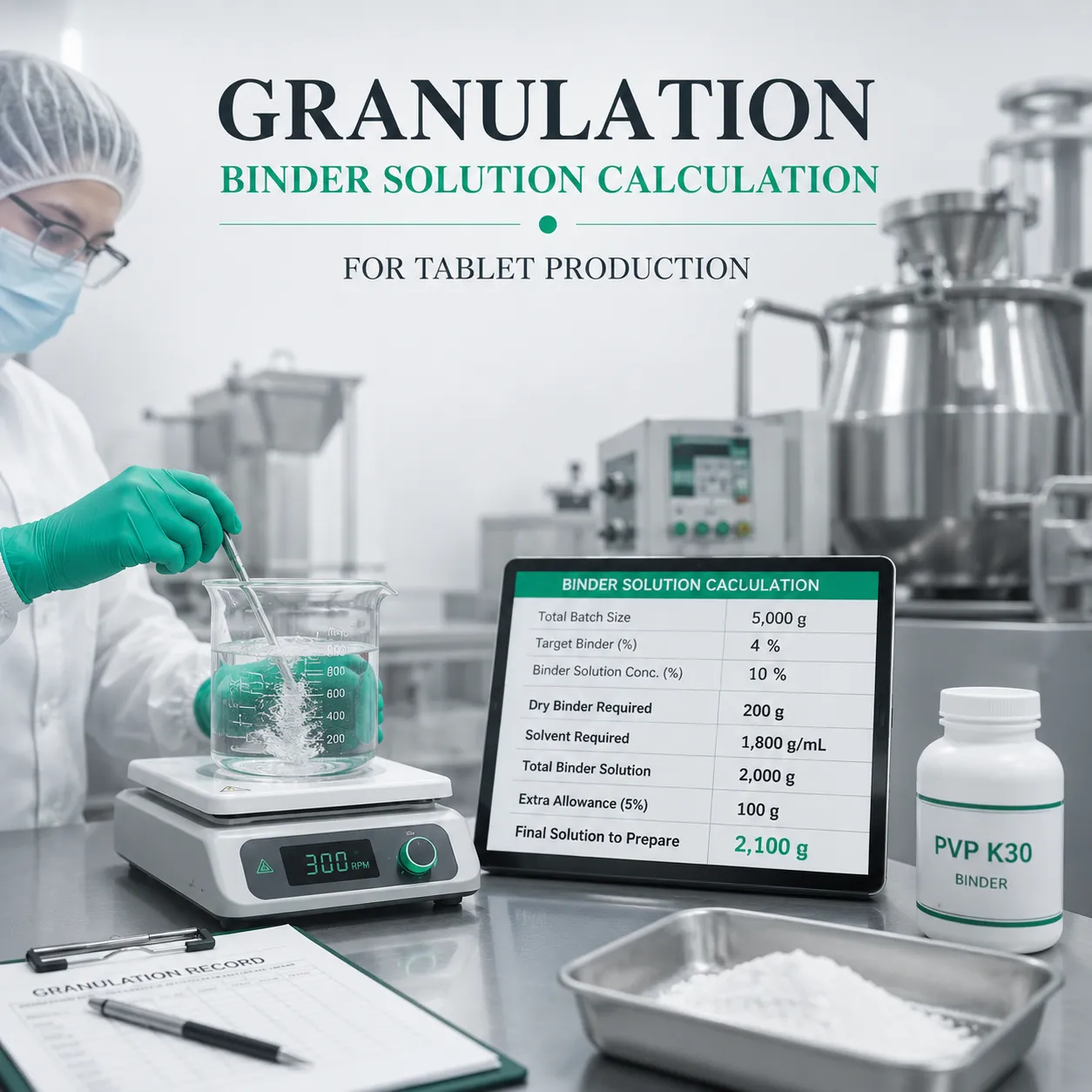
Batch Parameters
| Parameter | Value |
|---|---|
| Total Batch Size | 5,000 g |
| Target Binder Level | 4% |
| Binder Solution Concentration | 10% |
| Binder Type | PVP K30 |
Step 1: Calculate Dry Binder Requirement
Using the formula:
mb=5000×1004=200 g
Result
Required dry binder = 200 g
Step 2: Calculate Solvent Requirement
If 200 g represents 10% of the total solution:Total Solution Weight=0.10200=2000 g
Solvent quantity:
ms=2000−200=1800 g
Result
Required solvent = 1800 g (or mL for water)
Step 3: Final Binder Solution Preparation
Final Preparation
| Component | Quantity |
|---|---|
| PVP K30 | 200 g |
| Purified Water | 1800 g |
| Final Binder Solution | 2000 g |
The binder is dissolved completely in purified water before addition to the granulator.
Granulation Binder Solution Calculator
Practical Industry Considerations
1. Evaporation and Transfer Losses
In commercial manufacturing, additional binder solution is usually prepared to compensate for:
- Tubing hold-up
- Nozzle priming losses
- Vessel transfer loss
- Evaporation
Recommended Excess Preparation
| Batch Scale | Excess Solution |
|---|---|
| R&D Scale | 2–5% |
| Pilot Scale | 5–7% |
| Commercial Scale | 5–10% |
2. Binder Solution Viscosity
Highly concentrated binder solutions can become difficult to spray.
Typical Industry Guidance
| Binder Concentration | Observation |
|---|---|
| 5–10% | Easy spraying |
| 10–15% | Moderate viscosity |
| >20% | Difficult pumping/spraying |
Excessively viscous solutions may cause:
- Spray nozzle blockage
- Non-uniform granulation
- Overwetting
3. Impact on Drying Time
Higher solvent volumes increase:
- Drying time
- Energy consumption
- Moisture variability risk
The liquid-to-solid (L/S) ratio should remain within validated process limits.
GMP and Regulatory Considerations
GMP Expectations for Binder Solution Preparation
Pharmaceutical manufacturers should ensure:
Documentation
- Approved manufacturing instructions
- Batch manufacturing records (BMR)
- Dispensing records
Equipment Qualification
- Qualified granulators
- Calibrated weighing balances
- Validated spray systems
Process Controls
- Mixing time monitoring
- Binder solution concentration verification
- Granulation endpoint checks
Data Integrity
- Real-time recording
- ALCOA+ compliance
- Electronic batch records where applicable
Common Calculation Mistakes
| Mistake | Impact |
|---|---|
| Incorrect binder percentage | Weak or hard tablets |
| Wrong solvent calculation | Overwetting or under-granulation |
| Ignoring excess losses | Insufficient solution |
| Excessive concentration | High viscosity issues |
| Poor mixing | Non-uniform granules |
Example: Quick Binder Solution Reference Table
| Batch Size | Binder % | Dry Binder | 10% Solution Required |
|---|---|---|---|
| 10 kg | 3% | 300 g | 3 kg |
| 25 kg | 4% | 1 kg | 10 kg |
| 50 kg | 5% | 2.5 kg | 25 kg |
| 100 kg | 4% | 4 kg | 40 kg |
FAQs
1. What is a binder solution in tablet manufacturing?
A binder solution is a liquid preparation containing a binding agent dissolved in solvent to help powder particles adhere during wet granulation.
2. What is the typical binder percentage in tablets?
Most tablet formulations use 2–5% binder concentration based on total batch weight.
3. Which binders are commonly used in wet granulation?
Common binders include PVP K30, starch paste, HPMC, gelatin, and HPC.
4. Why is binder solution concentration important?
Incorrect concentration can affect granule strength, drying time, and tablet hardness.
5. How is solvent quantity calculated for binder solution?
The solvent quantity depends on the required binder amount and desired solution concentration.
6. What happens if too much binder solution is added?
Excess solution can cause overwetting, long drying times, sticking, and dense granules.
7. Why is extra binder solution prepared in industry?
Additional solution compensates for transfer losses, tubing hold-up, and spray nozzle priming.
8. Can binder solution viscosity affect granulation?
Yes. Highly viscous solutions can block spray nozzles and cause uneven granulation.
9. Which solvent is commonly used for binder preparation?
Purified water is most commonly used, although alcohol or hydroalcoholic solvents may also be used.
10. What GMP controls are required for binder preparation?
Manufacturers must ensure documented procedures, calibrated equipment, validated processes, and accurate batch records.