


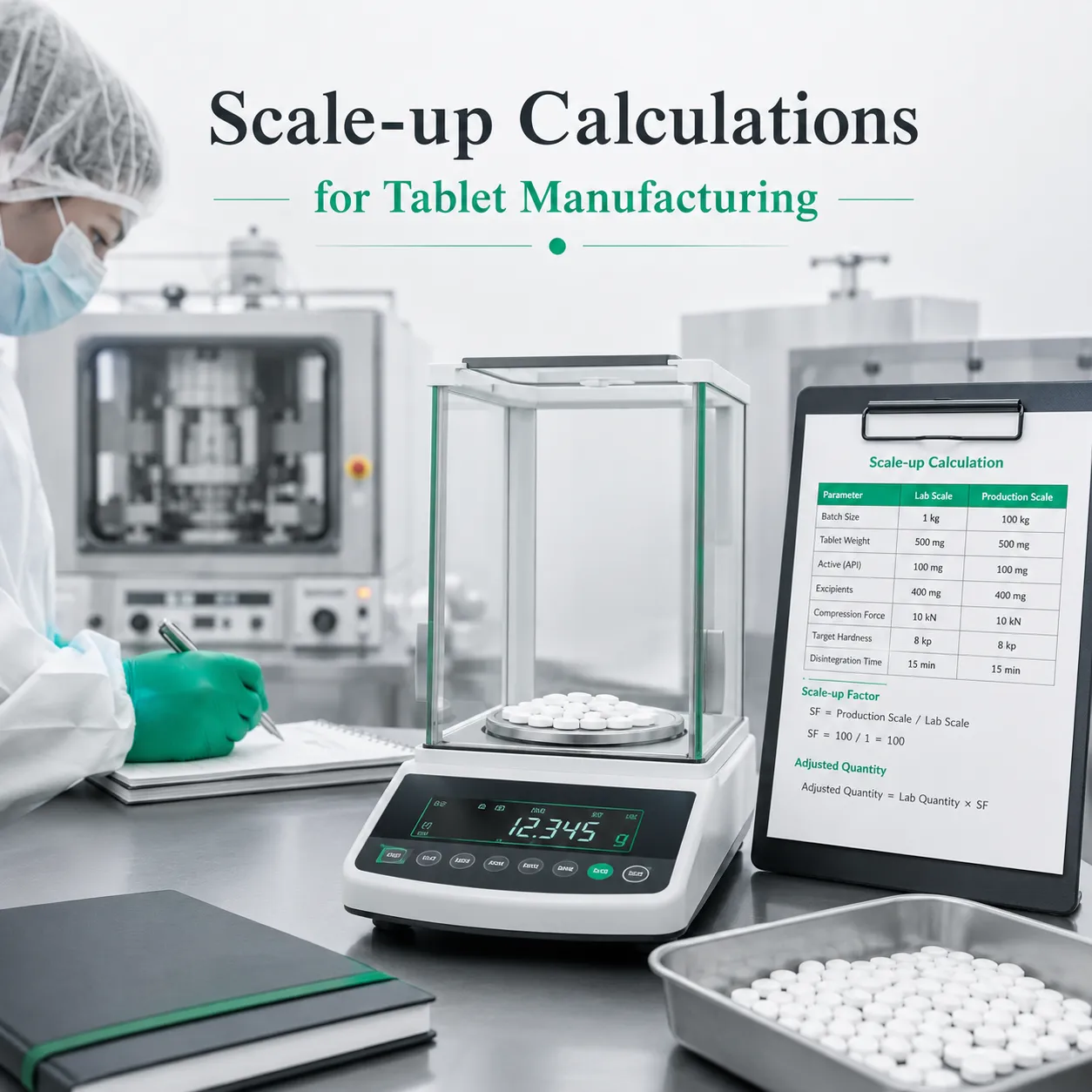

Learn tablet batch size calculations, Scale-up calculations, theoretical yield, practical yield, and batch reconciliation in pharmaceutical manufacturing.
What is a Master Formula Record (MFR)?
A Master Formula Record (MFR) is a master manufacturing document prepared by the research and development department and approved by Production and Quality Assurance.
It serves as the reference document for preparing:
- Batch Manufacturing Records (BMR)
- Batch Packaging Records (BPR)
- Manufacturing instructions
- Process controls
Major Components of an MFR
| Section | Details Included |
|---|---|
| Product Details | Brand name, generic name, dosage form, strength |
| Manufacturing Flow Chart | Material movement and process steps |
| Equipment List | Machine names and capacities |
| Special Instructions | Safety and processing precautions |
| Calculations | Potency, LOD, overages, batch calculations |
| Manufacturing Process | Granulation, blending, compression, coating |
| Packaging Process | Packing materials and reconciliation |
| Yield Information | Theoretical, practical yield, acceptance limits |
Product Details Included in MFR
The first section of the MFR typically includes:
- Company name, logo, and address
- Dosage form
- Brand name
- Generic name
- Product code
- Label claim
- Product description
- Batch size
- Pack size
- Shelf life
- Storage conditions
- MFR number and revision history
- Effective batch number
- Authorization signatures
These details ensure traceability and GMP compliance.
Best Practices for Pharmaceutical Yield Management
1. Use Approved MFRs
Always manufacture using the latest approved version.
2. Minimize Transfer Losses
Use closed transfer systems where possible.
3. Monitor Environmental Conditions
Control:
- Temperature
- Humidity
- Air differential pressure
4. Validate Equipment
Ensure equipment qualification:
- IQ
- OQ
- PQ
5. Investigate Yield Deviations
Unexpected losses should trigger:
- Root cause analysis
- CAPA
- QA review
Common Calculation Errors in Pharma Manufacturing
| Error | Impact |
|---|---|
| Incorrect potency adjustment | Assay failure |
| Wrong scale-up factor | Blend inconsistency |
| Missing overage | Low yield |
| Improper reconciliation | GMP observation |
| Calculation rounding errors | Batch deviation |
Pharmaceutical Manufacturing Calculators
1. Tablet Batch Size Calculator
2. Potency Adjustment Calculator
3. Overage Calculator
4. Scale-Up Calculator
5. Yield Calculator
6. Percentage Loss Calculator
FDA Yield Requirement
According to FDA 21 CFR § 211.103:
“Actual yields and percentages of theoretical yield shall be determined at the conclusion of each appropriate phase of manufacturing, processing, packaging, or holding of the drug product.”
FAQs
1. What is batch size calculation in pharmaceuticals?
Batch size calculation determines the quantity of raw materials needed to manufacture a defined number of dosage units.
2. What is theoretical yield in pharma?
Theoretical yield is the expected quantity of product obtained without any process loss.
3. What is practical yield?
Practical yield is the actual quantity produced after manufacturing losses.https://iampharmacist.com/batch-re-processing-sop/
4. Why is batch reconciliation important?
Batch reconciliation ensures all materials are properly accounted for during manufacturing and packaging.
5. What is an MFR in pharmaceuticals?
A Master Formula Record is a master manufacturing document containing complete production instructions.
6. How is yield percentage calculated?
Yield percentage is calculated by dividing actual yield by theoretical yield and multiplying by 100.
7. What causes yield loss in tablet manufacturing?
Yield loss may occur due to sticking, dust generation, sampling, transfer loss, or rejected tablets.
8. What is scale-up in pharmaceutical manufacturing?
Scale-up is the process of increasing batch size from laboratory to commercial production.
9. What are acceptable yield limits in pharma?
Yield limits are established through process optimization and validation studies.
10. Which regulation covers yield calculations?
Yield calculations are covered under FDA 21 CFR § 211.103.