


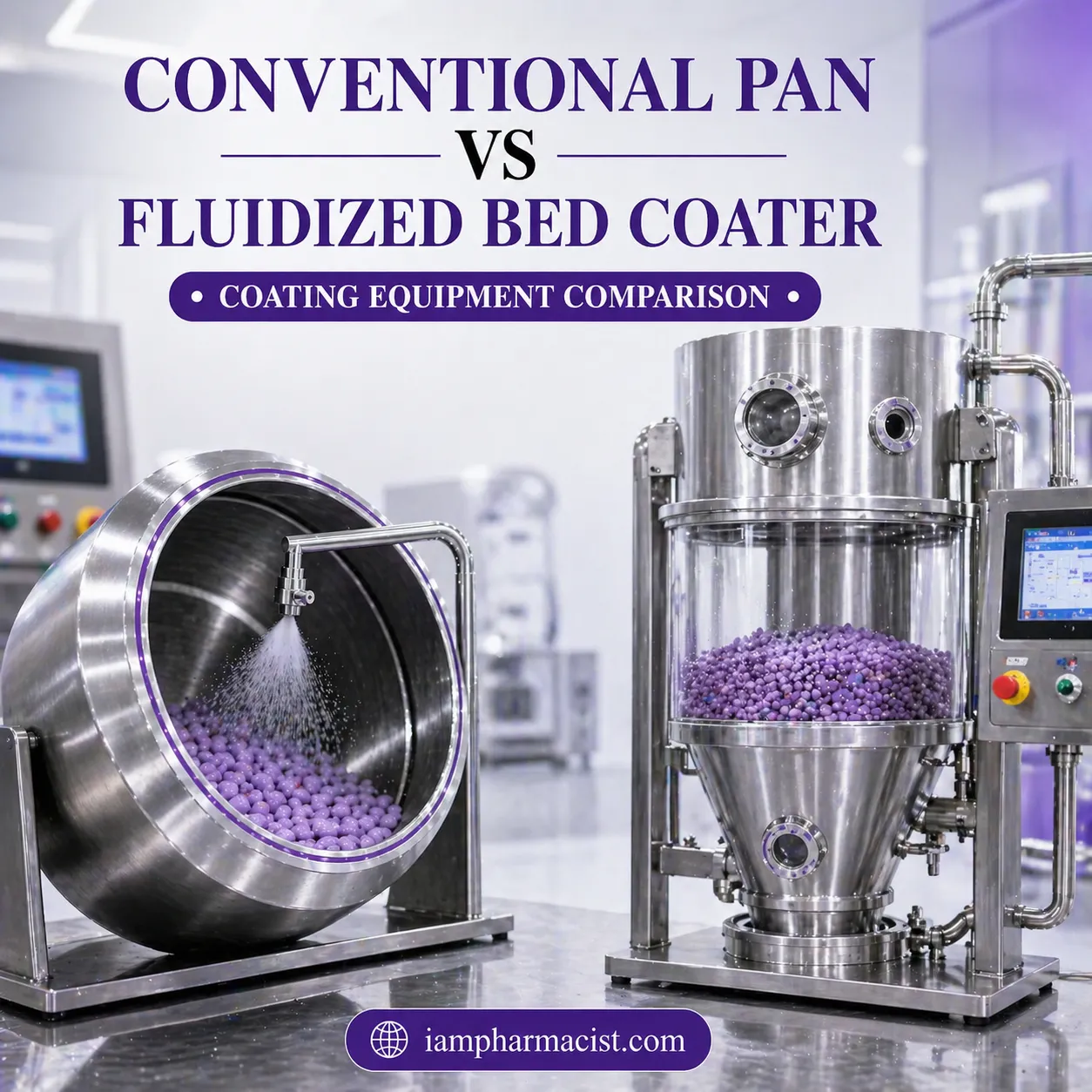

Compare conventional pan coating and fluidized bed coating Equipments in pharmaceuticals, including process, advantages, scale-up, costs, and applications.
Definition of Pharmaceutical Coating Equipment
Pharmaceutical coating equipment refers to specialized systems used to apply protective or functional coating films onto tablets, pellets, granules, or particles. Conventional pan coaters use mechanical tumbling for coating distribution, while fluidized bed coaters use controlled airflow and spray atomization to achieve highly uniform and functional coating deposition.
Introduction
Coating technology plays a critical role in pharmaceutical manufacturing by improving product appearance, protecting active ingredients, enhancing stability, masking taste, and controlling drug release profiles.
Among the most widely used pharmaceutical coating systems are the Conventional Pan Coater and the Fluidized Bed Coater. Both technologies provide reliable coating performance but differ significantly in process mechanism, coating uniformity, scalability, operational control, and application suitability.
Selecting the appropriate coating equipment depends on material properties, desired product performance, production scale, controlled-release requirements, and cost considerations. https://iampharmacist.com/critical-process-parameters/
This comprehensive guide compares conventional pan coating and fluidized bed coating technologies using pharmaceutical engineering, Quality by Design (QbD), and industrial manufacturing perspectives.
What Is a Conventional Pan Coater?
A conventional pan coater is a mechanical coating system that uses a rotating drum or pan to tumble tablets or pellets while coating solution is sprayed onto the moving bed.
Hot air is supplied to dry the deposited coating film and form a continuous protective layer.
Main Components of a Conventional Pan Coater
| Component | Function |
|---|---|
| Rotating Pan | Creates tablet tumbling |
| Spray Gun System | Applies coating solution |
| Hot Air System | Dries coating film |
| Exhaust System | Removes moisture |
| Baffles | Improve mixing efficiency |
What Is a Fluidized Bed Coater?
A fluidized bed coater is an advanced coating system that uses upward airflow to suspend particles while atomized spray deposits coating material onto particle surfaces.
The system enables highly uniform coating deposition and precise film thickness control.
Main Components of a Fluidized Bed Coater
| Component | Function |
|---|---|
| Wurster Column | Directs particle circulation |
| Spray Nozzle System | Atomizes coating solution |
| Air Distribution Plate | Ensures uniform airflow |
| PLC Control System | Automates process control |
| ΔP Monitoring System | Monitors bed stability |
Conventional Pan vs Fluidized Bed Coater: Key Differences
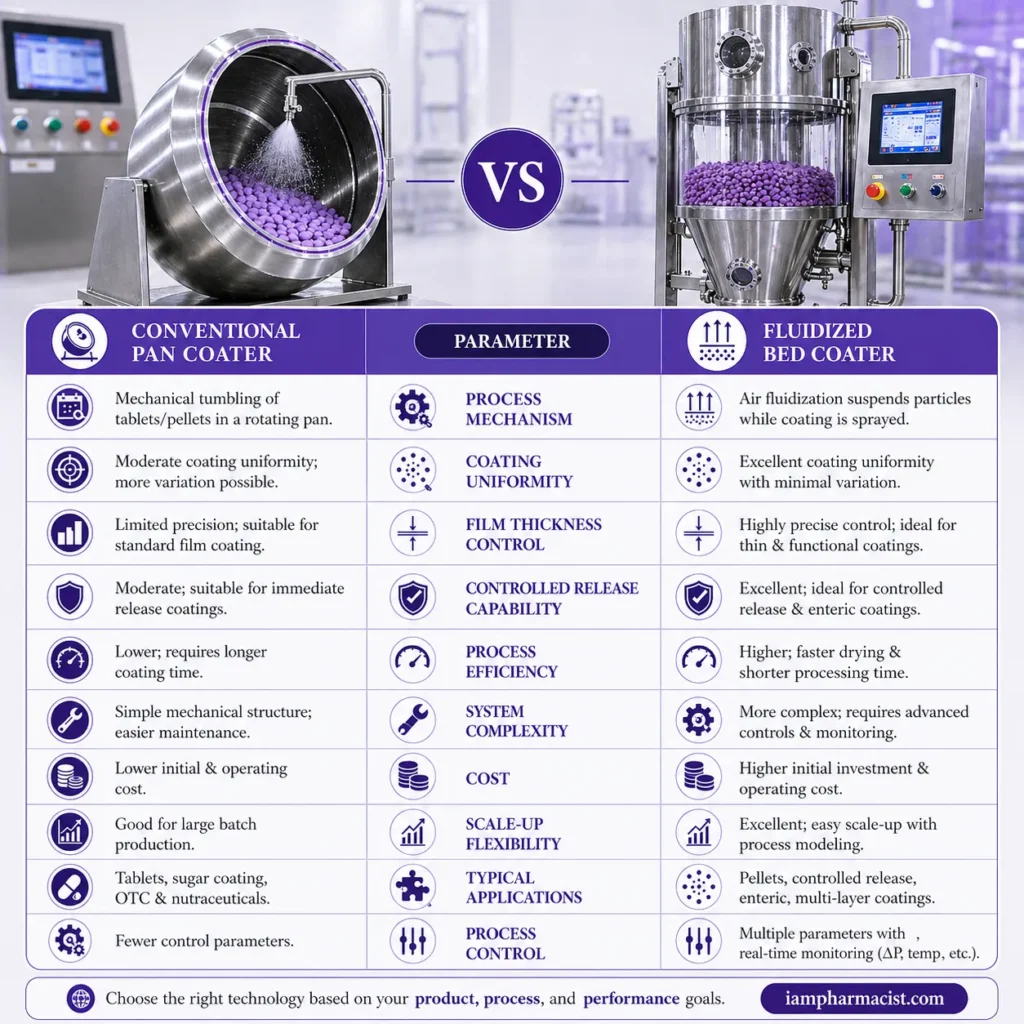
Coating Process Mechanism
Conventional Pan Coating Process
Pan coating uses rotating motion to expose tablets or pellets to atomized spray.
Process Steps
- Tablet loading
- Pan rotation initiation
- Spray deposition
- Hot air drying
- Film curing
- Cooling and unloading
The coating process relies heavily on balancing spray rate and drying efficiency.
Fluidized Bed Coating Process
Fluidized bed coating uses air suspension and layer-by-layer deposition.
Process Steps
- Particle fluidization
- Spray atomization
- Droplet deposition
- Rapid drying
- Film formation
- Cooling and discharge
Particles continuously circulate through the spray zone, improving coating uniformity. https://iampharmacist.com/coating-defects/
Applications of Conventional Pan Coating
Common Uses
| Application | Reason |
|---|---|
| Tablet Film Coating | Good appearance |
| Sugar Coating | Enhanced taste masking |
| Nutraceutical Tablets | Large-scale production |
| Vitamin Tablets | Cost efficiency |
| OTC Products | High batch capacity |
Pan coating is highly suitable for high-volume industrial production.
Applications of Fluidized Bed Coating
Common Uses
| Application | Reason |
|---|---|
| Enteric Pellets | Uniform coating |
| Controlled Release Pellets | Precise film thickness |
| Functional Multi-Layer Coating | Layer separation |
| Probiotic Protection | Moisture resistance |
| Agrochemical Granules | Abrasion resistance |
Fluidized bed coating is ideal for advanced drug delivery systems.
Advantages of Conventional Pan Coating
Major Advantages
- Lower equipment cost
- Simple mechanical design
- Lower maintenance requirements
- High batch capacity
- Reduced operating costs
- Suitable for irregular tablet shapes
- Easier explosion-proof modifications
Pan coaters are often preferred for cost-sensitive manufacturing operations.
Advantages of Fluidized Bed Coating
Major Advantages
- Excellent coating uniformity
- Precise film thickness control
- Low film thickness variation
- Better controlled-release performance
- Strong coating durability
- Reduced coating defects
- Excellent scale-up capability
- Advanced process monitoring
Fluidized bed systems provide superior performance for functional coating applications.
Disadvantages of Conventional Pan Coating
Common Limitations
- Lower coating uniformity
- Higher risk of uneven drying
- Limited ultra-thin coating capability
- Increased tablet-to-tablet friction
- Reduced controlled-release precision
Disadvantages of Fluidized Bed Coating
Common Limitations
- Higher equipment investment
- Complex process control
- Higher energy consumption
- Requires skilled operators
- Sensitive to temperature variations
- Explosion-proof requirements for solvents
Coating Durability and Film Integrity
Fluidized bed coating generally provides stronger coating durability and abrasion resistance due to denser film formation.
Why Fluidized Bed Coating Performs Better
- Layer-by-layer deposition
- Reduced microcrack formation
- Better particle circulation
- Improved film integrity
- More uniform drying
Pan coating still offers excellent mechanical stability for standard tablet coating applications.
Cost Comparison
| Cost Factor | Conventional Pan | Fluidized Bed |
|---|---|---|
| Initial Investment | Lower | Higher |
| Energy Consumption | Lower | Higher |
| Maintenance Cost | Lower | Higher |
| Automation Cost | Moderate | High |
| Operating Complexity | Low | High |
Pan coating typically provides lower total cost of ownership (TCO).
Process Control and Monitoring
Fluidized Bed Monitoring
Fluidized bed systems rely heavily on real-time monitoring.
Key Parameters
- ΔP pressure monitoring
- Outlet air temperature
- Inlet air temperature
- Spray rate
- Fluidization stability
Pan Coating Monitoring
Pan coating uses fewer process control dimensions.
Key Parameters
- Pan speed
- Spray rate
- Drying airflow
- Tablet bed temperature
Quality by Design (QbD) in Coating Equipment Selection
QbD principles help optimize coating process selection based on product requirements.
QbD Considerations
| QbD Factor | Importance |
|---|---|
| CQAs | Product performance |
| CPPs | Process control |
| Design Space | Process robustness |
| Risk Assessment | Defect prevention |
| DoE | Process optimization |
Fluidized bed coating often benefits more from advanced QbD strategies due to its process complexity.
How to Choose Between Pan Coating and Fluidized Bed Coating
Step 1: Define Product Requirements
Determine:
- Immediate release or controlled release
- Tablet or pellet dosage form
- Desired film functionality
Step 2: Evaluate Batch Size
Large tablet batches may favor pan coating due to lower costs.
Step 3: Assess Coating Uniformity Needs
Choose fluidized bed coating if:
- Precise film thickness is required
- Controlled release is critical
- Functional layering is necessary
Step 4: Consider Process Complexity
Evaluate:
- Available technical expertise
- Automation capability
- Monitoring systems
Step 5: Analyze Cost and Scalability
Compare:
- Equipment investment
- Maintenance requirements
- Energy costs
- Production scalability
Scale-Up Considerations
Conventional Pan Scale-Up
Scale-up depends on:
- Pan diameter
- Spray gun angle
- Pan speed
- Drying efficiency
Fluidized Bed Scale-Up
Scale-up depends on:
- Airflow distribution
- Fluidization behavior
- Atomization characteristics
- Pressure balance
Thermodynamic and atomization models support robust scale-up performance.
Future Trends in Pharmaceutical Coating Equipment
Emerging Technologies
- Process Analytical Technology (PAT)
- AI-based process control
- Real-time coating monitoring
- Continuous manufacturing
- Smart automation systems
- Advanced Wurster technology
Modern pharmaceutical coating increasingly integrates automation and digital manufacturing.
FAQs
1. What is the difference between pan coating and fluidized bed coating?
Pan coating uses mechanical tumbling, while fluidized bed coating uses airflow suspension for coating deposition.
2. Which coating system provides better coating uniformity?
Fluidized bed coating generally provides superior coating uniformity and film thickness control.
3. Is pan coating cheaper than fluidized bed coating?
Yes, pan coating usually has lower equipment, maintenance, and operating costs.
4. What is a Wurster column in fluid bed coating?
A Wurster column is a component that controls particle circulation during fluidized bed coating.
5. Which coating equipment is best for controlled release formulations?
Fluidized bed coating is preferred for controlled-release and enteric-coated pellet systems.
6. What are the main applications of pan coating?
Pan coating is widely used for tablet film coating, sugar coating, and nutraceutical tablets.
7. Why is fluidized bed coating more complex?
It requires precise airflow, spray atomization, temperature control, and fluidization monitoring.
8. What causes coating defects in fluidized bed coating?
Imbalance between spray rate, drying rate, and fluidization stability may cause defects.
9. Can pan coating handle large batch production?
Yes, pan coating is highly suitable for high-volume manufacturing operations.
10. What is the future of pharmaceutical coating equipment?
Future systems will include AI-driven monitoring, PAT integration, and continuous manufacturing technologies.
Conclusion
Both conventional pan coating and fluidized bed coating are highly effective pharmaceutical coating technologies with proven industrial applications. The optimal choice depends on product functionality, production scale, coating precision requirements, and economic considerations.
Conventional pan coating remains ideal for large-scale tablet production and cost-efficient operations, while fluidized bed coating excels in advanced controlled-release, enteric, and multi-layer functional coating applications.
Careful evaluation of CQAs, CPPs, process scalability, and long-term manufacturing goals is essential when selecting pharmaceutical coating equipment.
{ “@context”: “https://schema.org”, “@type”: “Article”, “headline”: “Conventional Pan vs Fluidized Bed Coater”, “description”: “Comprehensive comparison of conventional pan coating and fluidized bed coating equipment in pharmaceutical manufacturing.”, “author”: { “@type”: “Person”, “name”: “Pharmaceutical Coating Technology Expert” }, “publisher”: { “@type”: “Organization”, “name”: “iampharmacist.com” } } { “@context”: “https://schema.org”, “@type”: “FAQPage”, “mainEntity”: [ { “@type”: “Question”, “name”: “What is the difference between pan coating and fluidized bed coating?”, “acceptedAnswer”: { “@type”: “Answer”, “text”: “Pan coating uses mechanical tumbling while fluidized bed coating uses airflow suspension for coating deposition.” } }, { “@type”: “Question”, “name”: “Which coating system provides better coating uniformity?”, “acceptedAnswer”: { “@type”: “Answer”, “text”: “Fluidized bed coating generally provides superior coating uniformity and precise film thickness control.” } } ] } { “@context”: “https://schema.org”, “@type”: “HowTo”, “name”: “How to Choose Between Pan Coating and Fluidized Bed Coating”, “step”: [ { “@type”: “HowToStep”, “name”: “Define Product Requirements” }, { “@type”: “HowToStep”, “name”: “Evaluate Batch Size” }, { “@type”: “HowToStep”, “name”: “Assess Coating Uniformity Needs” }, { “@type”: “HowToStep”, “name”: “Consider Process Complexity” }, { “@type”: “HowToStep”, “name”: “Analyze Cost and Scalability” } ] }