


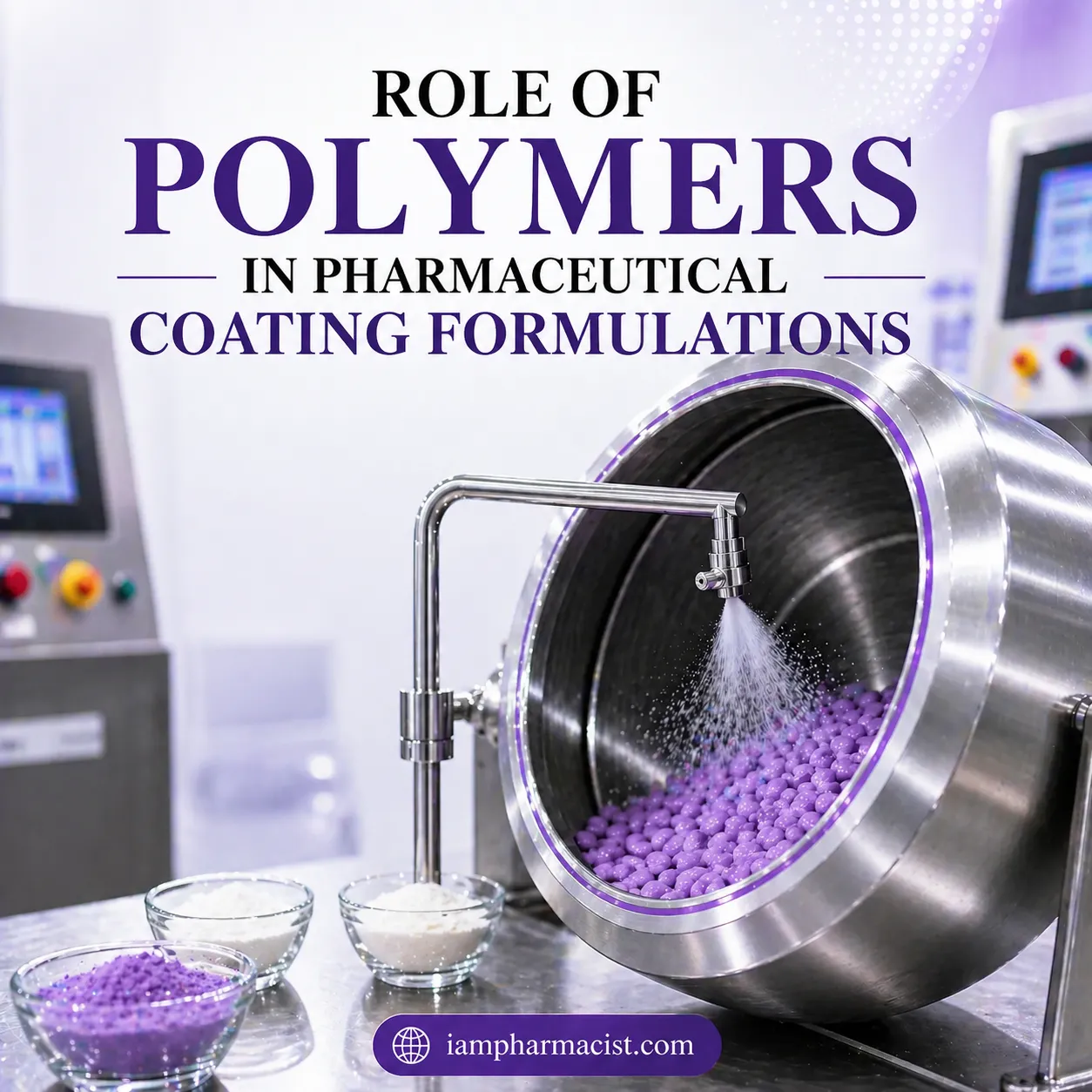

Explore the role of polymers in pharmaceutical coating formulations, including controlled release, stability, taste masking, and drug delivery systems.
Definition of Polymers in Pharmaceutical Coating
Polymers in pharmaceutical coating formulations are natural or synthetic macromolecules used to create protective, functional, or modified-release films around dosage forms. They enhance tablet stability, mask unpleasant taste, improve appearance, control drug release, and increase bioavailability while ensuring product integrity and patient compliance.
Introduction
Polymers are among the most essential components in modern pharmaceutical coating formulations. They serve as functional excipients that regulate drug release, improve stability, enhance bioavailability, and provide protective barriers against environmental conditions.
In pharmaceutical manufacturing, polymers are widely used in immediate-release tablets, modified-release systems, enteric coatings, gastro-retentive dosage forms, implants, and advanced drug delivery systems. Their versatile physicochemical properties make them ideal for controlling drug dissolution, prolonging therapeutic effects, and improving patient compliance.
The advancement of polymer science has transformed pharmaceutical coating technology by enabling sophisticated delivery systems such as sustained-release tablets, biodegradable implants, hydrogels, nanoparticles, and polymer-drug conjugates.
Importance of Polymers in Pharmaceutical Coating
Pharmaceutical polymers contribute significantly to dosage form performance and therapeutic effectiveness.
Major Functions of Polymers
- Control drug release rates
- Improve tablet appearance
- Enhance mechanical strength
- Protect APIs from moisture and oxidation
- Mask unpleasant taste and odor
- Improve patient compliance
- Increase shelf-life stability
- Enhance bioavailability
- Enable targeted drug delivery
Types of Polymers Used in Pharmaceutical Coatings
Natural Polymers
Natural polymers are biocompatible and biodegradable materials derived from natural sources.
| Natural Polymer | Application |
|---|---|
| Starch | Binder and film former |
| Chitosan | Controlled release coating |
| Alginate | Gastro-retentive systems |
| Gelatin | Capsule coating |
| Pectin | Colon-targeted delivery |
Synthetic Polymers
Synthetic polymers provide better reproducibility and controlled release characteristics.
| Synthetic Polymer | Pharmaceutical Use |
|---|---|
| Hydroxypropyl Methylcellulose (HPMC) | Film coating and sustained release |
| Polyvinyl Pyrrolidone (PVP) | Binder and coating agent |
| Ethyl Cellulose | Extended-release coating |
| Eudragit Polymers | Enteric coating |
| Polyethylene Glycol (PEG) | Plasticizer and solubility enhancer |
Role of Polymers in Immediate-Release Dosage Forms
Immediate-release dosage forms rapidly disintegrate after administration to provide fast therapeutic action.
Polymer Functions in Immediate Release Tablets
- Improve tablet hardness
- Enhance coating smoothness
- Reduce friability
- Improve dissolution
- Protect sensitive APIs
Common Immediate-Release Polymers
- HPMC
- PVP
- PEG
- Cellulose derivatives
These polymers provide rapid hydration and fast drug dissolution profiles.
Role of Polymers in Modified-Release Dosage Forms
Modified-release systems are designed to release drugs over an extended period.
Functions in Modified Release Systems
- Sustain drug release
- Reduce dosing frequency
- Minimize plasma fluctuations
- Improve patient adherence
- Reduce side effects
Controlled Release Mechanisms of Polymers
| Mechanism | Polymer Action |
|---|---|
| Diffusion Controlled | Drug diffuses through polymer matrix |
| Erosion Controlled | Polymer gradually degrades |
| Swelling Controlled | Polymer hydrates and expands |
| Osmotic Controlled | Polymer regulates water penetration |
Biodegradable Polymers in Drug Delivery
Biodegradable polymers are extensively used because of their excellent biocompatibility and safe degradation characteristics.
Advantages of Biodegradable Polymers
- Non-toxic degradation
- Improved biocompatibility
- Reduced surgical removal
- Controlled drug release
- Enhanced therapeutic effectiveness
Common Biodegradable Polymers
| Polymer | Biomedical Application |
|---|---|
| Polylactic Acid (PLA) | Implants and microspheres |
| Polyglycolic Acid (PGA) | Sutures and drug delivery |
| PLGA | Nanoparticles and depot injections |
| Polycaprolactone | Long-term implants |
Role of Polymers in Taste Masking
Many APIs possess bitter or unpleasant taste profiles.
How Polymers Help
- Form protective film barriers
- Prevent API dissolution in saliva
- Improve palatability
- Enhance pediatric compliance
Taste masking is especially important for chewable tablets and oral dispersible formulations.
Polymers in Enteric Coating Formulations
Enteric polymers prevent drug release in the stomach and allow release in the intestine.
Benefits of Enteric Coating
- Protect acid-sensitive drugs
- Reduce gastric irritation
- Improve targeted delivery
- Enhance drug stability
Common Enteric Polymers
- Cellulose acetate phthalate (CAP)
- Eudragit L100
- Hydroxypropyl methylcellulose phthalate (HPMCP)
Polymer Properties Affecting Pharmaceutical Coating
Important Polymer Characteristics
| Property | Importance |
|---|---|
| Molecular Weight | Controls viscosity and film strength |
| Solubility | Determines release behavior |
| Glass Transition Temperature | Affects film flexibility |
| Biocompatibility | Ensures patient safety |
| Biodegradability | Supports controlled degradation |
Advanced Applications of Pharmaceutical Polymers
Modern pharmaceutical technologies increasingly depend on advanced polymer systems.
Emerging Applications
- Nanoparticle drug delivery
- Hydrogels
- Polymeric micelles
- Gene delivery systems
- Tissue engineering scaffolds
- Stimuli-responsive drug systems
- Smart coatings
How to Select Polymers for Pharmaceutical Coating Formulations
Step 1: Define Drug Release Requirements
Determine whether the formulation requires:
- Immediate release
- Sustained release
- Delayed release
- Enteric release
Step 2: Evaluate Drug Properties
Assess:
- Solubility
- Stability
- Hygroscopicity
- API compatibility
Step 3: Assess Polymer Characteristics
Select polymers based on:
- Film-forming ability
- Viscosity
- Mechanical strength
- Solubility profile
Step 4: Conduct Compatibility Studies
Perform:
- FTIR analysis
- DSC studies
- Stability studies
- Dissolution compatibility testing
Step 5: Optimize Coating Parameters
Optimize:
- Spray rate
- Drying temperature
- Coating thickness
- Polymer concentration
Challenges Associated with Pharmaceutical Polymers
Common Challenges
- Stability concerns
- Moisture sensitivity
- Polymer incompatibility
- High processing cost
- Batch variability
- Environmental sensitivity
Proper formulation development minimizes these issues.
Comparative Table of Common Pharmaceutical Coating Polymers
| Polymer | Type | Release Profile | Main Application |
|---|---|---|---|
| HPMC | Synthetic | Sustained Release | Film coating |
| Ethyl Cellulose | Synthetic | Extended Release | Matrix systems |
| Eudragit | Synthetic | Enteric Release | Gastro-resistant coating |
| Chitosan | Natural | Controlled Release | Mucoadhesive systems |
| PLA | Biodegradable | Long-term Release | Implants |
Regulatory Considerations for Pharmaceutical Polymers
Regulatory agencies require polymer safety, compatibility, and performance evaluation.
Regulatory Focus Areas
- Toxicological safety
- Residual solvent limits
- Stability performance
- Biocompatibility
- GMP compliance
- Functional performance validation
Manufacturers must comply with:
- FDA guidelines
- ICH Q8
- ICH Q9
- ICH Q10
- USP/NF standards
FAQs
1. What are polymers in pharmaceutical coatings?
Polymers are natural or synthetic materials used to form protective or functional coatings around pharmaceutical dosage forms.
2. Why are polymers important in tablet coating?
They improve stability, control drug release, enhance appearance, and mask unpleasant taste.
3. Which polymer is commonly used in film coating?
Hydroxypropyl Methylcellulose (HPMC) is one of the most commonly used film-coating polymers.
4. What are biodegradable polymers?
Biodegradable polymers degrade safely within the body and are widely used in implants and controlled-release systems.
5. How do polymers control drug release?
Polymers regulate drug diffusion, swelling, erosion, or osmotic release mechanisms.
6. What is enteric coating polymer?
An enteric polymer prevents drug release in acidic stomach conditions and dissolves in the intestine.
7. What are natural pharmaceutical polymers?
Examples include starch, chitosan, alginate, gelatin, and pectin.
8. What are synthetic pharmaceutical polymers?
Examples include HPMC, PVP, Eudragit, PEG, and ethyl cellulose.
9. Are polymers safe in pharmaceutical formulations?
Yes, pharmaceutical polymers undergo rigorous safety and biocompatibility testing before approval.
10. What is the future of polymers in drug delivery?
Advanced polymers are enabling smart drug delivery systems, nanotechnology, and personalized medicine applications.
{ “@context”: “https://schema.org”, “@type”: “Article”, “headline”: “Role of Polymers in Pharmaceutical Coating Formulations”, “description”: “Comprehensive guide to polymers used in pharmaceutical coating formulations and advanced drug delivery systems.”, “author”: { “@type”: “Person”, “name”: “Pharmaceutical Formulation Expert” }, “publisher”: { “@type”: “Organization”, “name”: “iampharmacist.com” } } { “@context”: “https://schema.org”, “@type”: “FAQPage”, “mainEntity”: [ { “@type”: “Question”, “name”: “What are polymers in pharmaceutical coatings?”, “acceptedAnswer”: { “@type”: “Answer”, “text”: “Polymers are natural or synthetic materials used to form protective or functional coatings around pharmaceutical dosage forms.” } }, { “@type”: “Question”, “name”: “Why are polymers important in tablet coating?”, “acceptedAnswer”: { “@type”: “Answer”, “text”: “They improve stability, control drug release, enhance appearance, and mask unpleasant taste.” } } ] } { “@context”: “https://schema.org”, “@type”: “HowTo”, “name”: “How to Select Polymers for Pharmaceutical Coating Formulations”, “step”: [ { “@type”: “HowToStep”, “name”: “Define Drug Release Requirements” }, { “@type”: “HowToStep”, “name”: “Evaluate Drug Properties” }, { “@type”: “HowToStep”, “name”: “Assess Polymer Characteristics” }, { “@type”: “HowToStep”, “name”: “Conduct Compatibility Studies” }, { “@type”: “HowToStep”, “name”: “Optimize Coating Parameters” } ] }