


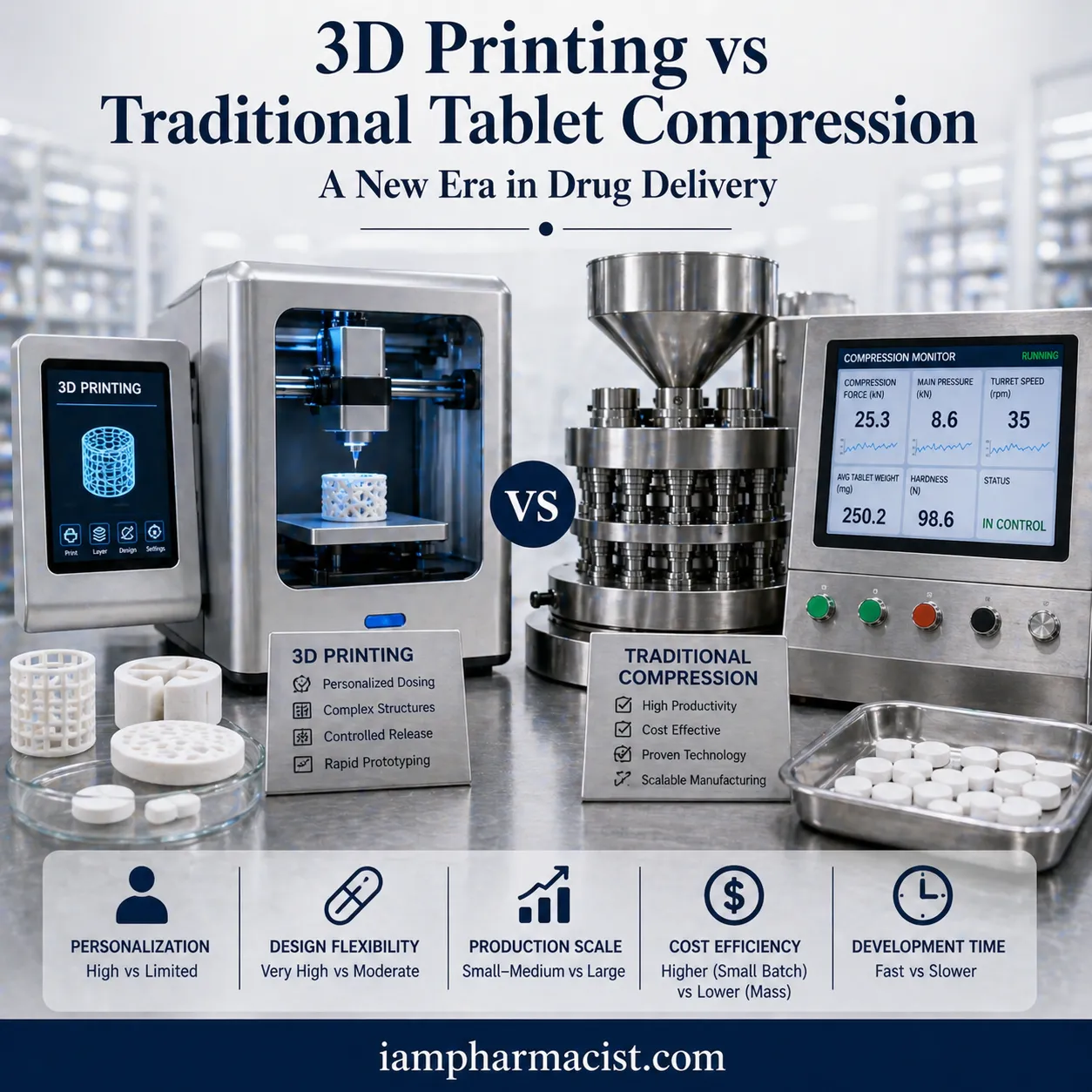

3D Printing vs Traditional Tablet Compression in pharma—benefits, limitations, and future of personalized drug delivery systems.
Definition
3D printing in pharmaceuticals is an additive manufacturing process that creates drug products layer-by-layer using digital designs, while tablet compression is a traditional method that forms tablets by compressing powder blends into solid dosage forms.
Introduction
Pharmaceutical manufacturing is undergoing a major transformation.
For decades, tablet compression has dominated drug production due to its:
- High efficiency
- Low cost
- Scalability
But now, 3D printing (additive manufacturing) is emerging as a disruptive technology, offering:
- Personalized dosing
- Complex drug release profiles
- Rapid prototyping
Unlike traditional “one-size-fits-all” tablets, 3D printing enables patient-specific medicines, marking the beginning of a new era in drug delivery.
👉 The approval of the first 3D-printed drug Spritam® and multiple FDA IND approvals highlight this shift toward innovation
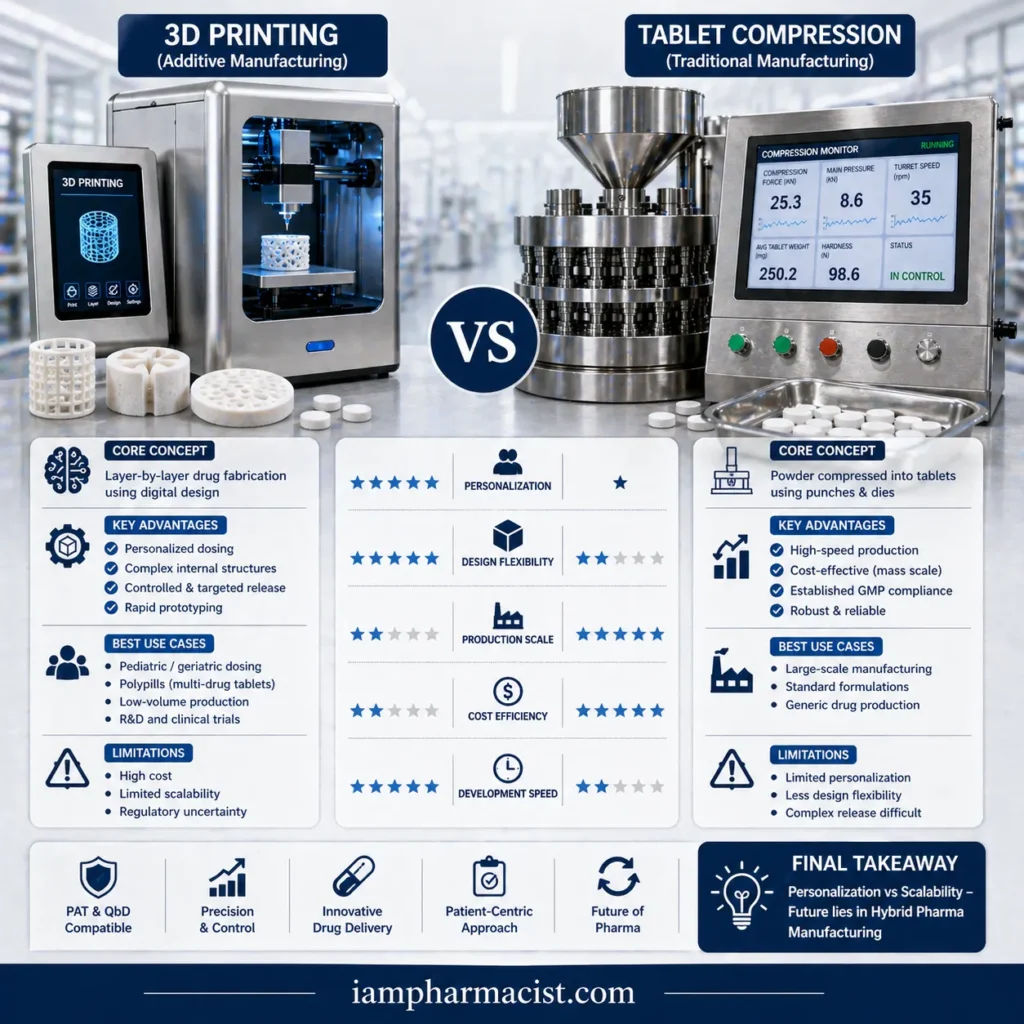
Key Differences at a Glance
| Feature | 3D Printing | Tablet Compression |
|---|---|---|
| Manufacturing Type | Additive | Compression |
| Personalization | High | Limited |
| Production Scale | Small–Medium | Large-scale |
| Complexity of Design | Very High | Moderate |
| Cost Efficiency | Higher (small batches) | Lower (mass production) |
| Development Speed | Fast prototyping | Slower |
How Each Technology Works
3D Printing (Additive Manufacturing)
- Create digital model (CAD)
- Slice model into layers
- Print layer-by-layer
- Post-process final product
👉 Enables precise control over structure, dose, and release behavior.https://www.webofpharma.com/2025/05/in-process-checks-and-failure-handling.html
Tablet Compression (Traditional Method)
- Blend API + excipients
- Granulation (if required)
- Feed into die cavity
- Compress using punches
- Eject tablet
👉 Designed for high-speed, large-scale production. https://iampharmacist.com/process-analytical-technology/
Step-by-Step: Choosing the Right Technology
Step 1: Define Product Requirement
- Personalized dose → 3D printing
- Mass production → compression
Step 2: Evaluate Drug Properties
- Complex release profile → 3D printing
- Simple formulation → compression
Step 3: Consider Production Scale
- Small batch → 3D printing
- Large batch → compression
Step 4: Assess Cost & Time
- Fast development → 3D printing
- Cost efficiency → compression
Step 5: Regulatory Considerations
- Established pathway → compression
- Emerging regulations → 3D printing
Advantages of 3D Printing in Pharmaceuticals
1. Personalized Medicine
- Custom doses for pediatric and geriatric patients
- Improved patient compliance
2. Complex Drug Release
- Multi-layer tablets
- Controlled and targeted release
3. Rapid Development
- Faster prototyping
- Reduced development time
4. Flexible Manufacturing
- Easy modification of formulations
- Small batch production https://iampharmacist.com/continuous-manufacturing-in-tablet-compression/
Advantages of Tablet Compression
1. High Efficiency
- Millions of tablets per day
2. Cost-Effective
- Ideal for mass production
3. Established Technology
- Widely accepted by regulators
4. Process Stability
- Proven and reliable
Limitations of Each Approach
3D Printing Challenges
- High equipment cost
- Limited large-scale production
- Regulatory uncertainty
Tablet Compression Challenges
- Limited personalization
- Difficult to create complex structures
- Longer development cycles
Real-World Applications of 3D Printing
- Immediate-release tablets
- Controlled-release tablets
- Polypills (multiple drugs in one tablet)
- Microneedles and implants
👉 3D printing enables innovative dosage forms not possible with traditional methods https://iampharmacist.com/ai-and-data-analytics/
Future Trends
- Personalized medicine at scale
- Integration with AI and PAT
- Continuous + digital manufacturing
- Smart drug delivery systems
👉 3D printing is expected to complement—not fully replace—tablet compression.
FAQs
1. What is 3D printing in pharma?
A method to create drugs layer-by-layer using digital designs.
2. How is it different from tablet compression?
3D printing is additive; compression uses mechanical force.
3. What is the main advantage of 3D printing?
Personalized medicine.
4. Is tablet compression outdated?
No, it is still widely used for mass production.
5. Can 3D printing replace traditional methods?
Not completely—both will coexist.
6. What is Spritam®?
The first FDA-approved 3D-printed drug.
7. What are polypills?
Tablets containing multiple drugs.
8. Why is 3D printing important?
It enables customized and complex drug delivery.
9. What are challenges of 3D printing?
Cost, scalability, and regulation.
10. What is the future of pharma manufacturing?
Hybrid systems combining traditional and advanced technologies.
{ “@context”: “https://schema.org”, “@type”: “Article”, “headline”: “3D Printing vs Traditional Tablet Compression”, “description”: “Compare 3D printing and traditional tablet compression in pharmaceuticals.”, “author”: { “@type”: “Organization”, “name”: “iampharmacist.com” }, “mainEntityOfPage”: { “@type”: “WebPage”, “@id”: “https://iampharmacist.com/3d-printing-vs-tablet-compression” } } { “@context”: “https://schema.org”, “@type”: “HowTo”, “name”: “How to Choose Between 3D Printing and Tablet Compression”, “step”: [ {“@type”: “HowToStep”,”text”: “Define product requirements”}, {“@type”: “HowToStep”,”text”: “Evaluate drug properties”}, {“@type”: “HowToStep”,”text”: “Consider production scale”}, {“@type”: “HowToStep”,”text”: “Assess cost and time”}, {“@type”: “HowToStep”,”text”: “Check regulatory requirements”} ] } { “@context”: “https://schema.org”, “@type”: “FAQPage”, “mainEntity”: [ {“@type”: “Question”,”name”: “What is 3D printing in pharma?”,”acceptedAnswer”:{“@type”:”Answer”,”text”:”A method to create drugs layer-by-layer.”}}, {“@type”: “Question”,”name”: “Can 3D printing replace tablet compression?”,”acceptedAnswer”:{“@type”:”Answer”,”text”:”No, both will coexist.”}} ] }