


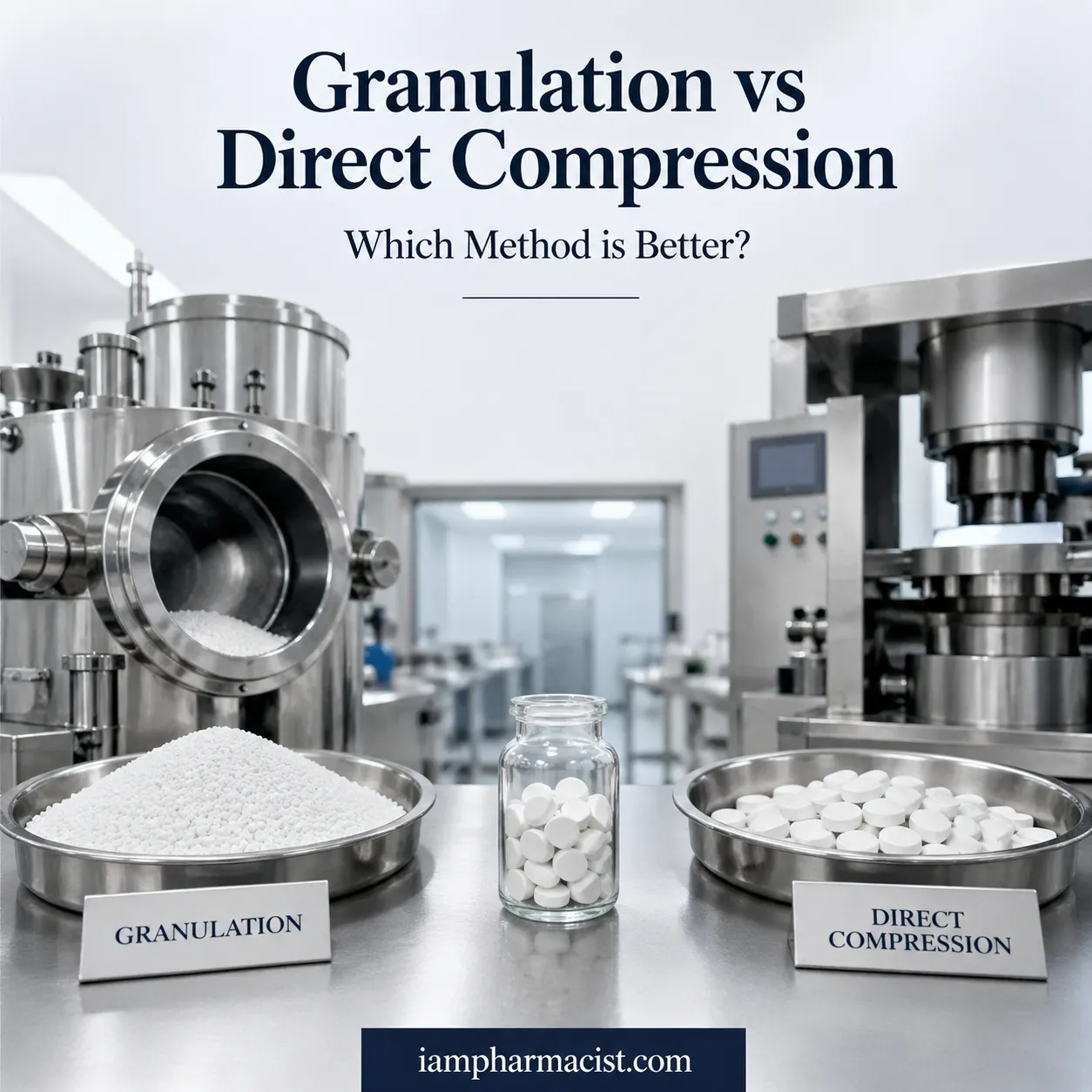

Compare granulation vs direct compression in tablet manufacturing. Learn benefits, challenges, and how to choose the best method for quality tablets.
Definition
Granulation and direct compression are two primary tablet manufacturing methods. Direct compression involves blending and compressing powders directly, while granulation modifies powder properties to improve flow and compressibility before compression.
Introduction
Tablet manufacturing demands precise control over properties like hardness, uniformity, friability, and dissolution. Choosing the right process—direct compression or granulation—plays a critical role in achieving these quality standards.
Each method offers unique advantages depending on:
- API characteristics
- Desired tablet performance
- Production efficiency
Understanding when to use each approach can significantly improve both product quality and manufacturing cost-effectiveness.
Quick Comparison Table
| Feature | Direct Compression | Granulation (Wet/Dry) |
|---|---|---|
| Process Complexity | Simple | More complex |
| Production Speed | Fast | Slower |
| Cost | Lower | Higher |
| Flow Properties | Requires excellent flow | Improved through granulation |
| Compressibility | Limited | Enhanced |
| API Suitability | Sensitive APIs preferred | High-dose or poor-flow APIs |
| Risk of Segregation | High | Low |
What is Direct Compression?
Overview
Direct compression is the simplest and fastest method where powders are:
- Blended
- Lubricated
- Compressed into tablets
Advantages
- Fewer processing steps
- Lower cost and faster production
- Ideal for heat- and moisture-sensitive APIs
Limitations
- Requires excellent powder flow and compressibility
- Risk of segregation with uneven particle sizes
- Challenging for low-dose or high-dose APIs
💡 Key Insight:
Uniform mixing is critical—poor blending leads to inconsistent dosage.
What is Granulation?
Granulation modifies powder properties to improve flow and compressibility.
Types of Granulation
1. Wet Granulation
- Uses liquid binder to form granules
- Produces strong, uniform tablets
Pros:
- Excellent compressibility
- Uniform API distribution
Cons:
- Time-consuming
- Not suitable for moisture-sensitive APIs
2. Dry Granulation
- Uses compaction (roller compaction/slugging)
- No heat or moisture involved
Pros:
- Suitable for sensitive APIs
- More cost-effective than wet granulation
Cons:
- Less effective than wet granulation for binding
Key Differences That Matter
1. Powder Flow & Segregation
- Direct compression → higher risk
- Granulation → improved uniformity
2. Compressibility
- Direct compression → depends on excipients
- Granulation → inherently improved
3. Cost & Efficiency
- Direct compression → faster, cheaper
- Granulation → higher cost but better quality control
How to Choose the Right Method
Step 1: Evaluate API Properties
- Poor flow → choose granulation
- Heat-sensitive → choose direct or dry granulation
Step 2: Assess Dosage Requirements
- Low-dose → risk of segregation → granulation preferred
- High-dose → may require granulation for compressibility
Step 3: Consider Production Scale
- High-speed production → direct compression
- Complex formulations → granulation
Step 4: Analyze Cost Constraints
- Tight budget → direct compression
- Quality-critical product → granulation
Step 5: Validate Through Testing
- Perform pilot batches
- Evaluate hardness, dissolution, uniformity
When is Direct Compression Better?
- Simple formulations
- APIs with good flow and compressibility
- Cost-sensitive, high-volume production
When is Granulation Better?
- Poor-flow or cohesive powders
- High-dose APIs
- Products requiring high uniformity and strength
Industry Insight
Modern pharmaceutical manufacturing increasingly focuses on excipient innovation to improve direct compression performance, reducing the need for complex granulation processes while maintaining quality.
FAQs
1. What is the main difference between granulation and direct compression?
Direct compression skips preprocessing, while granulation modifies powder properties before compression.
2. Which method is faster?
Direct compression is faster due to fewer steps.
3. Why is granulation used?
To improve flow, compressibility, and uniformity.
4. Is direct compression cheaper?
Yes, it requires fewer processing steps and less equipment.
5. What are the risks of direct compression?
Segregation and poor compressibility.
6. When should wet granulation be used?
For formulations needing strong binding and uniformity.
7. Is dry granulation suitable for sensitive APIs?
Yes, it avoids heat and moisture.
8. Can excipients replace granulation?
In some cases, advanced excipients enable direct compression.
9. Which method gives better tablet strength?
Granulation generally provides stronger tablets.
10. How do you choose the best method?
Based on API properties, cost, and desired tablet quality.
{ “@context”: “https://schema.org”, “@type”: “Article”, “headline”: “Granulation vs Direct Compression: Which Method is Better?”, “description”: “Compare tablet manufacturing methods and choose the best approach.”, “author”: { “@type”: “Person”, “name”: “Pharma Manufacturing Expert” } } { “@context”: “https://schema.org”, “@type”: “FAQPage”, “mainEntity”: [ { “@type”: “Question”, “name”: “What is direct compression?”, “acceptedAnswer”: { “@type”: “Answer”, “text”: “A tablet manufacturing method where powders are directly compressed.” } } ] } { “@context”: “https://schema.org”, “@type”: “HowTo”, “name”: “Choose Between Granulation and Direct Compression”, “step”: [ {“@type”: “HowToStep”, “text”: “Evaluate API properties”}, {“@type”: “HowToStep”, “text”: “Assess dosage requirements”}, {“@type”: “HowToStep”, “text”: “Consider production scale”}, {“@type”: “HowToStep”, “text”: “Analyze cost constraints”}, {“@type”: “HowToStep”, “text”: “Validate with testing”} ] }