


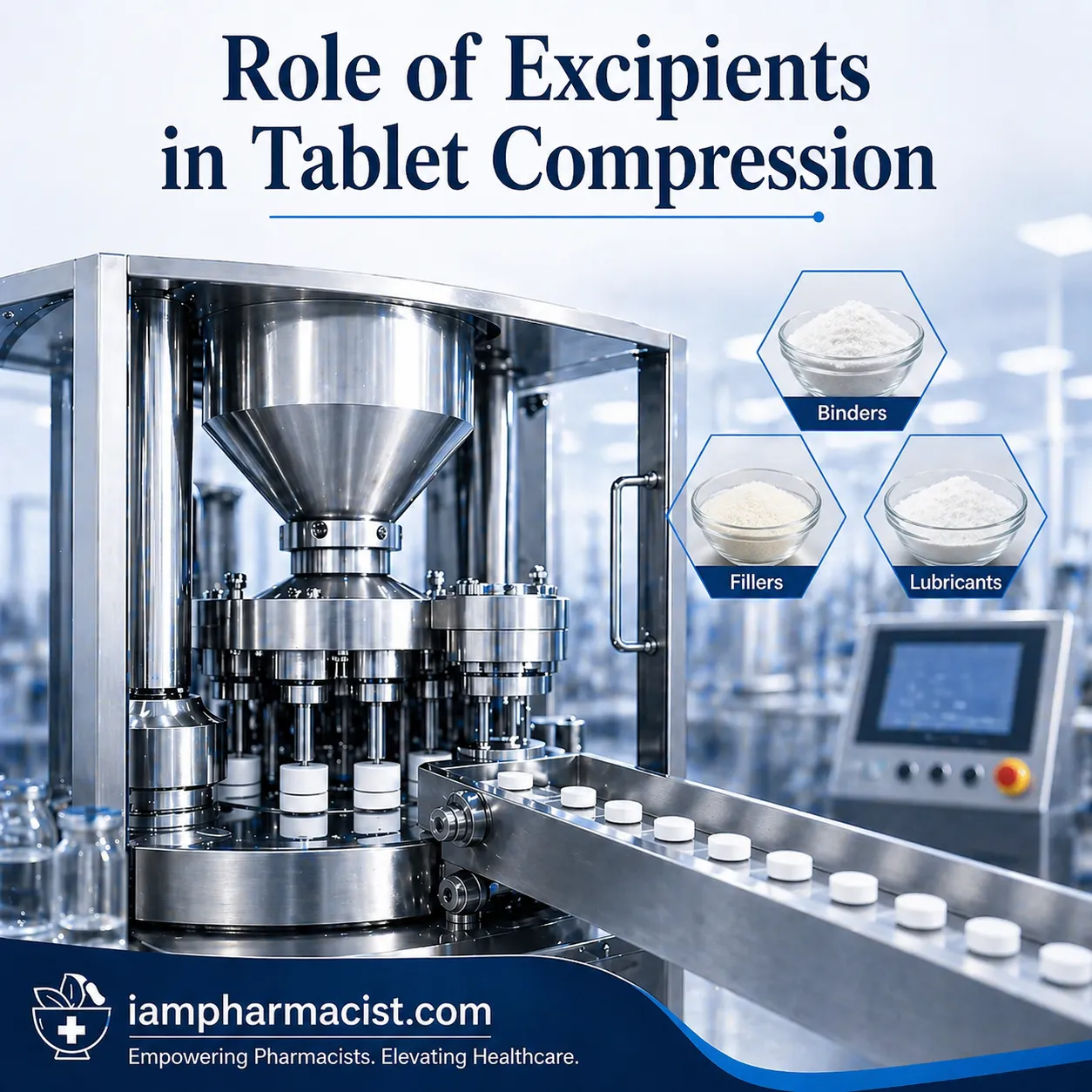

Discover Role of Excipients in Tablet Compression, how binders, lubricants, and fillers impact tablet compression, quality, and performance in pharmaceutical manufacturing processes.
Definition
Excipients in tablet compression are inactive pharmaceutical ingredients added to improve manufacturability, stability, and performance of tablets, including binders, lubricants, and fillers.
Introduction
In tablet manufacturing, the active pharmaceutical ingredient (API) alone cannot deliver a stable, effective, and manufacturable product. That’s where excipients come in.
These “inactive” ingredients are anything but passive—they directly influence:
- Tablet strength and integrity
- Flowability during compression
- Dissolution and bioavailability
Understanding how binders, lubricants, and fillers function is essential for optimizing tablet quality and preventing manufacturing defects.
Overview Table: Key Excipients and Their Roles
| Excipient Type | Primary Function | Impact on Tablet Quality | Risk if Misused |
|---|---|---|---|
| Binders | Provide cohesion | Improves hardness and integrity | Poor disintegration if excessive |
| Fillers | Increase bulk and size | Ensures uniform weight and handling | Compatibility issues with API |
| Lubricants | Reduce friction during compression | Smooth ejection and surface quality | Slower dissolution if excessive |
1. Binders (Cohesion Builders)
Function
Binders provide the adhesive force that holds powder particles together, ensuring tablets remain intact after compression.
Key Benefits
- Enhances tablet hardness
- Improves powder flow
- Prevents breakage
Common Examples
- Polyvinylpyrrolidone (PVP)
- Hydroxypropyl methylcellulose (HPMC)
- Starch and cellulose derivatives
Critical Insight
Too much binder → tablets become too hard and resist disintegration
Too little binder → tablets crumble easily
2. Fillers / Diluents (Bulk Enhancers)
Function
Fillers increase the volume of tablets when API dosage is too small for direct compression.
Key Benefits
- Improves tablet size and weight consistency
- Enhances compressibility
- Supports uniform die filling
Common Examples
- Lactose
- Mannitol
- Dicalcium phosphate
- Microcrystalline cellulose
Critical Insight
Compatibility is crucial—some fillers may interfere with drug absorption.
3. Lubricants (Friction Reducers)
Function
Lubricants reduce friction between powder and machine surfaces during compression and ejection.
Key Benefits
- Prevent sticking to punches and dies
- Improve powder flow
- Protect tooling from wear
Types
- Soluble: Polyethylene glycol (PEG)
- Insoluble: Magnesium stearate, stearic acid
Critical Insight
Excess lubricant can:
- Delay disintegration
- Reduce dissolution rate
- Affect tablet bioavailability
How Excipients Interact in Tablet Compression
Excipients do not work in isolation—they interact dynamically:
- Binders increase cohesion
- Lubricants reduce friction (but may counteract binding)
- Fillers influence compressibility and flow
Balancing these interactions is key to achieving optimal tablet performance.
How to Optimize Excipients in Tablet Formulation
Step 1: Define Product Requirements
- Immediate vs controlled release
- Target hardness and dissolution
Step 2: Select Appropriate Binders
- Choose based on desired cohesion
- Adjust concentration carefully
Step 3: Choose Compatible Fillers
- Ensure chemical compatibility with API
- Optimize for compressibility and flow
Step 4: Add Lubricants Strategically
- Add at final mixing stage
- Keep concentration below 1% (typical range)
Step 5: Test and Validate
- Evaluate hardness, friability, disintegration
- Adjust formulation iteratively
Common Mistakes in Excipient Selection
- Overusing lubricants → poor dissolution
- Using incompatible fillers → reduced bioavailability
- Incorrect binder levels → weak or overly hard tablets
- Poor mixing → inconsistent tablet quality
FAQs
1. What are excipients in tablet compression?
Inactive ingredients that improve manufacturability and performance.
2. What is the role of binders in tablets?
They provide cohesion and improve tablet strength.
3. Why are lubricants used in tablet manufacturing?
To reduce friction and prevent sticking during compression.
4. What are fillers in tablets?
They increase bulk and ensure consistent tablet size.
5. Can excipients affect drug absorption?
Yes, some fillers and lubricants can influence bioavailability.
6. What happens if too much binder is used?
Tablets may become too hard and not disintegrate properly.
7. What is the ideal lubricant concentration?
Typically less than 1% to avoid negative effects.
8. Why is lactose commonly used as a filler?
It has good compressibility and stability.
9. What are super disintegrants?
Fast-acting agents that enhance tablet breakdown.
10. How do excipients affect tablet quality?
They influence hardness, dissolution, and manufacturability.
{ “@context”: “https://schema.org”, “@type”: “Article”, “headline”: “Role of Excipients in Tablet Compression”, “description”: “Learn how binders, lubricants, and fillers impact tablet manufacturing.”, “author”: { “@type”: “Person”, “name”: “Pharma Technical Expert” } } { “@context”: “https://schema.org”, “@type”: “FAQPage”, “mainEntity”: [ { “@type”: “Question”, “name”: “What are excipients in tablet compression?”, “acceptedAnswer”: { “@type”: “Answer”, “text”: “Excipients are inactive ingredients used to improve tablet manufacturing and performance.” } } ] } { “@context”: “https://schema.org”, “@type”: “HowTo”, “name”: “Optimize Excipients in Tablet Compression”, “step”: [ {“@type”: “HowToStep”, “text”: “Define product requirements”}, {“@type”: “HowToStep”, “text”: “Select binders”}, {“@type”: “HowToStep”, “text”: “Choose fillers”}, {“@type”: “HowToStep”, “text”: “Add lubricants”}, {“@type”: “HowToStep”, “text”: “Validate formulation”} ] }