


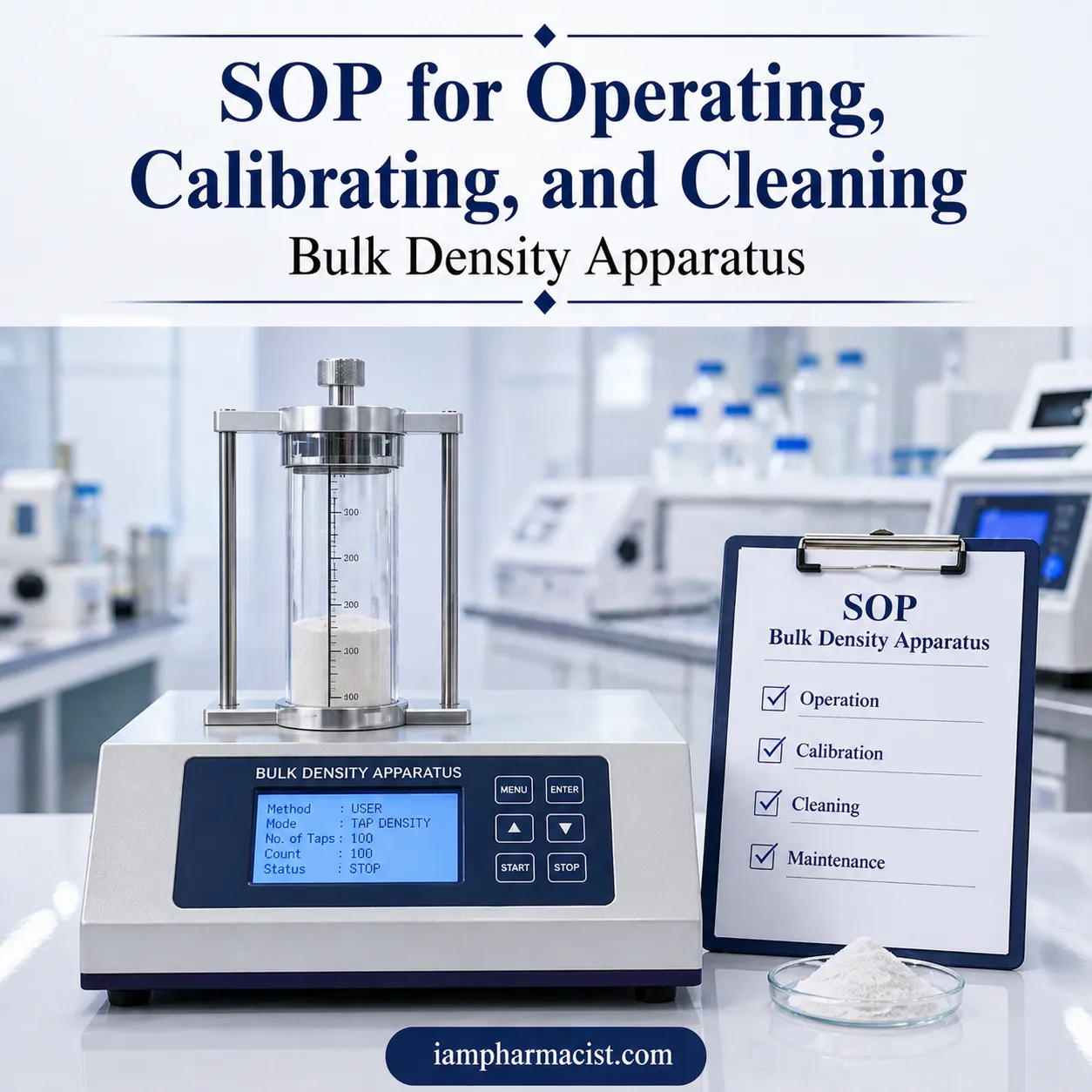

Learn SOP for operating, calibrating, and cleaning bulk density apparatus for tapped density testing of API with QC-compliant procedures.
Definition
A bulk density apparatus SOP is a standardized procedure that describes how to operate, calibrate, and clean the instrument used to determine the bulk and tapped density of pharmaceutical powders, ensuring accuracy, repeatability, and compliance with pharmacopeial standards.
| Parameter | Description |
|---|---|
| Initial Volume | Unsettled powder volume |
| Final Volume | Volume after tapping |
| Number of Taps | Typically 50, 100, or 200 |
| Sample Type | API or excipient powder |
| Output | Bulk density & tapped density |
Step-by-Step List
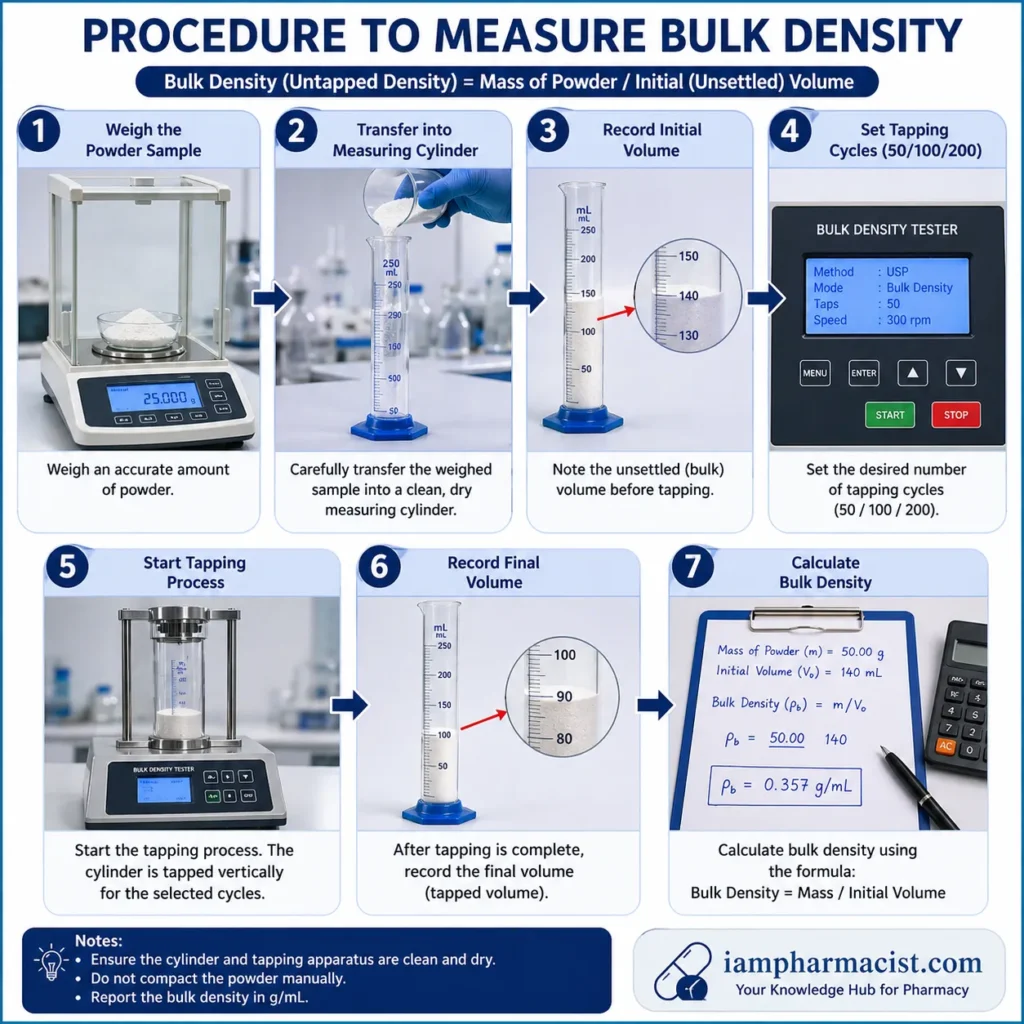
Tapped Density Test Steps:
- Weigh the powder sample
- Transfer into measuring cylinder
- Record initial volume
- Set tapping cycles (50/100/200)
- Start tapping process
- Record final volume
- Calculate tapped density
Introduction
In pharmaceutical quality control, understanding powder flow properties is essential for formulation development and manufacturing consistency. The bulk density apparatus is a critical tool used to determine both bulk density and tapped density of active pharmaceutical ingredients (API) and excipients.
A well-defined SOP ensures accurate measurement, minimizes variability, and supports compliance with pharmacopeial standards such as USP and IP. https://www.webofpharma.com/2026/04/dissolution-apparatus-2-paddle-guide.html
1.0 OBJECTIVE
To establish a standardized procedure for the operation and calibration of the bulk density apparatus.
2.0 SCOPE
Applicable to the Quality Control (QC) Department for powder density testing.
3.0 RESPONSIBILITY
Quality Control Supervisor
4.0 ACCOUNTABILITY
Sr. Manager Quality Assurance (QA)
5.0 PROCEDURE
5.1 Operation of Bulk Density Apparatus
Step-by-Step Operating Instructions
- Connect the instrument to the main power supply and switch ON
- Verify that the home screen is displayed
- Select Method and Mode using Enter and Increment keys
- Set initial taps and final taps in User Mode
- Enter:
- Batch number
- Sample weight
- Unsettled volume
- Fill the measuring cylinder with weighed powder sample
- Secure the cylinder using aluminum cap
- Press Enter to start tapping
- Allow strokes to continue until preset value is reached
- Observe and record final volume (stacking behavior)
5.2 Calibration Procedure
Calibration Steps
- Clean the instrument and measuring cylinders thoroughly
- Set tapping cycles to:
- 50 taps
- 100 taps
- 200 taps
- Weigh lactose (40 mesh passed) as standard material
- Transfer sample into measuring cylinder
- Secure cylinder with threading plates and cover
- Run the instrument for each tap setting
- Record readings after each cycle
- Compare results with standard reference values
Acceptance Criteria
- Results must fall within predefined tolerable limits
Failure Handling
- Label instrument as “Out of Order”
- Inform service engineer or manufacturer
5.3 Cleaning Procedure
Routine Cleaning Steps
- Switch OFF and unplug the instrument
- Remove measuring cylinders
- Clean with dry cloth or mild cleaning agent
- Avoid moisture in electronic components
- Ensure cylinders are completely dry before reuse
Understanding Bulk vs Tapped Density
- Bulk Density: Mass of powder divided by initial volume
- Tapped Density: Mass divided by volume after tapping
These values help calculate:
- Compressibility index
- Hausner ratio
- Flow properties of powders
6.0 ABBREVIATIONS
- SOP: Standard Operating Procedure
- Dept.: Department
FAQs
1. What is a bulk density apparatus?
It is a device used to measure bulk and tapped density of powders.
2. Why is tapped density important?
It indicates powder flow and compressibility characteristics.
3. What material is used for calibration?
Typically lactose passed through 40 mesh sieve.
4. What are standard tapping cycles?
50, 100, and 200 taps.
5. What is unsettled volume?
Initial volume of powder before tapping.
6. What happens during tapping?
Powder particles settle, reducing volume.
7. How is tapped density calculated?
Mass divided by final tapped volume.
8. What if calibration fails?
Instrument is marked “Out of Order” and serviced.
9. What industries use this test?
Pharmaceutical, chemical, and food industries.
10. Is this test required by pharmacopeia?
Yes, included in USP, IP, and BP standards.
{ “@context”: “https://schema.org”, “@type”: “Article”, “headline”: “Bulk Density Apparatus SOP for Tapped Density”, “description”: “Complete SOP for operation, calibration, and cleaning of bulk density apparatus used in pharmaceutical QC.”, “author”: { “@type”: “Person”, “name”: “Pharma QA Expert” }, “publisher”: { “@type”: “Organization”, “name”: “Pharma Insights” } } { “@context”: “https://schema.org”, “@type”: “FAQPage”, “mainEntity”: [ { “@type”: “Question”, “name”: “What is tapped density?”, “acceptedAnswer”: { “@type”: “Answer”, “text”: “Tapped density is the density of powder after it has been compacted by tapping.” } } ] } { “@context”: “https://schema.org”, “@type”: “HowTo”, “name”: “How to Measure Tapped Density”, “step”: [ {“@type”: “HowToStep”,”text”: “Weigh sample”}, {“@type”: “HowToStep”,”text”: “Fill cylinder”}, {“@type”: “HowToStep”,”text”: “Set taps”}, {“@type”: “HowToStep”,”text”: “Run test”}, {“@type”: “HowToStep”,”text”: “Record volume”} ] }