


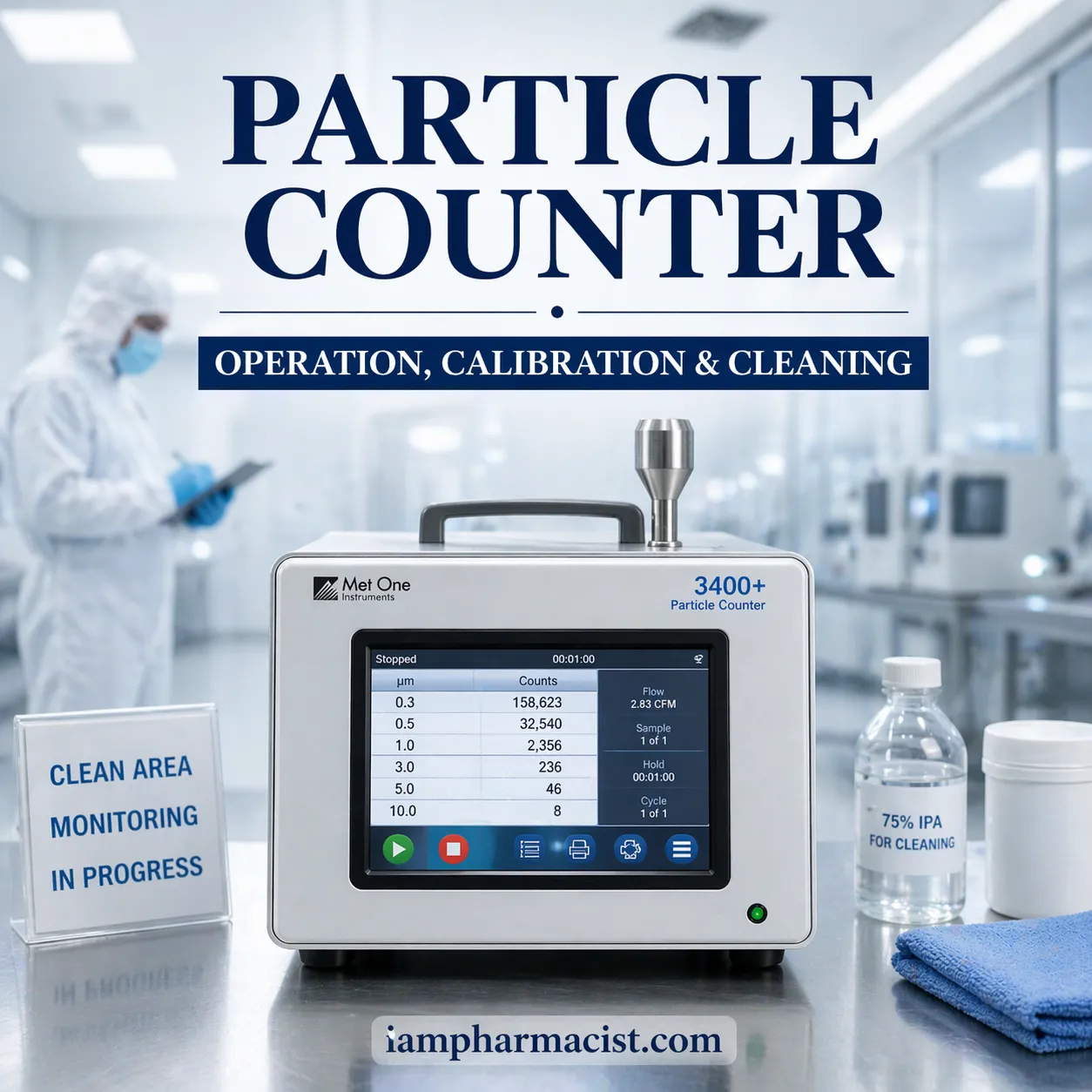

Complete SOP for particle counter operation, calibration, and cleaning in cleanrooms using Met One 3400 with step-by-step QC compliance guidance.
Definition
A Particle Counter SOP (Standard Operating Procedure) is a documented process used in cleanrooms and Quality Control laboratories to ensure accurate operation, calibration, and cleaning of particle counters for monitoring airborne particulate contamination.
| Section | Purpose | Key Activities |
|---|---|---|
| Operation | Measure airborne particles | Login, sampling, monitoring |
| Calibration | Ensure accuracy of readings | Flow rate, sensor verification |
| Cleaning | Prevent contamination | Inlet cleaning, wiping, storage |
Step-by-Step SOP
- Power ON and login
- Remove inlet cap
- Start sampling process
- Monitor particle counts
- Stop and record data
- Perform calibration checks
- Clean inlet and exterior
- Store properly
Introduction
Maintaining cleanroom integrity is critical in pharmaceutical manufacturing and sterile environments. A Particle Counter SOP ensures reliable monitoring of airborne contamination, helping meet regulatory standards such as ISO 14644 and GMP.
This guide provides a comprehensive, practical SOP for operating, calibrating, and cleaning the Met One 3400 particle counter, ensuring data accuracy, compliance, and equipment longevity.
1.0 OBJECTIVE
To lay down a procedure for operation, calibration, and cleaning of the particle counter.
2.0 SCOPE
Applicable to operation of particle counter Met One 3400 used in clean areas.
3.0 RESPONSIBILITY
Officer / Executive – Quality Control
4.0 ACCOUNTABILITY
Manager – Quality Control
5.0 PROCEDURE
5.1 Operation of Particle Counter
5.1.1 Logging In
- Switch ON the main power
- Enter Counter Navigation → Factory
Login Methods:
- If starting fresh → touch screen to login
- If another user is logged in → tap Lock icon → logout → login again
Login Steps
- Touch Name field
- Enter username using touchscreen
- Press Enter
- Touch Password field
- Enter password
- Press Enter
- If successful → Main screen appears
- If failed → re-enter credentials
5.1.2 Taking Counts
⚠️ Always remove inlet cap before operation
- Remove protective cap from inlet tube
- Ensure screen displays Counter Navigation
- Press Sample
- Press Run icon to start
During Operation
- Run icon changes to Stop
- Display shows:
- Particle counts
- Temperature
- Humidity
- Air velocity
Alarm Indications
- Red flashing text
- Audible alarm (if enabled)
Stopping Counts
- Automatic after cycle
- Manual: press Stop icon
After Completion
- Record total particle count
- Note environmental parameters
5.2 Calibration of Particle Counter
Calibration Frequency
- Every 6–12 months or as per SOP
- After repair or relocation
Calibration Parameters
- Flow rate accuracy
- Particle size detection
- Sensor performance
Calibration Procedure
- Verify flow rate using calibrated flow meter
- Check zero count using HEPA filter
- Perform particle size verification with standard particles
- Validate alarm limits and settings
- Document results in calibration log
Acceptance Criteria
- Flow rate within ±5%
- Zero count compliance
- Accurate particle size detection
5.3 Cleaning of Particle Counter
Cleaning Frequency
- Before and after use
- Weekly deep cleaning
Cleaning Procedure
- Switch OFF the instrument
- Wipe external surface with lint-free cloth
- Clean inlet probe using IPA (if required)
- Ensure no liquid enters instrument
- Replace protective cap
- Store in clean, dry area
6.0 ABBREVIATIONS
- SOP – Standard Operating Procedure
- QC – Quality Control
FAQs
1. What is a particle counter used for?
It measures airborne particles in cleanrooms to ensure contamination control.
2. What is Met One 3400?
A portable particle counter used in pharmaceutical cleanrooms.https://www.webofpharma.com/2026/03/performance-qualification-pq-in.html
3. How often should particle counters be calibrated?
Typically every 6–12 months.
4. Why remove inlet cap before use?
To prevent damage and ensure accurate sampling.
5. What parameters does it measure?
Particle count, temperature, humidity, and airflow.
6. What is zero count test?
A test using filtered air to verify no particle detection.
7. What happens if calibration is skipped?
Results may be inaccurate and non-compliant.
8. How to clean particle counter inlet?
Use lint-free cloth or IPA carefully.
9. What are alarm indications?
Visual (red flashing) and audible alerts.
10. What standards apply?
ISO 14644 and GMP guidelines.
{ “@context”: “https://schema.org”, “@type”: “Article”, “headline”: “Particle Counter SOP: Operation, Calibration & Cleaning”, “description”: “Complete SOP for particle counter use in cleanrooms.”, “author”: { “@type”: “Organization”, “name”: “QC SOP Experts” }, “datePublished”: “2026-04-21” } { “@context”: “https://schema.org”, “@type”: “FAQPage”, “mainEntity”: [ { “@type”: “Question”, “name”: “What is a particle counter used for?”, “acceptedAnswer”: { “@type”: “Answer”, “text”: “It measures airborne particles in cleanrooms.” } } ] } { “@context”: “https://schema.org”, “@type”: “HowTo”, “name”: “How to Operate a Particle Counter”, “step”: [ {“@type”: “HowToStep”, “text”: “Login to device”}, {“@type”: “HowToStep”, “text”: “Remove inlet cap”}, {“@type”: “HowToStep”, “text”: “Start sampling”} ] }