


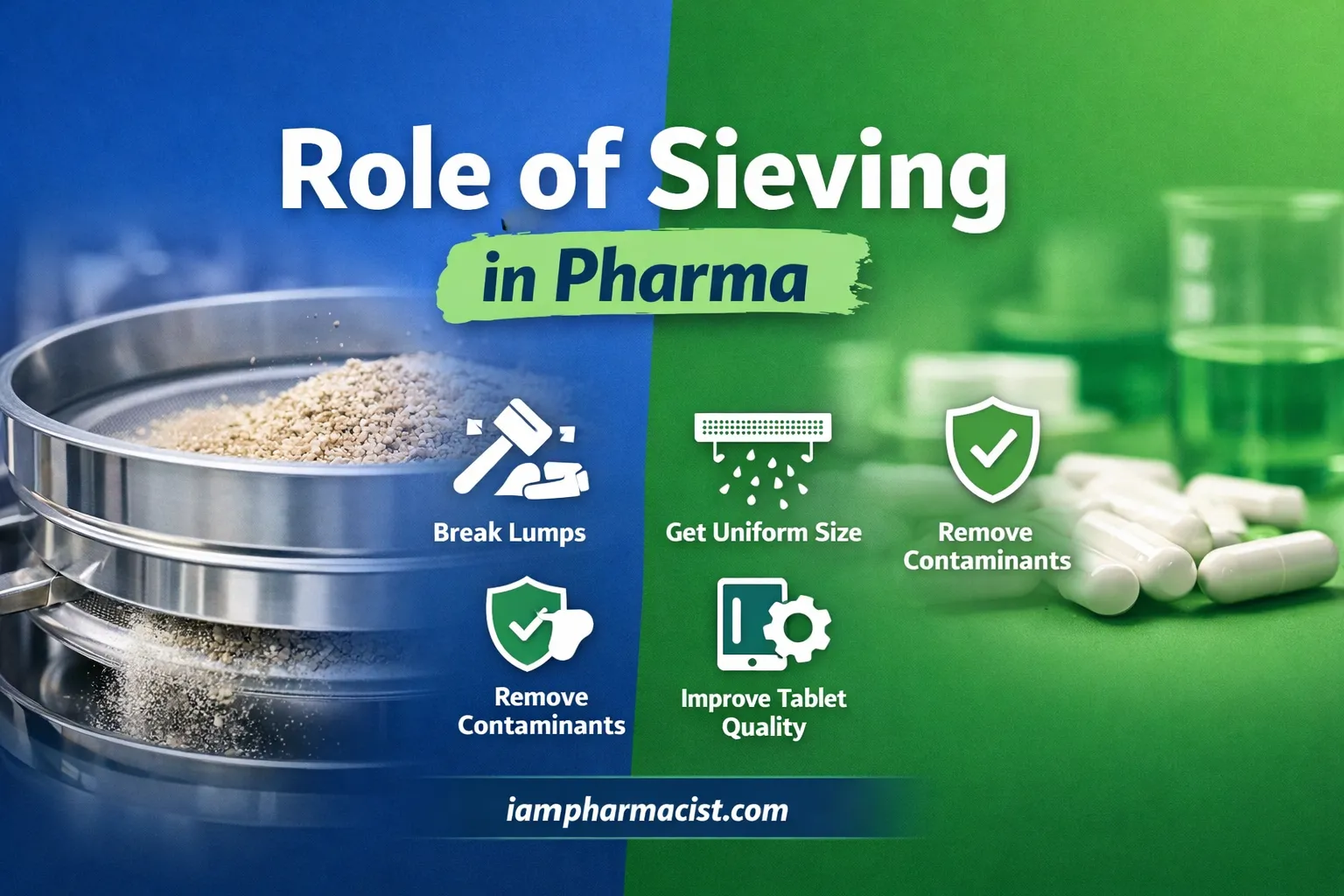

Learn the role of sieving in pharma, its purpose, equipment, and impact on tablet quality.
Role of Sieving in Pharma Process
The role of sieving process in pharma is critical to ensuring product quality, consistency, and safety. Whether manufacturing tablets, capsules, or other dosage forms, sieving plays a foundational role in preparing raw materials and granules for further processing.
In simple terms, sieving (or screening) involves passing powders or granules through meshes with uniform openings to achieve a consistent particle size.
What is Sieving in Pharmaceuticals?
Sieving is the process of separating particles based on size by passing them through a screen or mesh. It ensures that only particles of a desired size proceed to the next stage of manufacturing.
In pharmaceutical production, sieving is widely used for both raw materials and processed granules.
When is Sieving Performed in Pharma?
The role of sieving process in pharma becomes relevant at multiple stages:
- During raw material preparation
- Before mixing or blending
- After granulation (wet or dry)
- Prior to tablet compression or capsule filling
Although sieving is used across all dosage forms, it is especially crucial in tablet and capsule manufacturing, where particle size directly affects product performance.
Purpose of Sieving in Pharmaceutical Manufacturing
Sieving serves several important functions:
1. Breaking Down Large Lumps
Raw materials often arrive as agglomerates or lumps. Sieving helps break them into smaller, processable particles.
For example, drugs like metformin or sitagliptin phosphate may contain hard lumps that must be reduced using equipment like granulators or mills.
2. Achieving Uniform Particle Size
Uniform particle size is essential for proper mixing and content uniformity.
When all materials pass through the same mesh size:
- Segregation is minimized
- Blending becomes more efficient
- Dose accuracy improves
3. Removing Foreign Contaminants
One of the most important aspects of the role of sieving process in pharma is ensuring product safety.
Sieving helps remove unwanted materials such as:
- Rubber fragments
- Metal particles
- Fiber or glove residues
This step is vital for maintaining compliance and product integrity.
4. Producing Uniform Granules for Compression
During tablet manufacturing, sieving ensures consistent granule size after granulation.
Granule size directly affects:
- Flow properties
- Die filling efficiency
- Tablet weight uniformity
- Disintegration time
- Dissolution profile
Incorrect sieve selection can lead to:
- Poor flow (if too fine)
- Weight variation (if too coarse)
- Delayed drug release
Impact of Sieving on Tablet Quality
The role of sieving process in pharma extends beyond preparation—it directly influences final product performance.
- Flow Properties: Fine particles reduce flow, causing hopper issues
- Die Filling: Irregular granules lead to inconsistent tablet weights
- Disintegration: Larger granules may slow tablet breakup
- Dissolution: Poor particle size control can affect drug release
Proper sieve selection is therefore essential for achieving optimal results.
Equipment Used for Sieving in Pharma
Several types of equipment are used depending on the material and processing stage:
1. Russell Sifter
- Used for safety screening
- Provides uniform particle size
- Cannot break hard lumps
2. Oscillating Granulator
- Handles both lump breaking and sieving
- Ideal for wet and dry materials
3. Fitz Mill
- Efficient for size reduction and sieving
- Not suitable for very fine powders
4. Co Mill
- Used after drying to size granules
- Not effective for very hard lumps
5. Manual Sieves
- Traditional and simple method
- Used for small-scale or safety screening
- Suitable for softer granules
Conclusion
The role of sieving process in pharma is indispensable for ensuring uniformity, safety, and efficiency in drug manufacturing. From breaking lumps to controlling granule size, sieving directly impacts both process performance and final product quality.
Choosing the right sieve size and equipment is not just a technical step—it’s a critical decision that determines the success of pharmaceutical production.
Frequently Asked Questions (FAQs)
Is sieving used only for tablets and capsules?
No, it is also used in liquids and semisolids, but is most critical for solid dosage forms.
Why is uniform particle size important?
It ensures proper mixing, consistent dosage, and better product performance.
What is the difference between sieving and milling?
Sieving separates particles by size, while milling reduces particle size.
Can sieving remove contaminants?
Yes, it helps remove foreign particles like rubber, fibers, or metal fragments.
Which equipment is used for sieving in pharma?
Common equipment includes Russell sifters, oscillating granulators, Fitz mills, and co mills.
How does sieving affect tablet dissolution?
Improper particle size can slow or alter the drug’s dissolution rate.
What is sieving in pharmaceutical manufacturing?
Sieving is the process of separating particles based on size using a mesh or screen.
Why is sieving important in pharma?
It ensures uniform particle size, removes contaminants, and improves product quality.
What happens if sieving is not done properly?
It can lead to poor flow, weight variation, and inconsistent drug release.
Where is sieving used in pharma processes?
It is used during raw material preparation, mixing, granulation, and before compression.