


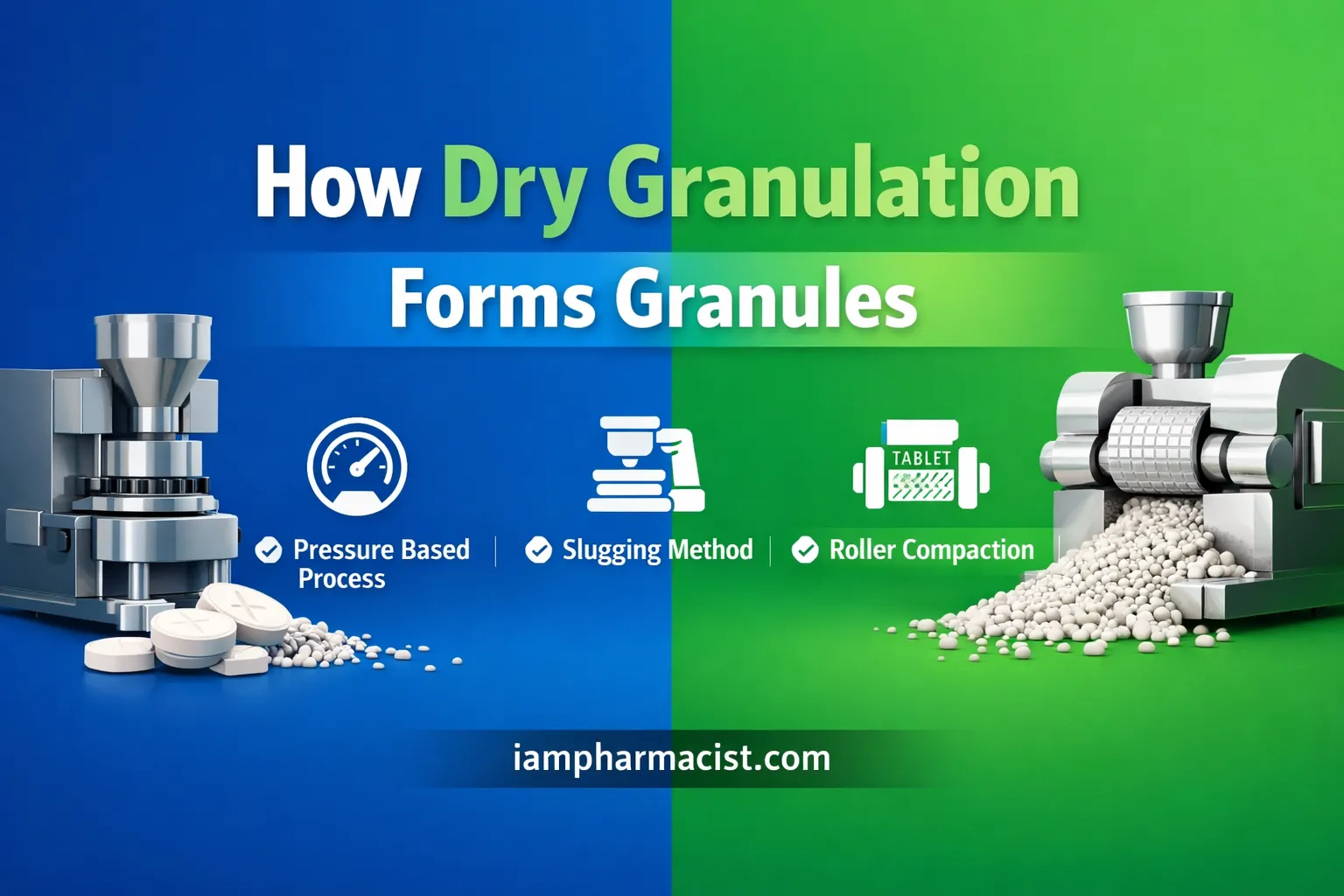

Learn How Dry Granulation Forms Granules using pressure methods like slugging and roller compaction.
How Granules Are Manufactured in Dry Granulation
In pharmaceutical manufacturing, transforming powders into uniform granules is a crucial step in tablet production. Two primary methods are widely used: wet granulation and dry granulation. While many professionals understand wet granulation, fewer fully grasp how granules are manufactured in dry granulation—a process that eliminates the need for liquids altogether.
Let’s break it down in a simple, practical way.
What Is Granulation?
Granulation is the process of converting fine powder particles into larger, free-flowing granules. This improves flow properties, compressibility, and uniformity—essential for producing high-quality tablets.
Wet Granulation vs Dry Granulation
Wet Granulation (Quick Overview)
In wet granulation, powders are mixed with a binder solution or solvent to form a wet mass. This mass is then:
- Screened (wet sieving)
- Dried using equipment like fluid bed dryers or tray dryers
- Resieved to obtain uniform granules
This method is widely used but requires additional drying steps and solvent handling.
How Granules Are Manufactured in Dry Granulation
Unlike wet granulation, granules are manufactured in dry granulation without using any liquid or binder solution. This often raises a key question:
How do powders form granules without moisture?
The answer is simple: pressure.
Role of Pressure in Dry Granulation
Pressure is the core mechanism that binds powder particles together in dry granulation. By applying high mechanical force, powders are compacted into dense forms, which are then broken down into granules of desired size.
There are two main techniques used:
1. Slugging Method
The slugging method involves compressing powders into large tablets, often called “slugs.”
Process:
- Fine powder is compressed using a tablet press at high pressure
- Large compacted slugs are formed
- These slugs are milled using equipment like:
- Oscillating granulator
- Cutting mill
- Granules are obtained by passing through a sieve of suitable size
Key Advantage:
Simple and effective for small-scale production.
2. Roller Compaction
Roller compaction is a more advanced and widely used method in modern pharmaceutical manufacturing.
Process:
- Powder is fed between two rotating rollers
- Rollers apply controlled pressure
- Powder is compressed into sheets or ribbons
- Sheets are milled to produce granules
Key Advantage:
Continuous process, suitable for large-scale production.
Why Use Dry Granulation?
Dry granulation is especially useful when:
- Materials are sensitive to heat or moisture
- Solvents cannot be used
- Faster processing is required
- Stability of the drug must be maintained
Conclusion
Understanding how granules are manufactured in dry granulation is essential for anyone working in pharmaceutical production. Unlike wet granulation, this method relies entirely on pressure to transform powders into granules. Whether using the slugging method or roller compaction, dry granulation offers a reliable, solvent-free approach to tablet manufacturing.
Frequently Asked Questions (FAQs)
1. What is dry granulation?
Dry granulation is a process where powders are converted into granules using pressure without adding any liquid.
2. How are granules manufactured in dry granulation?
Granules are formed by applying mechanical pressure to powders using slugging or roller compaction.
3. Why is no solvent used in dry granulation?
Because the process relies on pressure instead of binders or liquids to form granules.
4. What is the slugging method?
It involves compressing powders into large tablets (slugs) and then milling them into granules.
5. What is roller compaction?
A method where powders are compressed between rotating rollers to form sheets, which are then milled into granules.
6. Which method is better: slugging or roller compaction?
Roller compaction is preferred for large-scale production, while slugging is suitable for smaller batches.
7. What are the advantages of dry granulation?
No drying step, suitable for moisture-sensitive materials, and faster processing.
8. When is dry granulation preferred over wet granulation?
When the drug is sensitive to heat or moisture or when solvents cannot be used.
9. What equipment is used in dry granulation?
Tablet presses (for slugging), roller compactors, oscillating granulators, and mills.
10. Does dry granulation improve tablet quality?
Yes, it enhances flowability and compressibility, leading to better tablet uniformity.